
Beth Worthy
11/11/2026



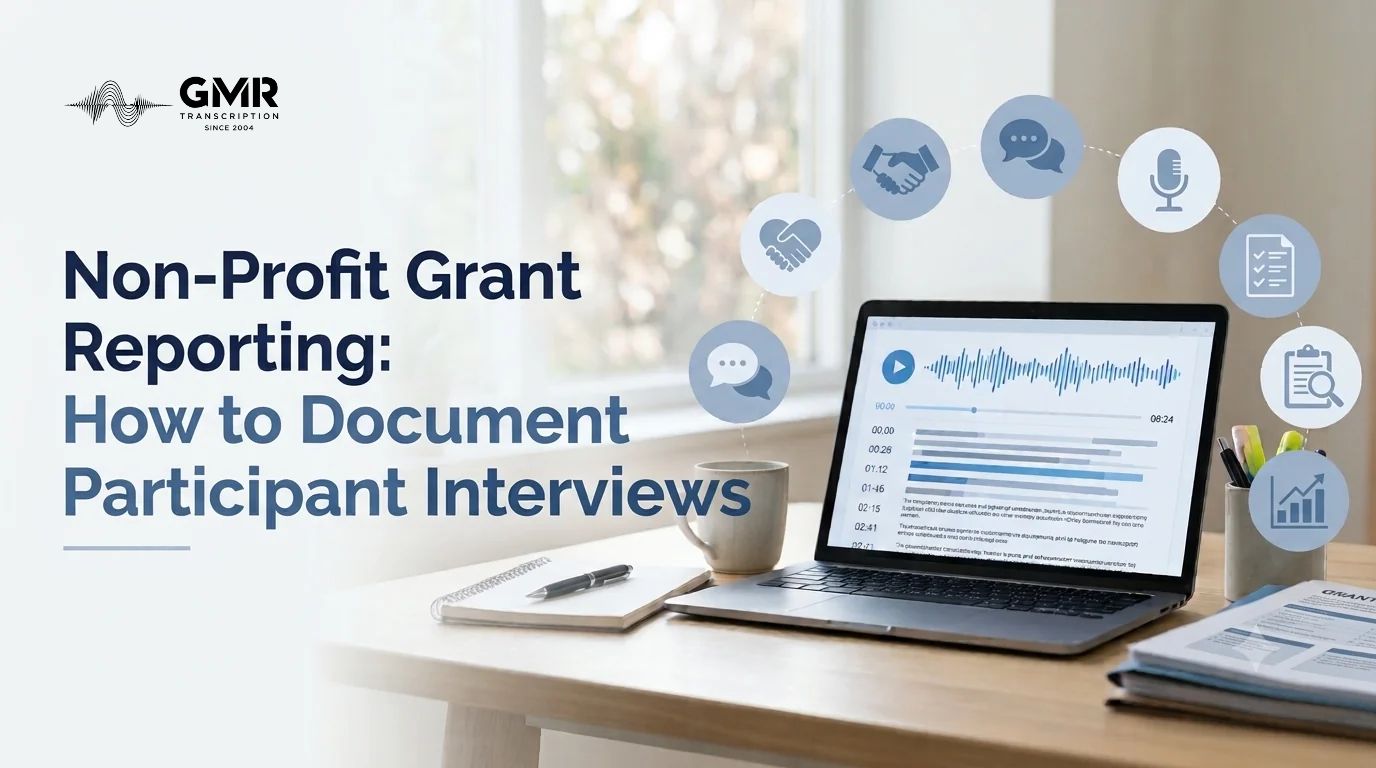
Grant applications and final reports explain a nonprofit's goals, activities, and outcomes. Participant interviews add another important layer: they capture the experiences behind those outcomes. When a nonprofit evaluates a program, conversations with participants, staff, and other stakeholders can reveal how services are experienced, which challenges persist, and where program delivery may need attention.
Documenting these interviews requires a consistent process. Interview notes can capture key observations, but they may omit participants' exact wording or details that become important during analysis. A clear recording and transcription workflow gives evaluators a more complete source to review, compare, and reference while preparing grant reports.
This article focuses on the interview evidence behind program evaluation. For broader guidance on preparing applications and reports, see my article on simplifying grant applications and reports for nonprofits.
Participant interviews help evaluators understand how a program works from the perspective of the people involved. A participant may describe how a service affected their daily routine, explain a barrier to accessing support, or identify an improvement that program staff had not considered.
Interview notes provide a useful record of these conversations. However, notes reflect the interviewer's selection and interpretation of what was said. They may summarize an answer, omit a qualification, or leave out a detail that becomes relevant when the team compares several interviews.
A transcript preserves the spoken exchange in a structured written format. Evaluators can revisit responses, examine the context surrounding a statement, and verify quotations before including them in reports.
The U.S. Department of Health and Human Services' Office of Planning, Research, and Evaluation discusses the role of qualitative methods in program evaluation in its publication, Qualitative Evaluation. The guidance identifies interview transcripts and other qualitative materials as sources that evaluators can analyze to understand experiences, patterns, and themes.
For nonprofit teams, the practical value lies in maintaining a consistent record that supports the evaluation process. A transcript also gives multiple reviewers a shared reference when they examine participant feedback.
Before recording an interview, the evaluation team should establish what participants are agreeing to and how their information will be handled. Consent and privacy decisions belong at the beginning of the documentation workflow because they influence recording, transcription, storage, analysis, and reporting.
The consent process should explain:
The exact consent language should follow the institution's policies, applicable ethics review requirements, and relevant funder terms. Teams should also confirm whether an Institutional Review Board (IRB) protocol applies to the project.
Privacy planning should include a decision about participant identification. Depending on the study, the team may use participant codes, pseudonyms, or de-identified transcripts during analysis. A separate reference document can connect those codes to participant identities when authorized access is required.
GMR Transcription's guide to the difference between de-identification, anonymization, and pseudonymization explains these approaches and why their distinctions matter when handling research data.
Once the recording and privacy requirements are established, the team can choose the transcription style that best supports the evaluation.
Verbatim transcription preserves the spoken words, including repetitions, false starts, and other speech patterns according to the agreed conventions. It can be useful when the way a participant expresses an experience carries meaning for the analysis.
Clean read transcription presents the spoken content in a more readable format while retaining the participant's intended meaning. It may be appropriate when evaluators need to review large volumes of interview responses and focus on the substance of what participants shared.
The choice should reflect the research questions and analysis method. Teams should also agree on speaker labels, timestamps, markers for inaudible speech, and how to handle overlapping conversations before transcription begins.
A consistent format makes it easier to compare interviews and locate specific passages. For projects involving multiple interviewers or transcription files, a shared style guide can help maintain consistency across the dataset.
GMR Transcription offers interview transcription,qualitative research transcription, and verbatim transcription services for different documentation needs. Teams can choose the format that best fits their evaluation requirements.
After transcription, evaluators can begin organizing responses around the study's research questions. Manual coding provides a practical baseline: reviewers read the transcripts, identify recurring ideas, assign codes to relevant passages, and compare how different participants describe similar experiences.
For example, an evaluation of a workforce development program may reveal recurring comments about transportation, access to training, instructor support, and job placement. Evaluators can group relevant passages under these themes and examine where participant experiences align or differ.
A useful review process includes:
The OPRE publication Qualitative Evaluation also discusses systematic coding, triangulation, member checking, and peer review as ways to strengthen qualitative analysis. These methods help evaluators examine how interpretations develop and whether findings remain grounded in participant accounts.
For teams working with completed GMR human transcripts, Transcript Intelligence can provide optional support for summaries and theme review. The human-produced transcript remains the official record, while the additional analysis can help teams organize information for further evaluation.
Direct participant quotations can make grant reports more specific and meaningful. They give readers a closer view of individual experiences and help illustrate the themes identified during evaluation.
Each quotation should be checked against the transcript and, where necessary, the original recording. Reviewers should confirm the wording, preserve the context, and ensure the quotation accurately represents the participant's intended meaning.
Privacy also matters when selecting quotations. A participant's name, job title, location, or description of a specific event may reveal their identity, even when the report uses a participant code. Teams should review quotations for identifying details and follow the consent terms and reporting arrangements established for the project.
When reporting themes, evaluators should also distinguish individual experiences from broader findings. One participant's statement can illustrate an issue, while comparisons across interviews and other evaluation sources help establish how widely that experience appears in the available data.
This approach supports clear reporting while respecting the people whose experiences contribute to the evaluation.
Strong grant reporting begins with a clear record of the experiences behind program outcomes. Consent, participant privacy, consistent transcription, systematic theme review, and careful quotation checks give nonprofit teams a structured way to move from interviews to meaningful findings.
GMR Transcription supports nonprofit organizations with human transcription for interviews and qualitative research. Request a quote to discuss your interview volume, transcription style, speaker labeling, and documentation requirements.