
Beth Worthy
6/11/2026



Most journalists know the feeling.
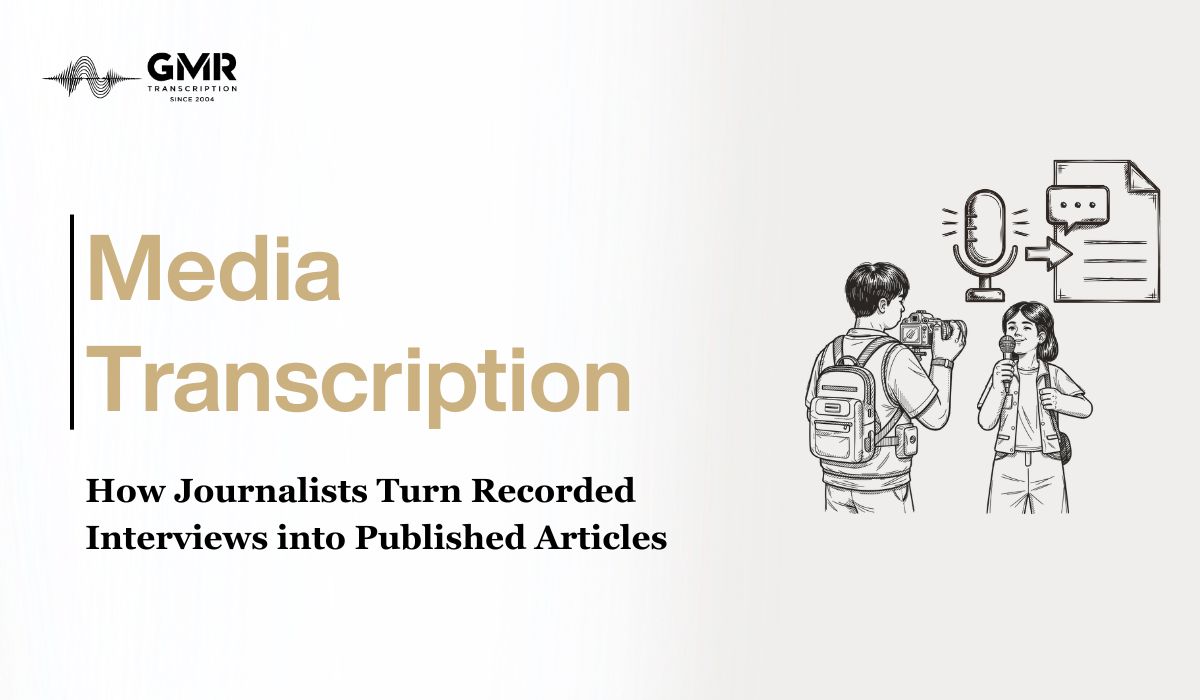
A source interview ends. The recording is saved. The deadline is already approaching. Somewhere within forty-five minutes of conversation is the quote that will anchor the story, provide context, or reveal the detail that separates a good article from a great one.
Finding that moment without a transcript often means replaying audio repeatedly, scrolling through waveforms, and relying on memory to locate a statement that seemed important at the time.
A transcript changes the process entirely.
Instead of treating the interview as a recording that must be reviewed in real time, journalists can work from a searchable, organized document. Quotes become easier to find. Context becomes easier to verify. The entire reporting process becomes more efficient.
This is why a well-designed transcription workflow for journalists is more than a convenience. It directly affects reporting accuracy, writing speed, source verification, and ultimately the quality of the published work.
Talk to our team about secure, accurate legal transcription by human experts.
Every profession values accuracy. Journalism depends on it.
A slight change in wording can alter the meaning of a statement. A source who says, "I think the policy may have changed," communicates something very different from a source who says, "The policy changed."
The distinction is not grammatical. It is factual.
Journalists work in an environment where accuracy influences credibility. Readers expect quotations to reflect what was actually said. Editors expect source material to be verifiable. Publications depend on trust, and trust begins with accurate reporting.
This is where transcription plays a critical role.
A verbatim transcript creates a documented record of the interview. It preserves the exact language used by the source, including qualifiers, corrections, hesitations, and clarifications. These details often help journalists evaluate how strongly a source stands behind a statement.
Without an accurate transcript, a reporter may rely on notes or memory. Both are useful, but neither offers the same level of precision as a written record generated directly from the interview itself.
For journalists covering politics, regulation, public policy, legal matters, or investigative topics, this precision becomes even more important.
The transcript functions as both a reporting tool and a safeguard.
Source interviews rarely take place under ideal conditions.
A journalist may interview over a mobile phone while traveling. A source may join from a remote location with inconsistent internet connectivity. Conversations may occur in busy offices, public spaces, conference halls, or outdoor environments.
These realities introduce complexity into the transcription process.
| Interview Environment | Common Audio Challenges | Impact on Accuracy |
| Phone interviews | Signal compression and dropped audio | Missing words and reduced clarity |
| Remote video calls | Internet instability and overlapping speech | Speaker identification challenges |
| Field reporting | Ambient noise and environmental interference | Difficult word recognition |
| Press conferences | Multiple speakers and interruptions | Attribution complexity |
| International interviews | Accents and multilingual terminology | Increased interpretation requirements |
These conditions affect both human and automated transcription.
However, journalism introduces another challenge that receives less attention: the importance of nuance.
Sources often communicate uncertainty. They qualify statements. They revise answers while speaking. They may intentionally use cautious language when discussing developing situations or sensitive information.
These nuances carry reporting value.
When a source says, "It appears that..." rather than "It is," the distinction matters. Experienced journalists recognize that confidence levels, uncertainty, and attribution are often part of the story itself.
Accurate transcription preserves these signals.
The most efficient journalism workflows begin before the article is written.
Many experienced reporters approach interviews with transcription already in mind. At the beginning of a recording, they clearly identify themselves and the source. Proper nouns, technical terminology, and unfamiliar names are confirmed during the conversation rather than corrected later.
These small practices improve transcript quality and reduce editing time.
The next step occurs immediately after the interview ends.
One of the most common workflow bottlenecks appears when reporters wait until they begin writing to order transcription. At that point, the transcript becomes a dependency. Writing cannot proceed efficiently until the transcript arrives.
A more effective approach is to submit the recording for transcription immediately after the interview. By the time the reporting process moves into drafting, the transcript is already available for review.
This shifts transcription from a delay point to a workflow accelerator.
When the transcript arrives, experienced journalists typically review the text before drafting the article. Reading a transcript often reveals structure that may not be obvious while listening to audio.
Themes emerge more clearly. Supporting quotes become easier to identify. Contradictions, clarifications, and follow-up angles become more visible.
The transcript becomes the working document.
Audio remains important, particularly when verifying quotations intended for publication. However, verification becomes targeted rather than exploratory. Instead of reviewing an entire interview again, journalists return directly to specific sections identified through timestamps.
This approach saves time while strengthening accuracy.
Not every interview requires the same transcription style.
For some stories, the exact wording used by a source carries significant weight. Political interviews, legal matters, regulatory discussions, and investigative reporting often require full verbatim transcription because every word matters.
Other assignments prioritize ideas over delivery. Feature reporting, profile pieces, and certain business interviews may benefit from intelligent verbatim transcription, which removes verbal fillers while preserving meaning.
Timestamping remains valuable in almost every context.
Long interviews frequently generate thousands of words. Timestamped transcripts allow journalists to move quickly between text and source audio whenever verification is required.
The right transcription format depends on the reporting objective, but the underlying goal remains consistent: creating a reliable source record that supports efficient reporting.
The role of transcription varies across journalism formats, but its value remains consistent.
Breaking news reporting often prioritizes speed. Reporters may conduct brief interviews under significant deadline pressure. In these situations, a transcript accelerates the retrieval and verification of quotes.
Investigative journalism places a greater emphasis on documentation. Interviews may span multiple hours and involve sensitive subject matter. Accurate transcripts provide a reliable record that can support months of reporting and fact-checking.
Podcast journalism introduces another dimension. The same transcript may support audio editing, episode production, accessibility requirements, and web publishing. A single document serves multiple functions across the production workflow.
International reporting creates additional complexity. Journalists frequently interview sources who speak languages other than English. In these situations, transcription and translation work together to create a usable reporting document while preserving the meaning of the original conversation.
Despite these differences, every format relies on the same foundation: an accurate record of what was said.
The importance of human oversight in transcription continues to be recognized across professions that rely on accurate records. In its 2026 Artificial Intelligence Position Statement, the National Court Reporters Association (NCRA) stated that artificial intelligence and automatic speech recognition technologies serve as supplemental tools but cannot replace trained human professionals in creating and preserving official records. The organization emphasized that human oversight remains essential for accuracy, context, reliability, and ethical stewardship of the record.
Journalism depends on context.
Interviews contain incomplete thoughts, interruptions, changing tone, and statements that evolve as the source speaks. Human transcription captures these elements in ways that support reporting accuracy.
Automated systems excel at generating text quickly. Journalism requires more than text generation. It requires faithful representation of a source's words, meaning, and intent.
This distinction becomes particularly important when interviews involve technical terminology, multiple speakers, accented speech, or emotionally charged conversations.
A transcript used in journalism is not simply a convenience. It becomes part of the reporting process itself.
Accuracy influences credibility. Credibility influences trust. Trust remains one of journalism's most valuable assets.
Every article begins with information. The quality of that information depends on how accurately it is captured, organized, and verified.
A structured transcription workflow for journalists helps transform recorded interviews into usable reporting assets. It improves efficiency, strengthens accuracy, and provides a reliable foundation for writing.
Whether the assignment involves breaking news, investigative reporting, feature writing, or podcast production, transcription supports better journalism by making source material accessible and verifiable.
GMR Transcription (GMRT) provides journalists with accurate, secure, and deadline-friendly transcription services designed for the realities of modern reporting. From recorded interviews to multilingual source conversations, transcripts are delivered in formats that support the way journalists actually work.
Working against a deadline? Contact GMRT for accurate interview transcription with turnaround options designed for fast-moving newsrooms and freelance reporting schedules.
Journalists use both verbatim and intelligent verbatim transcription depending on the assignment. Verbatim transcripts capture every spoken word and are often preferred for investigative, legal, or political reporting, while intelligent verbatim transcripts improve readability by removing filler words without changing meaning.
The fastest approach is to submit the recording for transcription immediately after the interview concludes. Professional transcription companies can often deliver transcripts within standard or same-day turnaround windows, allowing journalists to begin writing while the conversation is still fresh.
Transcripts make interviews searchable, easier to annotate, and significantly faster to review than audio recordings. They allow reporters to identify quotes, verify information, and organize story structure without repeatedly listening to the same recording.
The choice depends on how the interview will be used. Verbatim transcription is ideal when exact wording matters. In contrast, intelligent verbatim transcription is often preferred for general reporting because it produces cleaner, more readable text while preserving the substance of the conversation.