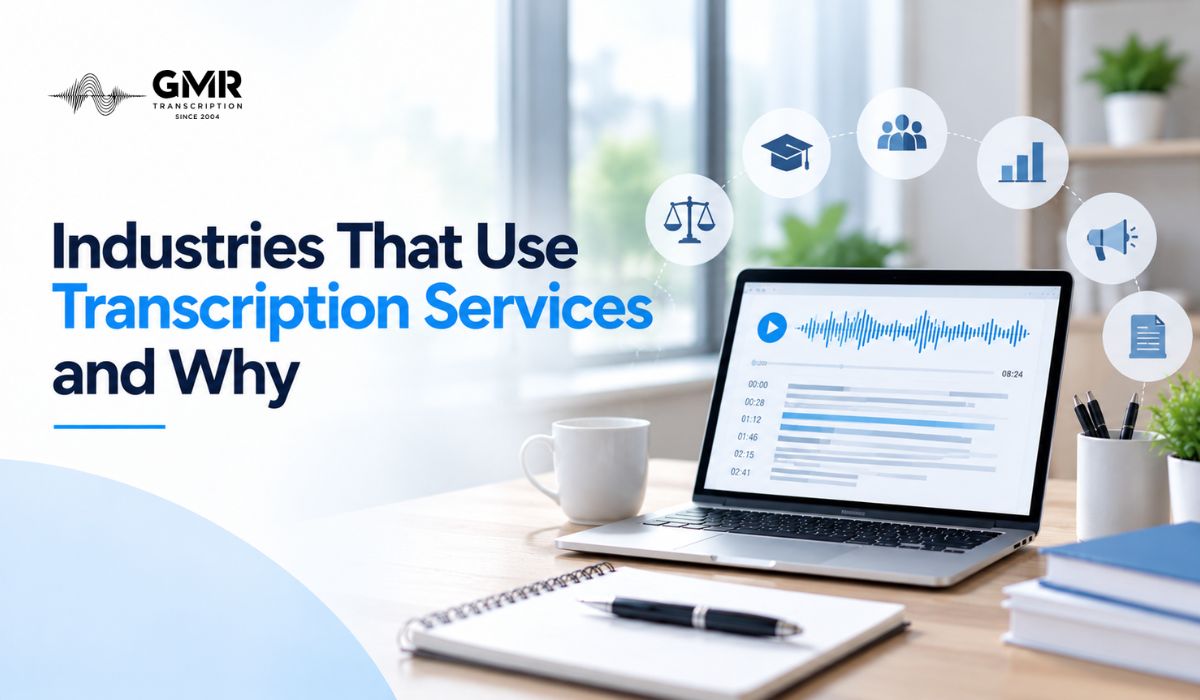




Transcription turns audio and video recordings into text. The reasons for doing it vary. A law firm needs a record it can rely on. A university needs research data it can search. A marketing team needs customer comments it can quote.
This article looks at seven industries in the United States that rely on transcription. For each one, you will see what they record, what they do with the transcripts, and what to watch for. It ends with a checklist for choosing a provider and a short FAQ.
In short
- Legal, education, business, insurance, market research, media, and government all rely on transcripts.
- Each field records different material and needs different details, such as speaker labels or exact wording.
- Decide how you will use the transcript before you choose a style.
- Ask any provider who does the work, how accuracy is checked, and how files are protected.
Industries and Their Transcription Needs at a Glance
| Industry | Typical recordings | What the transcript is used for |
|---|---|---|
| Legal | Depositions, hearings, recorded statements | Case preparation and review of testimony |
| Education | Lectures, seminars, research interviews | Study material and research analysis |
| Business | Meetings, calls, webinars, interviews | Records and content reuse |
| Insurance | Claim interviews and recorded statements | Claim review and documentation |
| Market research | Focus groups and customer interviews | Coding, comparison, and report quotes |
| Media | Podcasts, video, interviews | Accessibility, search, and articles |
| Government | Hearings, public meetings, speeches | Public records and documentation |
How Each Industry Uses Transcription
1. Legal
Legal work depends on exact words. Attorneys in the United States use transcripts of depositions, hearings, and recorded statements. They prepare cases with them and compare accounts. They also look for inconsistencies in testimony. A missed word can change meaning, so accuracy and confidentiality matter most.
What to watch for: speaker identification when several attorneys and witnesses take turns, exact wording for objections and interruptions, and a format that matches how your firm files and cites records. See our legal transcription services for details.
2. Education
Schools and universities record lectures, seminars, and interviews. Students use transcripts to review hard material. Researchers use them to analyze interview data. Schools also keep them as an archive.
What to watch for: specialized vocabulary, names of authors and theories, and research recordings with consent conditions about who may read them. For academic projects, see our academic transcription service and our guide to transcription for academic research.
3. Business and corporate
Companies transcribe meetings, calls, webinars, and interviews. The transcript is a clear record of what was decided. Text is easier to search than audio, and teams can reuse it for training, reports, or articles. People who missed a meeting can catch up without listening to the whole recording.
What to watch for: calls with many speakers, product and client names, and internal confidentiality. Decide who should see transcripts of sensitive talks. Our business transcription service covers these needs.
4. Insurance
Claims teams handle many recorded interviews and statements. A written record gives everyone on a claim the same document to review. Insurance fraud is a large problem. The Coalition Against Insurance Fraud estimated its cost to the United States at $308.6 billion per year in a 2022 report. Accurate records help investigators compare statements, but they do not detect fraud on their own.
What to watch for: exact wording in recorded statements, dates, names, and figures that must match across documents, and careful handling of personal information. See our insurance transcription service.
5. Market research
Companies run focus groups and customer interviews to learn what people prefer and why. Reviewing hours of recordings is slow, so researchers work from transcripts. They search for topics, compare participants, and quote customers accurately. Time codes and speaker labels make it easy to return to the original recording.
What to watch for: group talks where people speak over each other, brand and product names that must be spelled correctly, and one consistent style across every session. Learn more about transcription for market research, or start with our guide to doing market research.
6. Media
Media teams transcribe podcasts, interviews, and video. This makes content easier to access and easier to find. Transcripts help viewers who cannot listen and support captions. Editors also use them to quote or repurpose material, and journalists check a quote against the original before they publish.
What to watch for: guest names and spellings, background noise in field recordings, and whether the text needs to be verbatim for a quote or clean for an article. See our podcast transcription and video transcription pages.
7. Government
Federal, state, and local agencies document hearings, public meetings, interviews, and speeches. Written records are easier to find and review. They also support transparency, because the public can read what was said.
What to watch for: long recordings with many named speakers, formal procedures that need a set format, and clear rules about who can see drafts and final transcripts. These recordings can also include sensitive material, so confidentiality matters.
What These Industries Have in Common
The recordings differ, but the needs are similar. Someone has to rely on what was said, often later, when memory has faded or another person needs to check it.
- A reliable record. Everyone can read and point to the same version of events.
- Searchability. Finding one statement in ten hours of audio is slow. In text, it takes seconds.
- Shared access. A team, a court, or a committee can review the same document at once.
- Reuse. The same text can feed a report, a summary, an article, or an archive.
- Accountability. When a decision depends on a statement, someone can verify it.
Matching the Transcript to the Use
Before you order a transcript, decide what you will do with it. The table shows common choices. Treat them as starting points, because your own rules come first.
| Use | Style to consider | Features to request |
|---|---|---|
| Legal review | Verbatim | Speaker labels, exact wording, filing format |
| Research analysis | Verbatim or clean | Speaker labels, time codes, participant codes |
| Meeting record | Clean | Speaker labels, readable paragraphs |
| Claims and investigations | Verbatim | Speaker labels, time codes, unclear-audio markers |
| Publishing and reuse | Clean | Time codes, correct name spellings |
What to Look for in a Transcription Provider
Whatever your industry, a few questions help you compare providers:
- Who does the transcription? Find out if people or software produce the text, and if people review it.
- How is accuracy checked? Ask about proofreading steps and what the accuracy guarantee covers.
- How is confidentiality handled? Look for non-disclosure agreements and secure file handling.
- Can it handle your terms and format? Specialized words, many speakers, and templates all affect quality.
- Are rates and turnaround clear? Rates usually depend on turnaround, audio quality, and speaker count.
At GMR Transcription, every transcript is produced by human transcriptionists based in the United States. You can read about our approach on our human transcription services page.
How to get better results from any provider
- Record in a quiet space with microphones close to speakers.
- Send a list of names, product terms, and acronyms with your files.
- State the style, speaker labels, and time code format before work begins.
- Review the first transcript and share feedback so later files match.
Frequently Asked Questions
Which industry uses transcription the most?
There is no single answer. Every field here relies on recordings for different reasons. A better question is which of your recordings you need to search, share, or rely on later.
Does it matter if a provider is based in the United States?
For U.S. recordings, it can. A U.S.-based team knows American English, regional accents, and local terms. You can also ask who handles your files and where. Confirm those answers with any provider before you send recordings.
Is a transcript the same as captions?
No. A transcript is a text version of the full recording. Captions are timed text shown on screen with a video. A transcript can be the starting point for captions, but they serve different purposes.
Does the style of transcript matter?
Yes. Verbatim keeps every word, including fillers and false starts. It suits records where exact wording matters. Clean verbatim removes them for easier reading. Choose based on how you will use the document.
How do I protect confidential recordings?
Limit who can open the files. Share them only with providers that work under confidentiality agreements. Agree in advance on how recordings and transcripts are stored and deleted.