
Beth Worthy
11/25/2026



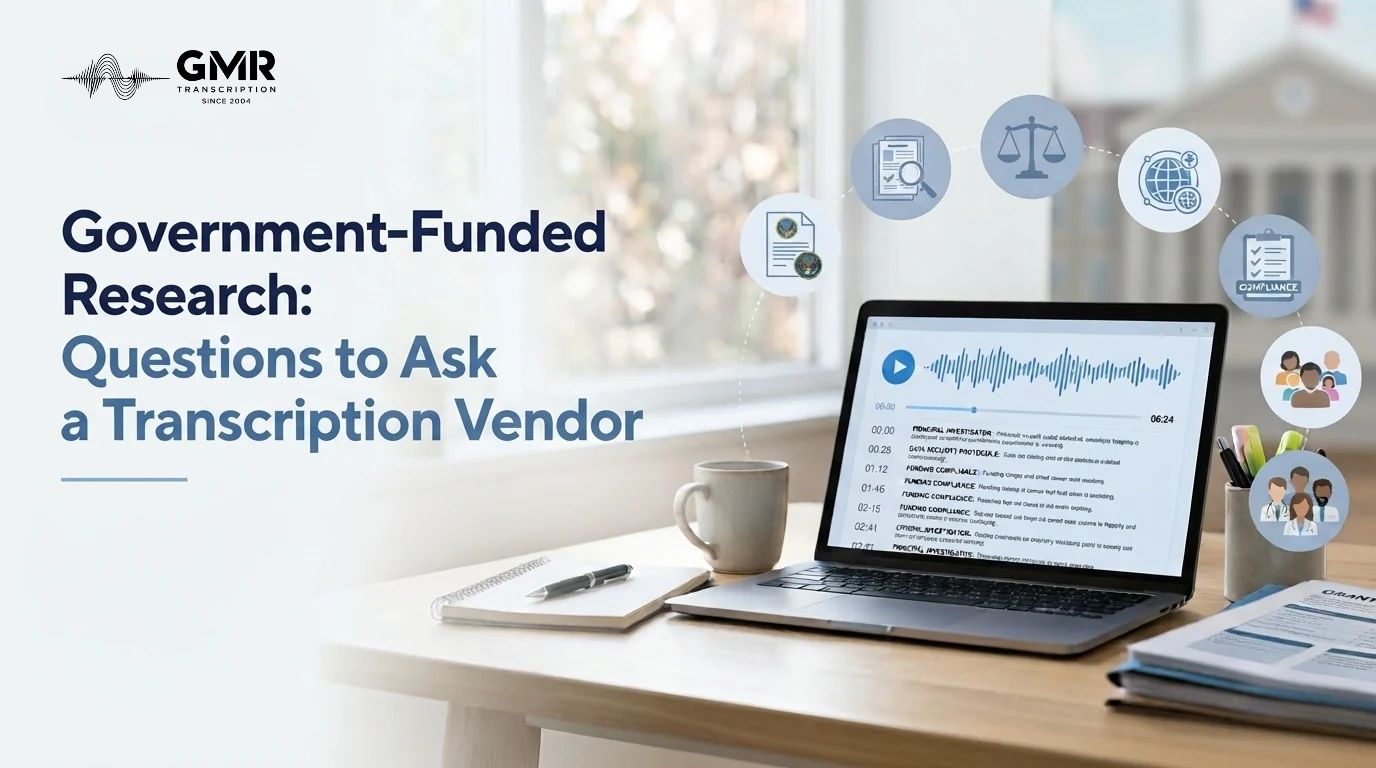
Government-funded research projects often involve sensitive interviews, focus groups, and other recorded conversations. Principal investigators and research administrators must consider how these materials will be handled throughout the project, from collection and transcription to analysis, storage, and eventual deletion.
Choosing a transcription vendor is therefore an important part of research planning. The vendor's workflow needs to fit the institution's data policies, award terms, and any applicable Institutional Review Board (IRB) protocol. A provider's general confidentiality statements may offer useful information, but research teams should understand the specific arrangements before sharing recordings.
For institutions evaluating government research transcription, the most useful approach is to ask clear questions, review the vendor's published policies, and obtain project-specific commitments in writing.
Before approaching a transcription vendor, identify the requirements that already govern your research data. These may come from the grant or contract award, the institution's data management policy, a data use agreement, and the approved IRB protocol.
Each document can address different aspects of how research information should be collected, accessed, processed, stored, shared, and retained. A vendor's standard procedures cannot override those obligations.
The principal investigator and research administration team should review the following:
This review helps determine which requirements the transcription vendor must accommodate. It also gives the research team a clear basis for evaluating proposals and documenting its selection.
One of the first questions to ask a transcription vendor is straightforward: Who will have access to our recordings and transcripts?
Research interviews can contain participant names, personal experiences, institutional information, and other sensitive details. Understanding who handles these materials helps the institution assess whether the vendor's workflow fits its confidentiality commitments.
During the vendor evaluation, ask:
1. Who performs the transcription?
Clarify whether human transcriptionists, automated systems, or a combination complete the work. Ask where the transcription team is based and whether external partners or subcontractors participate in the workflow.
2. How are files assigned?
Ask whether recordings are assigned to specific transcriptionists and how access to uploaded materials is restricted.
3. What confidentiality agreements apply?
Request information about the confidentiality obligations signed by people handling the recordings. If the institution requires a specific Non-Disclosure Agreement (NDA), ask whether the vendor can review and sign it before work begins.
4. Can the vendor accommodate project-specific instructions?
Research teams may require participant identifiers to be replaced with codes, particular speaker labels to be used, or identifying details to be handled according to an approved protocol. Discuss these requirements before submitting recordings.
GMR Transcription's published Data Security information describes individual customer accounts, access to files assigned to the people working on them, locked computer accounts for transcriptionists, and confidentiality agreements. Its Confidentiality and Non-Disclosure Policy also states that transcriptionists sign confidentiality agreements and that GMR will review customer-specific NDAs.
These published policies provide a starting point for evaluation. Research administrators should review them against their institution's requirements and confirm any additional arrangements directly with the vendor.
What happens to a recording after transcription is complete? How long does the vendor retain the transcript? Can the institution request deletion at a particular stage?
These questions deserve written answers because research projects often have defined retention periods and data disposal procedures. The institution may also need to preserve certain records for future analysis, audit purposes, or other obligations.
Ask the vendor to clarify:
GMR's published Data Security page states that it deletes voice files from its servers after transcript delivery. Its Confidentiality Policy separately describes deletion of completed transcripts from the transcriptionist's computer.
These statements address different stages and locations in the workflow. Institutions should obtain written clarification of the complete retention and deletion schedule, including how it applies to recordings, transcripts, and any other project files. Confirm the applicable arrangements before submitting sensitive research materials.
The institution should also retain its own copies of required research records according to its approved data management plan. Vendor retention and institutional retention serve different purposes and should be planned together.
Data handling is only one part of vendor selection. The completed transcripts must also support the research methodology and analysis process.
Before starting a project, discuss the documentation format and transcription conventions the team requires.
A written style guide can help maintain consistency when a project involves dozens of interviews or multiple rounds of data collection. It also gives the transcription vendor a clear reference for applying the same conventions across the assignment.
GMR Transcription provides research transcription services for interviews, focus groups, and other research materials. Its academic transcription services also support research interviews and discussions. Teams can discuss their preferred formatting, speaker labels, and transcription style before requesting a project estimate.
An Institutional Review Board evaluates research involving human participants and reviews the ethical considerations of the proposed study. Its approved protocol may specify how the study collects, protects, and handles participant information throughout the research process.
When transcription involves an external provider, the research team should determine whether the approved protocol already covers that arrangement or requires additional review or approval.
A transcription vendor does not grant IRB approval to a study. The institution and research team remain responsible for following the approved protocol and obtaining any required amendments or permissions.
Two useful resources from GMR Transcription explore these considerations in greater detail:
For broader data organization practices, researchers can also consult GMR's guide to qualitative research data management.
Government-funded research requires coordination between the funding agreement, institutional policies, research protocol, and external service providers. A structured vendor evaluation helps principal investigators and research administrators understand how recordings will be handled and whether the proposed workflow fits the study.
Before sharing files, document the answers to questions about confidentiality agreements, file access, storage, retention, deletion, and transcript formatting. Confirm any project-specific requirements in writing and retain the documentation with the research administration records.
GMR Transcription provides human transcription for academic and research projects, with published information about confidentiality, file handling, and customer-specific NDAs. Request a quote to discuss your research scope, recording volume, transcript requirements, and institutional data handling expectations before submitting materials.