
Beth Worthy
10/9/2026



A recording can become important evidence long before anyone has determined whether it is authentic. An investigator may receive an audio file from a client, an attorney may receive a recording from a party to a dispute, or a reporter may obtain leaked audio and need to understand exactly what it contains. When questions arise about whether the recording was edited, interrupted, converted, or otherwise altered, the first step is knowing which questions transcription can answer and which require forensic audio examination.
The central distinction is straightforward: transcription documents what can be heard; audio authentication examines whether the recording matches its claimed provenance and integrity. A careful human transcriptionist can listen closely, preserve difficult passages, add timestamps, and flag audible irregularities for further examination. A qualified forensic audio examiner then applies appropriate technical methods to evaluate questions of authenticity.
The Scientific Working Group on Digital Evidence (SWGDE) describes authentication examination in its Best Practices for Digital Audio Authentication as a technical process for evaluating whether a recording is consistent with how it is alleged to have been produced.
That difference matters because a transcript can make an audio file easier to investigate while remaining a separate layer of evidence from the authentication analysis itself.
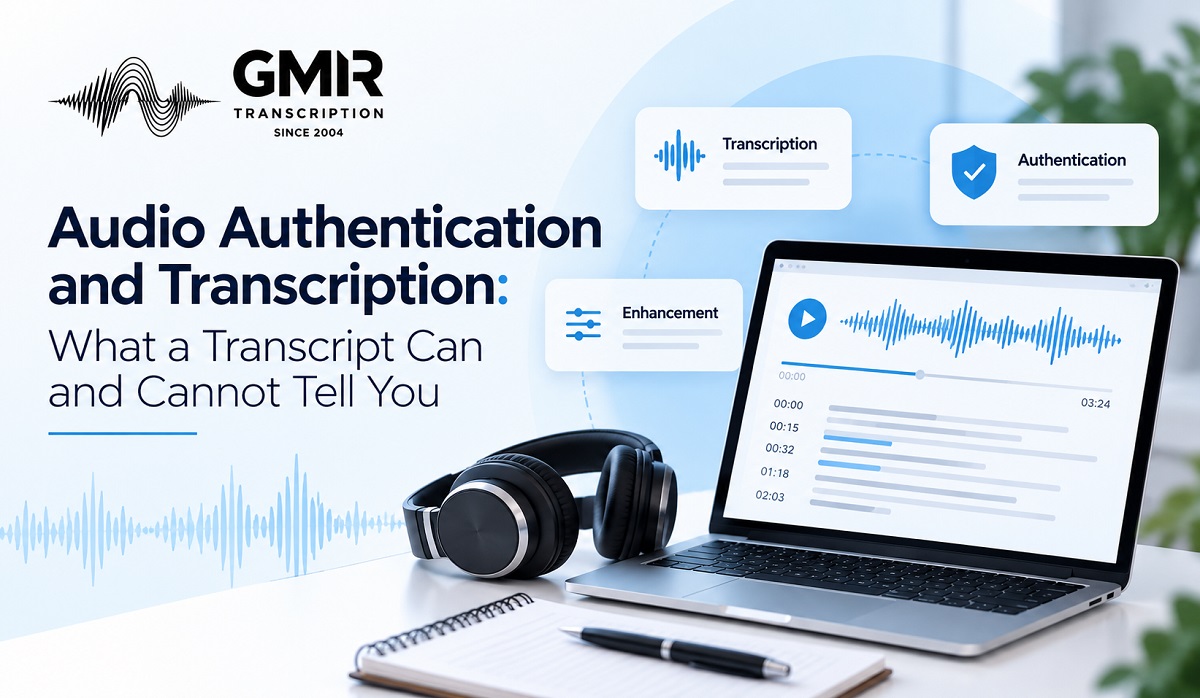
These three processes often appear together in investigations, yet they answer different questions.
| Process | Who typically performs it | Primary output | Question it addresses |
| Audio authentication | Qualified forensic audio examiner | Technical findings and conclusions | Is the recording consistent with its claimed origin and integrity? |
| Audio enhancement | Qualified forensic audio practitioner | Processed audio and documentation of processing | Can relevant sounds or speech be made more intelligible? |
| Transcription | Professional transcriptionist | Written representation of audible speech | What was said, and where does it occur in the recording? |
SWGDE guidance emphasizes that forensic authentication can involve multiple forms of analysis, including technical assessment, critical listening, and examination of specific portions of the recording. It also states that individual tests should not be relied upon alone and that results should be documented and interpreted systematically.
Transcription serves a different purpose. It converts speech into a searchable written record that investigators, attorneys, and examiners can review efficiently. A verbatim transcript can preserve repetitions, interruptions, unintelligible sections, and overlapping speech rather than smoothing the conversation into a polished summary. A transcript therefore supports an authentication workflow but does not establish authenticity on its own.
A human transcriptionist working carefully through a recording may encounter audible characteristics that deserve attention. These can include an abrupt start or stop in the middle of a word, an unusual silence, a sudden change in background noise, a noticeable shift in room acoustics, repeated background sounds, or a change in the apparent distance between a speaker and the microphone.
These observations can become useful investigative markers. A transcriptionist can attach a timestamp and describe what is audible, giving an examiner a precise point to investigate further.
The language used for these observations matters. A notation such as [abrupt change in background noise] describes what the listener hears. A notation such as [edited here] concludes why the change occurred. That conclusion belongs to the forensic examination process.
SWGDE's authentication guidance specifically identifies critical listening as part of forensic examination and says examiners should pay attention to voices, acoustic events, background noise changes, unusual noises, and possible recording or editing events. It also recognizes that apparent discontinuities can result from recording pauses or voice activation. An apparent irregularity therefore deserves investigation, not an automatic conclusion.
Compression, recording settings, network interruptions, device behavior, and other technical factors can produce audible changes that resemble editing. The most useful principle for transcription is simple: flag, don't fix; describe, don't conclude.
If you suspect a recording may have been edited or otherwise altered, the instructions given to the transcription partner can affect the usefulness of the resulting transcript.
Start by preserving the original file. Send a working copy for transcription and keep the original protected and unchanged. SWGDE guidance recommends obtaining the purported original where possible, and notes that transcoded or re-encoded versions are not equivalent to the original recording for all aspects of forensic examination. It also explains that examination work should be conducted on an appropriate working copy.
Give the transcriptionist context about the task without directing them toward a conclusion. Ask for neutral observations and timestamps for significant irregularities. Useful instructions can include:
Time-stamped transcripts are particularly useful in investigative work because they allow reviewers to move directly from a written statement to the corresponding moment in the recording. GMR Transcription's investigative transcription guidance describes timestamps as a way to connect statements to precise moments in audio and support timeline reconstruction and evidence review. For a suspect recording, that same approach creates a practical handoff between the transcription workflow and any subsequent forensic examination.
Automated speech recognition can make large volumes of audio searchable quickly. Investigative recordings often include conditions that make interpretation harder, including background noise, overlapping speakers, clipped speech, repetitions, unusual terminology, and inconsistent recording quality.
Automated output also differs structurally from a forensic-minded transcription workflow. Automated systems generally aim to convert speech into readable text. Their output may omit or normalize disfluencies, merge repeated words, misinterpret clipped speech, or provide no notation for non-speech audio events unless the system has been specifically designed to identify them.
That makes human review especially valuable when the purpose goes beyond understanding a conversation's general content. A human listener can preserve uncertainty instead of filling gaps with plausible language and can document an audible event that falls outside the words themselves.
The gap matters most when an automated transcript appears unusually clean. Clean text can make a recording easier to read while removing clues about hesitation, repetition, overlap, or other characteristics that may matter during later review. For an evidence-focused workflow, readability should support fidelity, not replace it.
A forensic audio examiner becomes appropriate when the authenticity or integrity of the recording itself is disputed or materially important to the investigation. Escalation is particularly appropriate when a transcriptionist identifies unusual discontinuities, when the available recording appears to be a copy or conversion, when the original recording is unavailable, or when relying on the recording has significant consequences.
The examiner should receive the original recording, when available, along with relevant information about the recording device, file history, metadata, custody, and the circumstances under which the recording was obtained. An annotated transcript can provide an efficient roadmap to passages that warrant attention, while the examiner's technical work remains independent of the transcription.
SWGDE recommends that an authentication examination be systematic, objective, repeatable, and supported by documented testing and results. Its guidance also recognizes that authentication conclusions can include findings such as consistency with an original, inconsistency with an original, or inconclusive results.
The legal question is separate again. Federal Rule of Evidence 901 requires evidence sufficient to support a finding that an item is what its proponent claims it to be, and it provides several examples of authentication, including testimony from someone with knowledge and identification of a voice. The rule provides a general framework rather than a single technical test for authenticating every recording. Courts and jurisdictions can apply different requirements, so counsel should determine the appropriate authentication strategy for a particular proceeding.
A transcript can document what is audible and help investigators identify passages that warrant closer examination. It does not establish the recording's authenticity. Authentication involves the evidentiary foundation and, when necessary, technical examination of the recording itself.
Use a working copy for transcription and preserve the original. The original may contain technical information that becomes important during forensic examination. SWGDE specifically recommends obtaining and preserving the purported original where possible.
Ask for neutral, descriptive notations with timestamps. Examples include [inaudible], [crosstalk], [abrupt change in background noise], or [unusual silence], depending on what the listener actually hears. Avoid asking the transcriptionist to label a passage as “edited” or “tampered” because those terms imply a forensic conclusion.
An automated transcript can help make audio searchable, but standard speech recognition should not be treated as an audio authentication examination. Its primary function is speech recognition, while forensic authentication requires examining the recording and interpreting relevant technical findings.
Bring in a qualified examiner when authenticity may be contested, an audible anomaly is identified, the recording's provenance is uncertain, the original is unavailable, or the recording carries significant legal or investigative consequences.
A well-prepared transcript can save investigators and forensic specialists time by turning a long recording into a searchable, time-anchored record and identifying passages that deserve closer attention. The transcript supports the examination while the forensic examiner remains responsible for the authentication analysis.
For teams handling investigative recordings, the strongest workflow preserves the original, creates a carefully controlled working copy, documents what can be heard, and escalates authenticity questions to qualified forensic specialists. GMR Transcription can support that workflow through time-stamped investigative transcription prepared by 100% U.S.-based human transcriptionists, helping investigators and legal teams navigate difficult recordings while preserving a clear boundary between transcription and forensic authentication.
Need a transcript for an evidence recording? Request a quote for investigative transcription and include any notation and timestamp requirements specific to your case.