
Beth Worthy
11/4/2026



Government agencies create and maintain records in many formats, including written correspondence, reports, meeting recordings, interviews, and other audio or video files. When researchers, journalists, or members of the public request access to these materials, records officers must identify the responsive records and review them under the applicable disclosure rules.
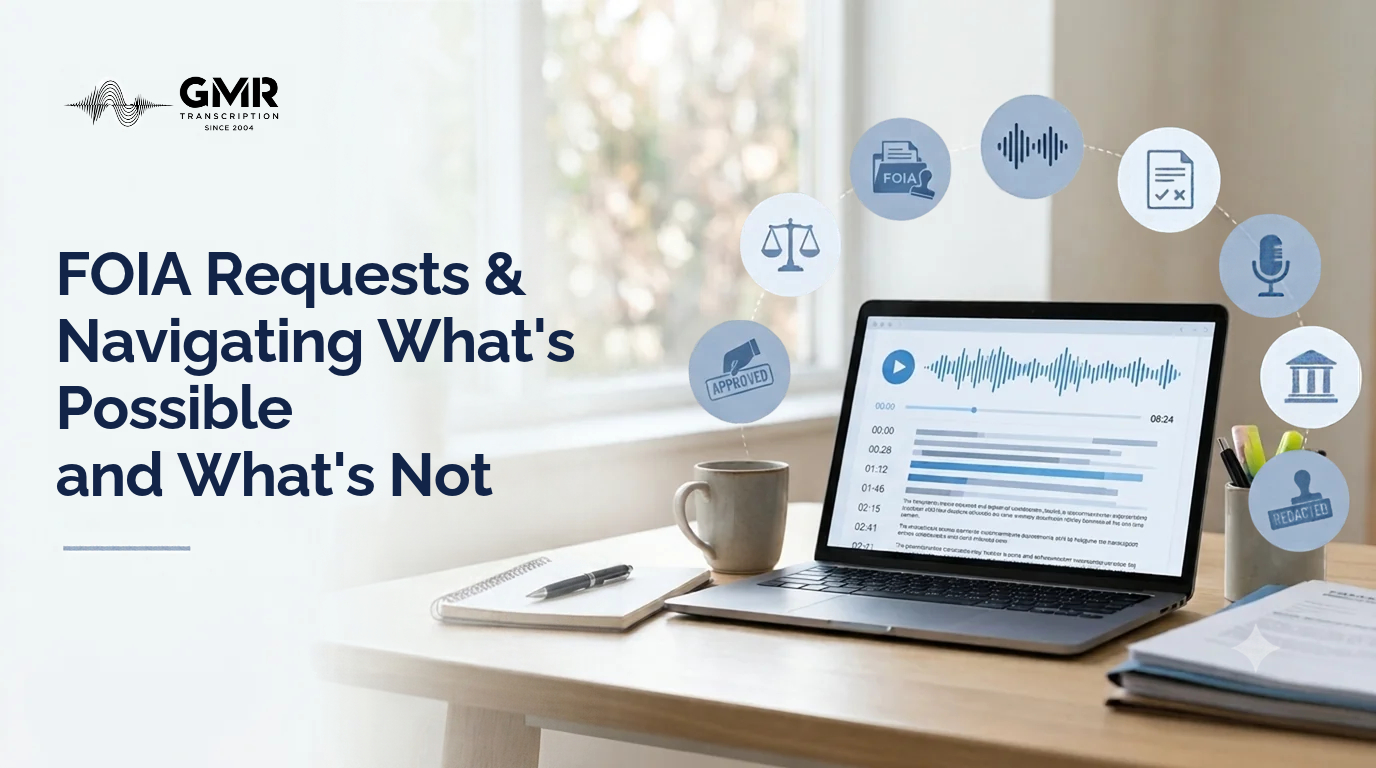
For recordings, a transcript can make this process more manageable. It gives staff a searchable written reference, helps locate relevant passages, and supports accurate quotation during review. However, transcription and FOIA processing serve different purposes. Understanding that distinction helps agencies, records officers, and requesters establish realistic expectations about what a transcript contributes to public records work.
The Freedom of Information Act (FOIA) provides public access to records held by federal executive branch agencies, subject to the statute's exemptions and exclusions. It applies to federal agencies, with each agency responsible for processing requests for its own records.
The scope matters for records officers and requesters. FOIA covers federal agency records, while records held by Congress, federal courts, state and local governments, and private organizations fall outside its general scope. State and local agencies operate under their respective public records laws, which vary by state.
The FOIA.gov Frequently Asked Questions explains that individuals can request agency records and specify a preferred format when available. It also clarifies that FOIA does not require agencies to create new records, conduct research, analyze data, or answer questions in response to a request.
The Department of Justice provides further guidance through its Guide to the Freedom of Information Act, which covers agency records, request processing, exemptions, and related legal considerations.
For recorded proceedings, the practical question is whether an existing recording falls within the scope of a request and qualifies as an agency record. A transcript may support the agency's internal review, but FOIA itself does not create a general obligation to produce a transcript whenever someone requests a recording.
Audio and video recordings can contain substantial information in a format that takes time to review. A public meeting recording, for example, may include multiple speakers, attendee questions, formal motions, discussions, and closing remarks. Locating one statement can require reviewing a lengthy recording.
A human-reviewed transcript provides a searchable reference for that material. Records staff can use it to locate relevant passages, check speaker statements, identify names and topics, and prepare accurate quotations. Timestamps can connect each passage to its corresponding point in the original recording.
This supports three practical activities:
The recording and transcript serve distinct purposes. The recording preserves the original audio or video, while the transcript provides a written representation of the spoken content. Agencies should retain and process records according to their applicable records management policies and legal obligations.
A transcript therefore works best as a companion to the original recording. It supports review and navigation while keeping the underlying source available for verification.
Transcript quality directly affects how reliably staff can use a recording during review. A small transcription error can change a statement's meaning, create confusion about who spoke, or make a passage harder to locate.
Consider a public meeting recording in which several officials discuss a proposed motion. A transcript may attribute a statement to the wrong speaker, omit a short word that changes a sentence's meaning, or record a person's name incorrectly. Each error can affect how a reviewer understands the exchange.
Public proceedings often involve several speakers, including elected officials, agency employees, legal representatives, and members of the public. Consistent speaker labels help readers follow the discussion and distinguish statements made by different participants.
When a recording contains overlapping speech or an unclear introduction, the transcriptionist should use an agreed convention to identify uncertainty. Guessing a speaker's identity can create confusion during subsequent review.
For a deeper look at this issue, see GMR Transcription's guide to why accurate speaker identification matters in multispeaker transcription.
Poor microphone placement, background noise, and simultaneous conversations can make parts of a recording difficult to understand. A reliable transcript should represent these passages transparently, using consistent markers for inaudible or overlapping speech.
Transcriptionists should preserve the distinction between words they can hear and passages that require further review. The guide to transcribing bad quality audio and representing inaudible speech explains how these conventions contribute to a clearer written record.
A transcript helps staff understand recorded content, but disclosure decisions remain part of the agency's FOIA review process.
Records officers and agency counsel assess whether requested material falls within the scope of the request, whether statutory exemptions apply, and which portions may be released. These decisions can involve personal privacy, confidential information, law enforcement interests, national security, and other legally protected interests.
A transcript can help reviewers locate potentially sensitive statements or identify passages requiring closer examination. It does not determine whether those statements qualify for an exemption or whether redaction is appropriate.
The agency's designated records personnel and legal counsel remain responsible for those determinations. The DOJ Guide to FOIA offers a detailed reference for understanding the statute's procedural requirements and exemptions.
For requesters, this distinction also helps set expectations. A transcript may improve access to a recording's content, while the agency's disclosure decision follows the applicable legal framework and review process.
When an agency considers using an external transcription provider, records staff should establish the project's handling requirements before sharing files. The following questions can help define the scope:
GMR Transcription outlines its approach to data security and confidential transcription. Agencies should review the published information alongside their own procurement, records management, and confidentiality requirements before assigning a project.
Teams that already have an AI-generated transcript can also explore human transcript proofreading to have an existing draft checked against the recording.
FOIA and state public records laws govern access to records, while transcription supports the practical work of reviewing recorded information. A searchable, human-reviewed transcript can help records officers locate statements, verify quotations, and navigate lengthy proceedings with greater clarity. The recording remains the source for checking the spoken content, and agency personnel retain responsibility for disclosure decisions.
GMR Transcription provides human transcription services for government and nonprofit organizations. Request a quote to discuss your recording volume, speaker identification requirements, formatting preferences, and confidentiality needs.