
Beth Worthy
1/28/2026



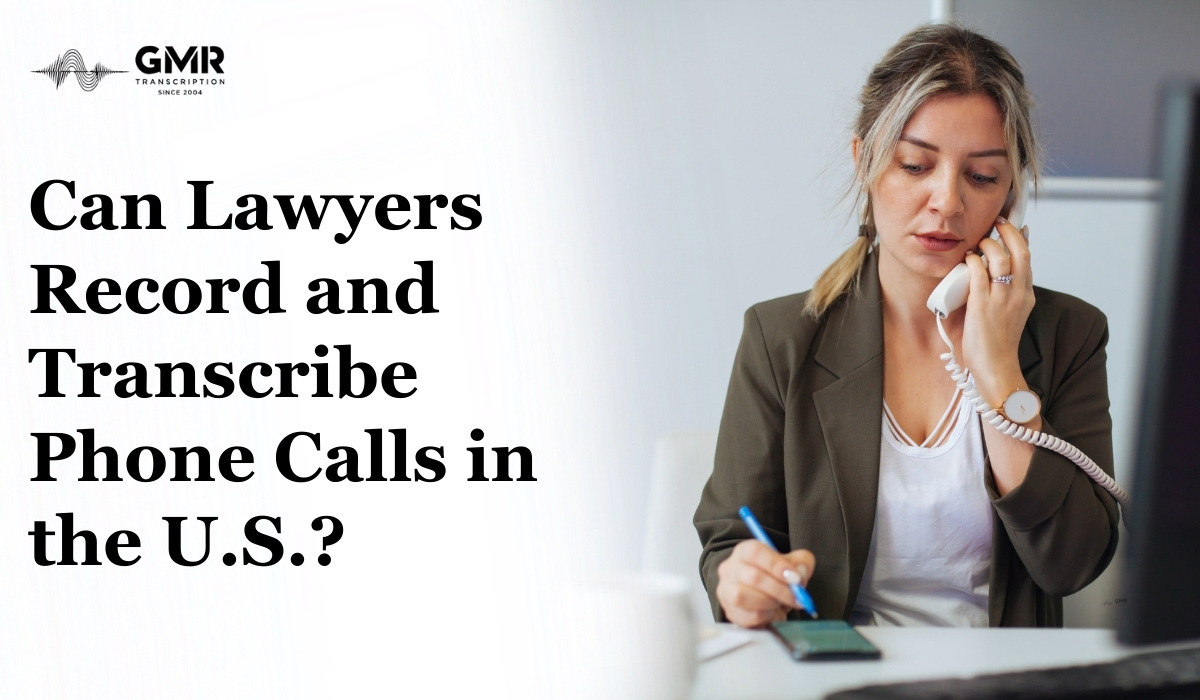
Despite years of guidance, call recording remains a source of uncertainty for lawyers across the United States. The confusion rarely stems from whether recording is permitted at all. Instead, it arises from how dramatically consent laws differ from state to state, and how easy it is to apply the wrong rule to the wrong call.
In practice, the legal risk is not the act of recording itself. It is being recorded under an incorrect consent framework. A call that is perfectly lawful in one jurisdiction can expose a lawyer to civil liability, criminal penalties, or ethical scrutiny in another.
Transcription further complicates the picture. Many assume transcription is a separate or safer step. Legally, it is not. Transcription inherits the legality, and the risks, of the original recording. If the recording is improper, the transcript is equally problematic.
This article explains how federal and state consent laws work, how they apply to lawyers in real-world scenarios, and how firms can use recording and transcription responsibly without turning them into compliance liabilities.
At the federal level, U.S. wiretapping law follows a one-party consent standard. This means that a conversation may be recorded as long as one participant consents. For lawyers, that consenting party is often the lawyer themselves.
However, federal law rarely provides the final answer. It establishes a baseline, not a universal permission. States are free to impose stricter requirements, and many do.
As a result, federal law alone typically governs only narrow situations, such as calls in which all participants are located in one-party consent states or in specific federally regulated contexts. In day-to-day legal practice, state law almost always controls.
State consent laws generally fall into two broad categories, but the labels themselves can be misleading if taken at face value.
In one-party consent states, the law allows recording as long as one participant consents. That participant can be the lawyer on the call.
In practical terms, a lawyer may record a call with a client, opposing counsel, or third party without notifying the other participant, provided the lawyer is lawfully participating in the conversation.
This framework applies in the majority of U.S. states, including New York, Texas, Ohio, and many others, as well as Washington, DC. However, even within one-party consent jurisdictions, nuances matter.
Some states introduce additional civil-law considerations, distinguish between obvious and non-obvious recording, or impose heightened privacy expectations in specific contexts. Connecticut and Hawaii, for example, are frequently confused because their statutes and case law are more layered than simple one-party labels suggest. Vermont, meanwhile, has no explicit statute and generally defaults to the federal standard.
The takeaway for lawyers is simple: one-party consent does not mean risk-free recording. Context still matters.
All-party (sometimes called two-party) consent states require that every participant in the conversation agree to the recording. These jurisdictions, including California, Florida, Pennsylvania, Massachusetts, and others, take a stricter view of conversational privacy.
In these states, consent must be clear. It may be explicit, such as a verbal agreement at the start of the call, or implied through unmistakable notice and continued participation. Silence alone is often insufficient.
Lawyers commonly run into trouble in these jurisdictions by assuming federal law applies, relying on implied consent without clear disclosure, or carrying over recording habits from one-party consent states.
Beyond the fundamental one-party-versus-all-party distinction, several states introduce additional layers that lawyers cannot afford to ignore. Some differentiate between phone calls and in-person conversations. Others treat business communications differently from personal ones. Still others expose lawyers to civil liability even when criminal penalties do not apply.
These nuances mean that a technically lawful recording can still trigger lawsuits, suppression motions, or ethical complaints depending on how it was obtained and used.
| One-Party Consent States (Plus DC) | Alabama, Alaska, Arizona, Arkansas, Colorado, Connecticut, District of Columbia (DC), Georgia, Hawaii, Idaho, Indiana, Iowa, Kansas, Kentucky, Louisiana, Maine, Minnesota, Mississippi, Missouri, Nebraska, New Jersey, New Mexico, New York, North Carolina, North Dakota, Ohio, Oklahoma, Rhode Island, South Carolina, South Dakota, Tennessee, Texas, Utah, Vermont, Virginia, West Virginia, Wisconsin, Wyoming |
|---|---|
| All-Party (Two-Party) Consent States | California, Connecticut, Delaware, Florida, Illinois, Maryland, Massachusetts, Montana, Nevada, New Hampshire, Pennsylvania, Washington |
Modern legal practice is rarely confined to one state. Clients, witnesses, and opposing counsel may all be located in different jurisdictions.
When a call crosses state lines, courts may apply the law of the state where the recording occurred, the state with the strongest privacy protections, or the state with the closest connection to the parties. The result is often unpredictable.
For this reason, many law firms adopt a conservative risk-management principle: assume the strictest applicable law controls. From a practical standpoint, obtaining verbal consent at the beginning of a call is the safest and most defensible approach, regardless of where the participants are located.
Even when a recording complies with state law, ethical rules and professional expectations still apply. Bar associations in several jurisdictions have cautioned against undisclosed recording, particularly when it undermines trust or appears deceptive.
For lawyers, the question is not only “Is this legal?” but also “How would this look if challenged?” Undisclosed recording can damage client relationships, complicate privilege assertions, and create reputational fallout, even when technically permitted.
Human-powered accuracy, legal-ready formatting, and secure handling of sensitive recordings.
Talk to our team about secure, accurate legal transcription by human experts.
Transcription does not introduce new consent requirements. If a recording was lawfully obtained, it may generally be transcribed. If it was unlawfully recorded, creating a transcript does not sanitize the violation.
While consent laws govern recording, transcription introduces a different category of risk: confidentiality. Sending sensitive audio to unsecured platforms or poorly vetted vendors can expose privileged information and, in some cases, waive attorney-client privilege.
Automated tools, consumer-grade software, and vendors without legal confidentiality safeguards can all create downstream exposure that far outweighs the original recording risk.
Responsible transcription requires more than accuracy. Law firms should ensure secure transmission, clear access controls, a documented chain of custody, and confidentiality agreements with any transcription service provider. For evidentiary use, verbatim accuracy, speaker identification, and certification become essential.
Courts may admit transcripts when their accuracy is established, and the original audio is available to support them. Poorly prepared transcripts, however, are easily challenged.
For law firms, compliance does not come from memorizing statutes. It comes from clear internal policies.
Firms that record calls responsibly typically standardize disclosure language, document consent, secure their recordings and transcripts, and vet vendors with the same care applied to other sensitive legal services.
Many recording problems stem from misconceptions: that one-party consent eliminates risk, that transcripts are safer than audio, or that legality automatically guarantees admissibility. Each of these assumptions has proven costly in real cases.
Call recording and transcription can be powerful tools for accuracy, documentation, and accountability when used correctly. The legal risk is manageable when firms understand consent laws, respect ethical boundaries, and treat transcription as a privileged legal process rather than a commodity.
When transparency and compliance are built into the workflow, recordings and transcripts become assets that support legal practice rather than liabilities that undermine it.
When your recordings need to stand up to scrutiny, your transcripts should too.
GMR Transcription delivers secure, certified legal transcription services handled by U.S.-based professionals who understand confidentiality, privilege, and evidentiary standards.