
Beth Worthy
5/6/2026



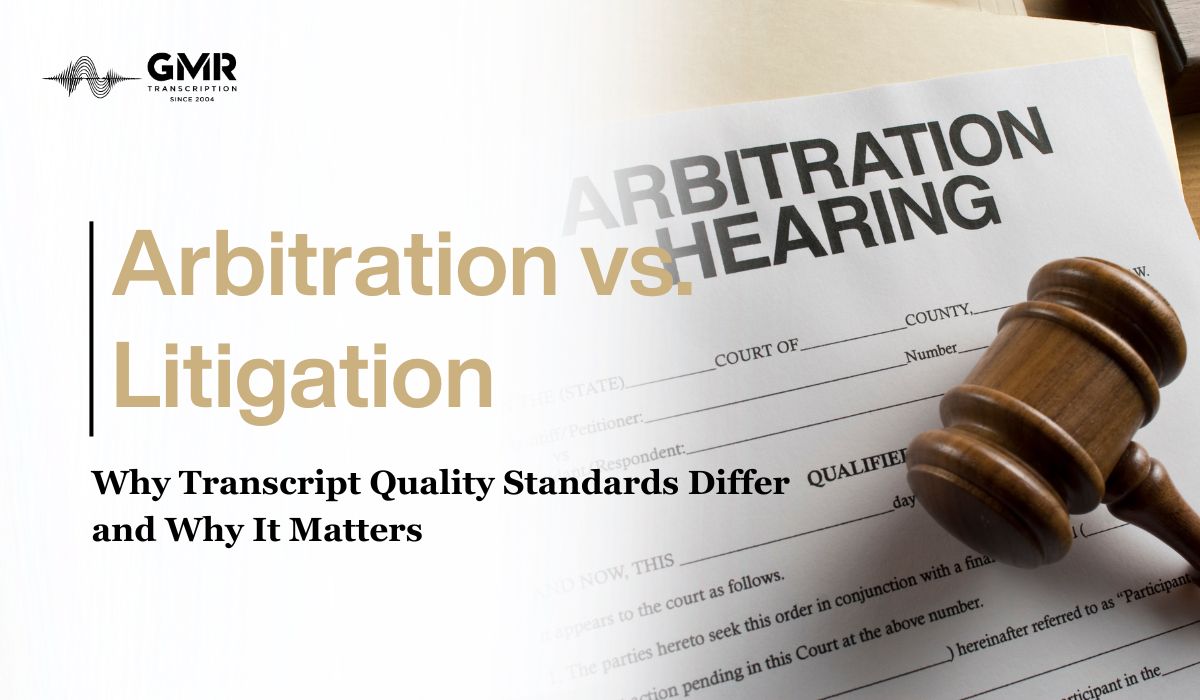
Attorneys who practice across both court litigation and arbitration often treat transcription as a procedural formality: order the transcript, receive the text, and use it in the proceeding. But that assumption carries real risk. The evidentiary rules and formatting standards governing what constitutes a transcript differ significantly between arbitration and litigation. Ordering the wrong type of transcript for the wrong proceeding is a mistake that rarely surfaces during preparation. It surfaces during the hearing itself.
Understanding how transcript quality standards differ between these two environments and correctly specifying those requirements at the outset are practical legal competence issues rather than administrative details.
In court proceedings, a litigation transcript is not simply a written record; it is an official document of the judicial process. It is governed by court reporter licensing requirements, state and federal rules of evidence, and, in federal courts, the Federal Court Reporters Act. The standard is verbatim: every word, every pause notation, every interruption captured in sequence. If audio is ever lost or disputed, the transcript is the authoritative record.
This standard applies uniformly across three primary litigation contexts:
Arbitration proceedings, whether administered under AAA, JAMS, ICC, or bespoke private rules, do not uniformly require a certified court reporter. In most cases, the parties agree on transcription arrangements, meaning the standard is whatever they specify. That flexibility is practical. It is also a source of substantial risk.
The variability plays out differently across arbitration formats:
Attorneys who assume that arbitration transcription standards are simply lower than court standards and order accordingly produce a document that is legally consequential but not to the evidentiary standard a judicial proceeding demands. In a post-award enforcement action, or in a challenge to the arbitral award, that transcript may be scrutinized by a court. If it was produced by an AI tool or a non-certified transcriptionist, its accuracy becomes questionable, and such challenges tend to arise at the worst possible moment.
A less-discussed but equally important risk involves the deposition transcripts taken before arbitration. When those transcripts are introduced into the arbitral record, they must meet the jurisdiction's verbatim standard, regardless of what the arbitration rules say about hearing transcription. Attorneys who apply different transcription standards to pre-arbitration depositions and to the arbitration hearing itself create an internal inconsistency that opposing counsel can exploit.
Before any arbitration proceeding, address the following in the scheduling order or pre-hearing conference agreement: (1) the transcription standard required, (2) whether a certified transcriptionist is required, (3) the format in which transcripts will be submitted to the tribunal, and (4) the timeline for transcript delivery and any correction process. Leaving these undefined is how transcript disputes arise mid-hearing.
Transcription should align with the legal context in which it will be used. Different proceedings require different levels of accuracy, certification, and formatting.
The following comparison clarifies how transcription standards align with use cases:
| Proceeding Type | Required Standard | Practical Requirement |
| Depositions | Verbatim, certified | Must meet jurisdictional rules and evidentiary standards |
| Court litigation | Verbatim, official record | Used for appeals and judicial review |
| Arbitration hearings | Defined by parties or institutions | Should align with potential enforcement or challenge |
| Internal investigations | Accurate, non-certified | Used for internal analysis and preparation |
| Pre-hearing interviews | Accurate, contextual | Not submitted as a formal record |
Verbatim certified transcription remains essential for depositions and any proceeding that may enter a judicial process. Arbitration hearings that involve high-value disputes or cross-border enforcement benefit from the same level of accuracy.
Non-certified transcription serves a different role. It supports internal preparation and investigation, where accuracy is required but formal certification is not.
AI-generated transcription introduces limitations in legal contexts. Multi-speaker dialogue, technical terminology, and nuanced exchanges require interpretation. Automated systems process patterns, while legal transcription requires precision.
When transcripts are intended for submission to a tribunal or citation in legal arguments, the standard must reflect that use.
Talk to our team about secure, accurate legal transcription by human experts.
In arbitration and litigation alike, an accurate transcript determines how reliably a proceeding can be reconstructed, cited, and enforced. The flexibility that arbitration affords in transcription arrangements is not an invitation to cut corners, but a choice that carries the same legal consequences as every other choice made in a high-stakes proceeding.
GMR Transcription (GMRT) provides human-verified transcription to the standard; each proceeding requires verbatim certified for court and deposition work, research-grade for internal investigation, and formatted for the specific submission requirements of major arbitral institutions.
Preparing for an arbitration or deposition series? Contact us to discuss the transcript standard your proceeding requires. Get a quote →