
Beth Worthy
12/10/2025



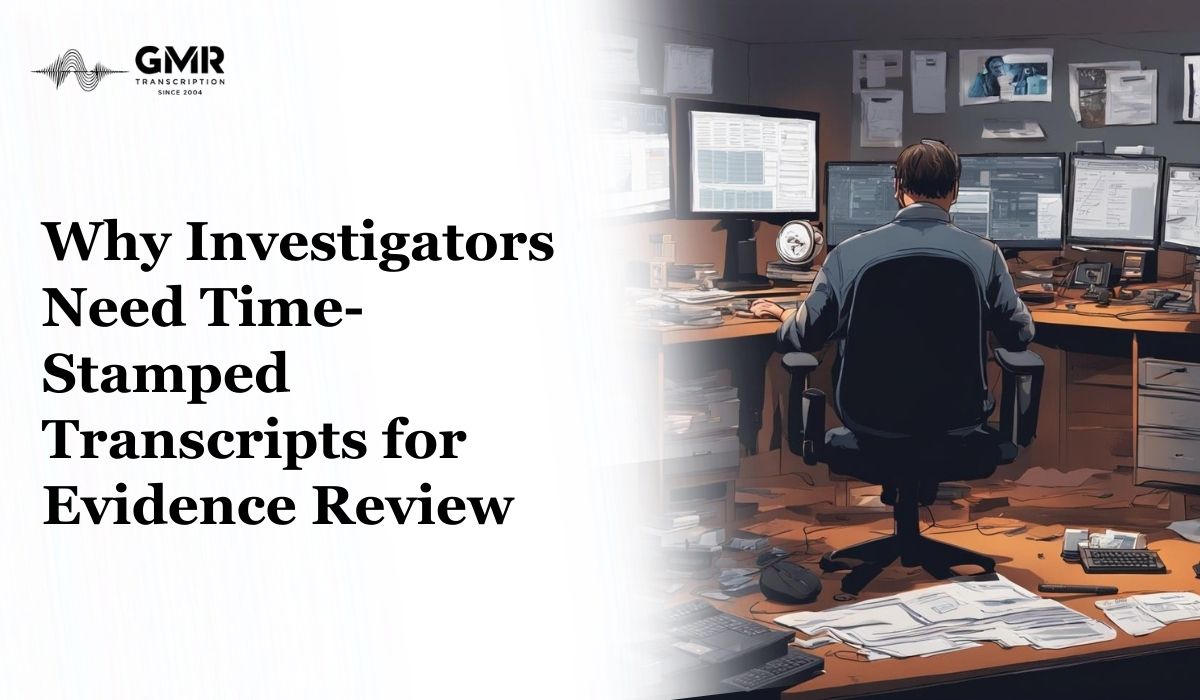
Investigators today handle an overwhelming volume of audio and video, including interrogations and witness statements, body-cam recordings, surveillance audio, and field interviews. These recordings are invaluable, but raw media is slow, disorganized, and easy to misinterpret. Reviewing the same clip multiple times, debating what was said, or trying to align timelines across sources wastes time and increases the risk of missed details.
This is why time-stamped transcripts have become essential investigative infrastructure. They turn chaotic, real-world recordings into structured, defensible evidence. And with GMR Transcription’s 100% US-based human transcribers, investigators get accuracy, confidentiality, and transcripts explicitly built for evidence review.
Audio and video evidence is growing faster than investigative teams can process it. Without structure, investigators spend hours scrubbing through footage to verify a single detail. Conflicting interpretations become common. Case-file preparation slows down. And discovery preparation becomes a race against time.
Time-stamped transcripts reintroduce order. They anchor verbal statements to precise time codes, support timeline reconstruction, and help investigators navigate multi-source evidence without having to replay long recordings. They also preserve consistency across teams, supervisors, legal partners, and forensic specialists.
Raw recordings create friction throughout the investigative workflow. Even experienced teams struggle to maintain continuity when there’s no reliable way to confirm exact statements or events. When the only option is to rewatch hours of media, small details slip through the cracks, contradictions, admissions, shifts in tone, or subtle behavioral cues.
Those gaps don’t just slow cases down; they can weaken evidentiary clarity and complicate courtroom preparation.
A time-stamped transcript is more than text. It’s media-to-text alignment that makes evidence navigable. Each line (or each speaker, depending on the case) is anchored to a specific timestamp so investigators can jump directly to the relevant moment.
Key capabilities include synchronized time markers, accurate speaker identification, strict-verbatim transcription when required, and clean formatting that fits smoothly into case documentation. Unlike general transcription, investigative transcription prioritizes precision, clarity, and reliability across complex recordings, from overlapping speakers to chaotic field environments.
Time-stamped transcripts are invaluable in scenarios where timing, sequencing, or correlation matters. Reconstructing a timeline from body-cam footage, aligning interviews with surveillance video, validating witness statements, or tracking changes in a suspect’s narrative all become significantly easier when every line of dialogue is tied to a concrete moment.
Investigators can also cross-reference multi-source evidence, calls, CCTV angles, field interviews, and radio transmissions without manually hunting through recordings. When the pressure is high and the evidence is messy, timestamps eliminate uncertainty.
With a structured, searchable transcript, investigators no longer rely on repeated scrubbing or subjective interpretation. They can keyword-search names, locations, threats, or coded language and go straight to the timestamp where the term appears. Teams reviewing the same case can discuss identical reference points without misunderstanding each other.
Time-stamped transcripts reduce cognitive load, speed up case briefing and report writing, support OSINT-style verification, and give legal teams a precise record to cite during filings, motions, and hearings.
Automated transcription tools perform poorly in the environments in which investigators work, such as stressful speech, background noise, overlapping dialogue, coded language, and poor audio quality. They often misidentify speakers or miss key contextual cues entirely.
DIY transcription isn’t practical either. It drains investigator time, introduces inconsistencies, and raises confidentiality risks. Sensitive-case transcription demands trained human listeners who understand nuance, context, and investigative priorities.
Investigative transcripts are rarely used in isolation. They’re shared with prosecutors, defense teams, supervisors, forensic specialists, and multi-agency partners. When a transcript includes precise timestamps, each party can reference the exact moment with absolute clarity. It strengthens case documentation, supports discovery demands, and ensures interpretations remain consistent across the entire chain of review.
GMR Transcription works closely with investigators, legal teams, and OSINT professionals who rely on accurate, confidential, and defensible transcripts. Our 100% US-based human transcriptionists specialize in complex recordings, surveillance audio, wiretaps, body-cam footage, multi-speaker scenes, and poor-quality evidence.
We provide:
Our transcripts integrate seamlessly into case files, making evidence review faster, clearer, and easier to defend.
Audio and video evidence are only getting more complex. Time-stamped transcripts give investigators the structure, accuracy, and navigability they need to work efficiently and defensibly. They reduce errors, strengthen evidentiary clarity, and accelerate every stage of the case, from early review to courtroom preparation.
For investigators who need human-accurate, secure, and analysis-ready transcripts, GMR Transcription remains a trusted partner built for the reality of modern evidence review.