
Beth Worthy
9/17/2026



People comparing transcription systems run into accuracy claims constantly: "99% accurate," "industry-leading WER," "outperforms human transcribers." Word Error Rate (WER) is the metric behind most of those claims, and it's genuinely useful. But a single percentage doesn't tell you what you actually need to know, which is whether a given system will produce a usable transcript of your audio.
This guide explains what WER measures, how to calculate it by hand, what a WER score does and doesn't tell you, and what to check before trusting a published accuracy number.
Word Error Rate is a standard metric for scoring how closely a transcript matches a known-correct reference transcript. It's most often used to evaluate automatic speech recognition (ASR) systems, but the same calculation can be applied to any transcript, human or machine-generated, when a verified reference is available.
WER works by counting the word-level differences between the transcript being tested and the reference, then expressing that count as a percentage of the reference's total word count. A lower WER means fewer word-level differences from the reference; it does not, by itself, mean the transcript reads well or captures everything a reader needs.
WER became the standard way to score speech recognition systems through decades of NIST speech-recognition evaluations, which is why you'll see it referenced across academic research, ASR vendor documentation, and transcription industry benchmarks alike. It gives researchers and buyers a consistent, repeatable way to compare systems, provided the comparison accounts for what was actually tested (more on that below).
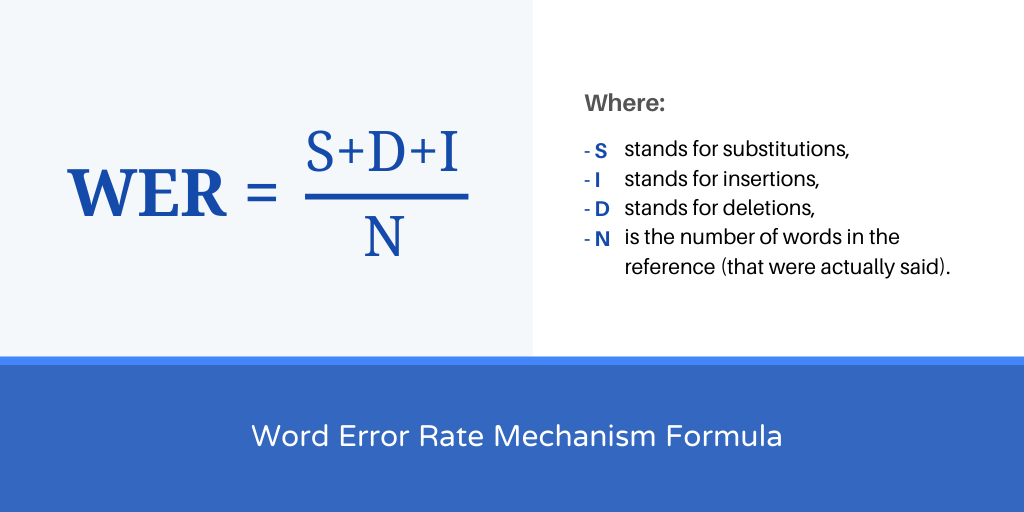
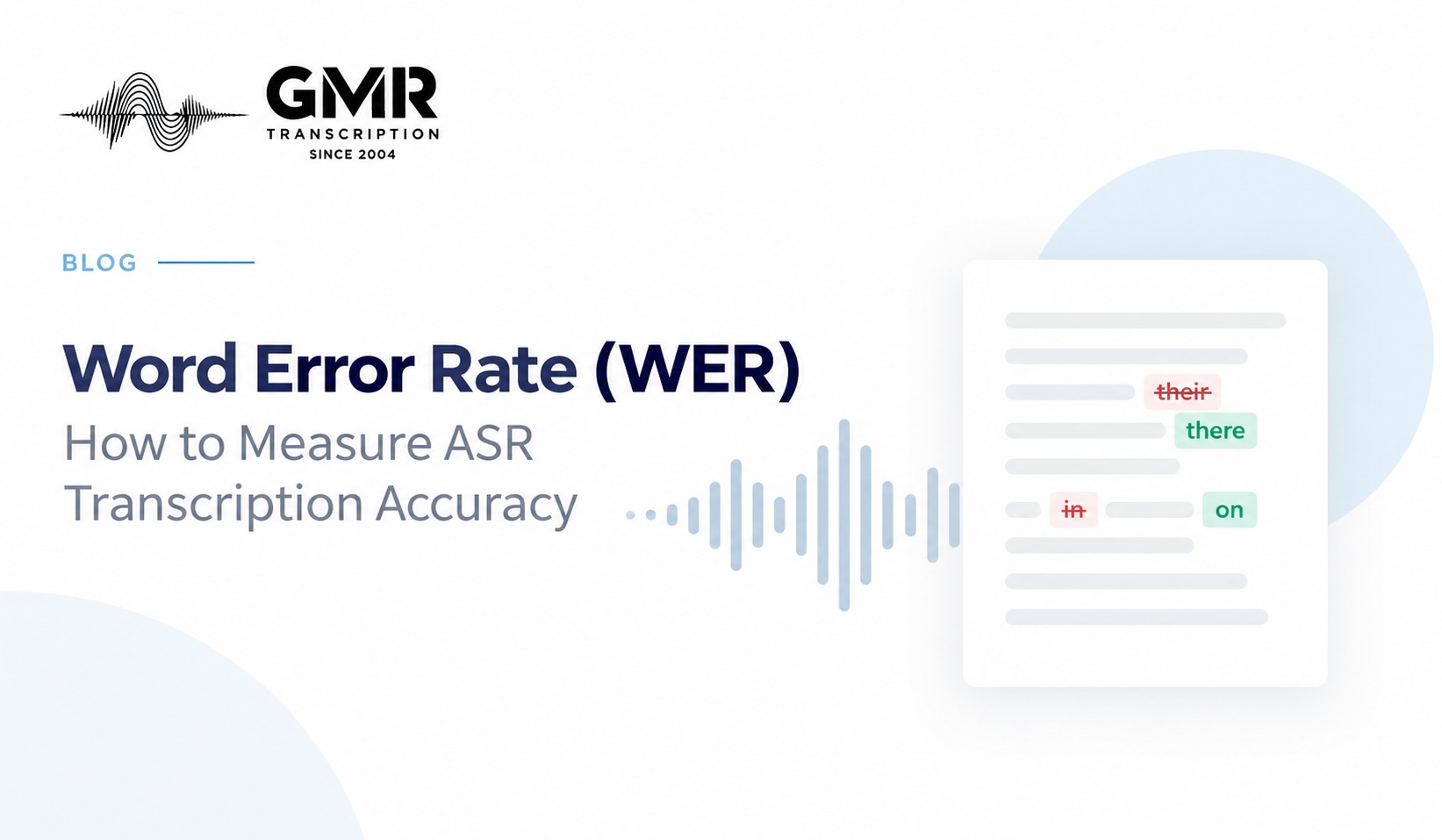
WER compares a hypothesis transcript (what the system or transcriptionist produced) against a reference transcript (the verified, correct version of what was said) and counts three types of errors:
The formula:
WER = (S + D + I) / N × 100
Where N is the total number of words in the reference transcript. The calculation is done by aligning the two transcripts word by word (technically, using edit-distance alignment) and tallying where they diverge.
A short example makes this concrete. Say the reference transcript, verified against the audio, reads:
Reference: "The researcher reviewed five interviews."
An ASR system produces:
Hypothesis: "The researcher reviewed fine interviews."
Comparing word by word:
WER = 1 / 5 × 100 = 20%
Deletions and insertions work the same way. If the system instead produced "The researcher reviewed interviews" (dropping "five" entirely), that's one deletion against five reference words, again 20% WER. If it produced "The researcher really reviewed five interviews" (adding a word that wasn't said), that's one insertion, or 1/5 = 20% WER as well.
Notice that all three examples land on the same WER despite being different kinds of errors, one of them (the dropped number) arguably more consequential than the others if the count matters to the reader. That's a preview of WER's biggest limitation, covered in detail below.
There's no universal cutoff for a "good" WER. A 10% WER on clean, single-speaker, general-vocabulary audio is a very different result from a 10% WER on a noisy, multi-speaker call full of technical terminology, and treating the two as equivalent is where a lot of accuracy comparisons go wrong.
What a WER figure actually represents depends on factors including:
A lower WER generally indicates fewer word-level recognition errors on the audio it was measured against. It is not a guarantee that a transcript will read well, preserve every important detail, or perform the same way on a different kind of recording.
Background noise, echo, distortion, low recording volume, and heavily compressed audio (common on phone calls and some VoIP platforms) all increase word-level errors, for both automated systems and human listeners.
Accents and dialects, speaking speed, multiple speakers, and crosstalk are consistent sources of error. A system or transcriptionist trained primarily on one variety of a language will generally perform less consistently on speech patterns it has seen less of.
Technical terminology, proper nouns, medication and product names, and industry-specific jargon are harder to recognize correctly than common conversational vocabulary, largely because these terms appear less often in the data used to build and test a system.
Microphone quality, phone-call compression, remote-meeting audio, and environmental noise (a car, a clinic waiting room, a conference hall) all shape how much signal is actually available to transcribe.
Performance varies across languages, and within a language, across domains. A benchmark measured on general conversational English says relatively little about performance on a Spanish-language interview, a courtroom deposition, or a clinical dictation.
WER counts word-level errors. It does not evaluate whether those errors change the meaning of what was said, and that gap is well documented in current ASR research, not just an industry talking point.
Apple's machine learning research team, publishing on transcript quality for podcast captions, found that a standard WER score of 9.2% on their test set dropped to just 1.4% once errors were filtered down to ones that actually affected readability or meaning. Most of the counted "errors" were things like filler words, contractions, or formatting choices that a reader would never notice. The team built a separate metric to isolate the errors that matter, precisely because raw WER doesn't distinguish them.
Speechmatics has published similar findings using their own illustrative examples: a transcript that renders "I'm a five-year-old" as "I am 5 year old" scores a startling 125% WER, yet remains completely understandable. Meanwhile, a single substitution that drops a qualifying word, changing "the suspect was released" to "the suspect was arrested," produces a much lower WER score while reversing the meaning of the sentence entirely.
In practical terms, this means:
Some evaluations try to work around these gaps with related or weighted metrics, such as character error rate (CER) for languages or systems where word boundaries are less meaningful, or severity-weighted scoring that penalizes meaning-changing errors more heavily than cosmetic ones. These approaches are worth knowing about, but they're less standardized than WER and aren't always reported.
This is where most published accuracy comparisons fall apart: two WER numbers are only comparable if they were measured the same way, on comparable audio. Before treating one WER figure as better than another, it's worth checking:
This matters most for searches like "lowest word error rate transcription API" or "what is the WER of the best medical transcription API," because the answer genuinely depends on what's being tested. A vendor-reported WER on general English audio says very little about how that same system will perform on a specialty medical dictation full of drug names and abbreviations, or on a multi-speaker legal deposition with crosstalk. A single published number, without knowing the test conditions behind it, isn't enough to declare one system more accurate than another for your use case.
A lower published WER does not automatically mean a system will perform better on your recordings. The only reliable way to know is to test candidate systems, or a transcription provider's actual output, against your own representative audio.
The practical impact of a word-level error depends heavily on context and terminology. A misheard filler word in a casual conversation is a non-issue. A misheard dosage, statute citation, data point, or proper noun in a legal transcript, an academic research interview, or a business meeting record can change how the document is used or understood later.
This is one reason domain-specific vocabulary is worth checking for specifically when evaluating any transcription option, rather than relying on a general-purpose accuracy figure. It's also why many organizations in these fields build a human review step into their workflow for anything that will be quoted, cited, or relied on as a record, regardless of which transcription method produced the first draft.
WER and "a transcript that does what you need it to do" overlap, but they're not the same thing:
| What WER Measures | What Users May Also Need |
|---|---|
| Word-level errors | Correct speaker identification |
| Substitutions | Correct technical terminology and proper nouns |
| Deletions | Complete content, with nothing dropped silently |
| Insertions | Appropriate formatting for the intended use |
| Overall word error rate | Accurate, consistent timestamps |
| Benchmark accuracy on a test set | Usability of the final transcript for its actual purpose |
Benchmark performance and final transcript quality are useful to evaluate separately. A system can score well on a published benchmark and still require review before a transcript is ready to quote, file, or publish.
Most transcription work today follows one of two general paths:
Both paths can produce a usable transcript. Where a review step (automated draft checked by a person, or a person's draft checked by a second reviewer) tends to add the most value is in exactly the areas WER doesn't score: correctly rendering specialized terminology and names, resolving ambiguous or unclear audio, assigning speakers correctly, applying formatting consistent with the project's requirements, and using context to catch an error that a word-by-word process would miss.
None of this means human transcription is automatically error-free. Every transcription method benefits from a defined review step. The relevant question when choosing between methods isn't "which one claims a lower error rate," but "which workflow, including any review built into it, reliably produces a transcript that's accurate and usable for what I need it for."
GMR Transcription's human transcription services are built around that review step by design, using US-based transcriptionists for audio and video transcription projects where terminology, speaker accuracy, and formatting need to hold up to scrutiny, not just score well on a benchmark.
Before comparing WER figures between systems or providers, it's worth asking:
Word Error Rate (WER) is a metric that scores how closely a transcript matches a verified reference transcript, expressed as a percentage of word-level errors relative to the reference's word count.
It measures three types of word-level differences between a transcript and its reference: substitutions, deletions, and insertions.
Add the number of substitutions, deletions, and insertions, divide by the total number of words in the reference transcript, and multiply by 100: WER = (S + D + I) / N × 100.
There isn't a universal threshold. What counts as a strong WER depends on the audio quality, language, accents, vocabulary, and domain being tested, so the same percentage can represent very different levels of real-world usefulness depending on those conditions.
WER is one measurable component of accuracy: it scores word-level correctness against a reference. "Transcription accuracy" in a broader sense also depends on things WER doesn't score, like speaker identification, punctuation, formatting, and whether errors change meaning.
Because WER scores are only comparable when they're measured under the same conditions. Different test datasets, languages, accents, audio quality, and domains will all produce different scores even for otherwise similar systems.
Audio quality, background noise, speaker accents and overlap, vocabulary and technical terminology, recording conditions, and the language or domain being transcribed all affect WER.
Yes, but only when the comparison controls for the testing conditions above. A WER figure without details on the dataset, language, accents, and domain tested isn't enough on its own to declare one service more accurate than another.
Not necessarily. WER treats every word-level error the same, so a transcript with a low WER can still contain a meaning-changing error, while one with a higher WER can be fully readable and usable.
ASR (automatic speech recognition) accuracy refers to how correctly a speech-to-text system converts audio into text, most commonly measured using Word Error Rate against a verified reference transcript.