
Beth Worthy
4/3/2026



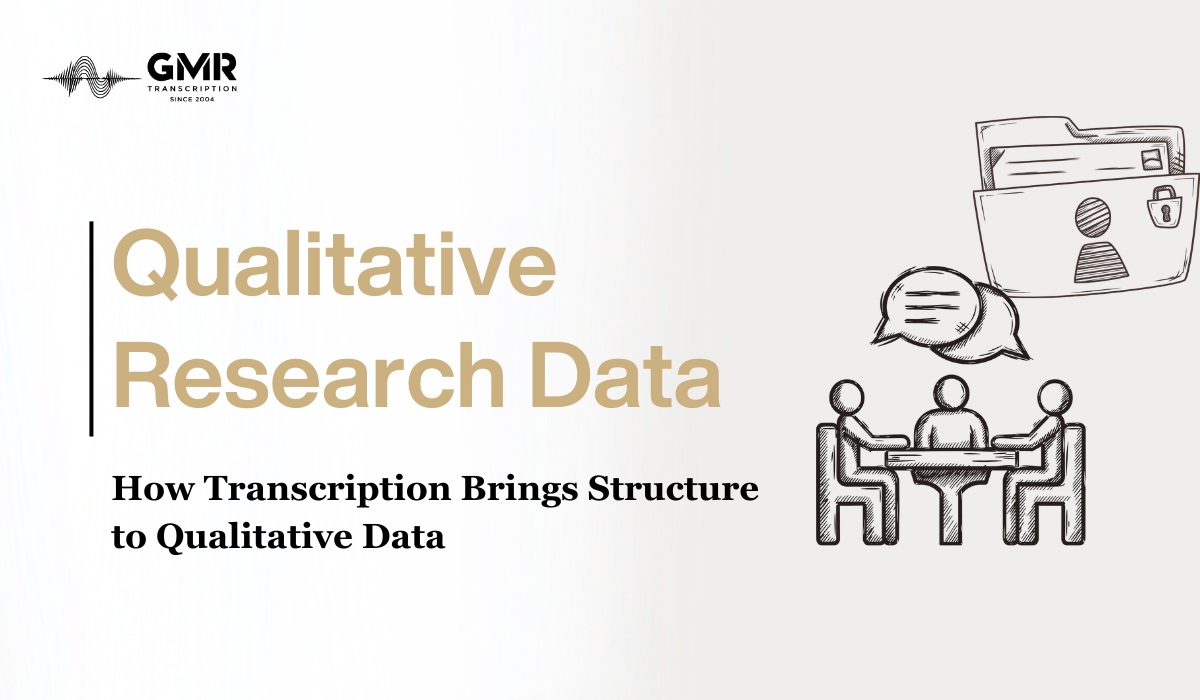
Qualitative research generates insight through conversation. Interviews, focus groups, and open-ended responses capture perspectives that structured data cannot. This depth introduces complexity that directly affects how insights are developed and validated.
Researchers work with large volumes of unstructured data. Audio recordings, notes, and transcripts must align to support analysis. When this data lacks structure or accuracy, interpretation becomes inconsistent and difficult to validate.
Research transcription forms the foundation of this structure. It converts conversations into organized, accessible records that support analysis. In qualitative research, where meaning depends on context and phrasing, “good enough is not enough.” Accuracy determines whether insights remain reliable throughout the research process.
Qualitative data organization begins with how conversations are documented. Audio recordings preserve discussions, yet they limit accessibility and slow analysis.
Research transcription transforms these recordings into structured data that supports:
When transcripts are accurate, the dataset becomes reliable. When transcription introduces errors, those errors propagate through every stage of analysis.
In qualitative research, transcription accuracy directly influences both organization and reproducibility.
AI transcription tools provide speed and convenience. They generate text quickly and support early-stage review. This efficiency makes them useful for preliminary workflows.
Qualitative research depends on more than just speed. Conversations include nuance, interruptions, overlapping speech, and evolving context.
AI systems process speech based on patterns. In complex conversations, this introduces limitations:
Research shows that automated systems continue to struggle with contextual understanding and domain-specific language in multi-speaker settings.
AI supports workflow efficiency, but accurate interpretation requires human judgment.
Human transcription captures more than words. It preserves meaning within the structure of the conversation.
Professionals delivering professional transcription services:
This level of detail ensures that transcripts reflect how information was communicated.
Context is fundamental for valid interpretation in qualitative research, and human transcription aligns with this requirement by preserving conversational context and intent.
The difference between audio-only data and structured transcripts becomes clear during analysis.
| Aspect | Audio-Only Data | Human Transcription |
| Accessibility | Requires repeated playback | Instantly searchable and structured |
| Interpretation | Dependent on notes and recall | Supported by documented text |
| Context clarity | Fragmented across recordings | Preserved within transcripts |
| Coding consistency | Difficult to maintain | Standardized and repeatable |
| Reliability | Varies across reviewers | Consistent across analysis |
Talk to our team about secure, accurate legal transcription by human experts.
Research transcription converts qualitative data into a format that supports reliable interpretation. This transformation reduces ambiguity and improves analytical consistency.
Qualitative research involves multiple interviews, focus groups, and observational sessions. Consistency across these datasets determines the reliability of findings.
Professional transcription services support consistency through:
Consistency ensures that patterns identified in the data reflect actual insights rather than variations in documentation.
Qualitative interviews often involve dynamic interactions. Participants clarify, revise, or expand on their responses. Meaning develops across the conversation. Human transcriptionists play a vital part in preserving this progression. It captures how ideas evolve and how participants respond within context.
AI systems process statements individually. Human transcription captures conversations as connected narratives. This distinction matters. When context is preserved, interpretation remains accurate. When context is fragmented, insights lose reliability.
Structured data improves efficiency. Transcripts allow researchers to move directly into coding and interpretation without repeated audio review.
Professional transcription services support efficiency while maintaining accuracy. Researchers spend less time correcting errors and more time analyzing insights.
AI-generated transcripts often require review and correction. This introduces additional steps and variability.
Reliable research transcription reduces rework and supports a streamlined research workflow.
Qualitative research often involves multiple researchers working on the same dataset. Collaboration depends on shared understanding.
Human transcription supports collaboration by providing:
Accurate transcripts ensure that all team members interpret data from the same foundation.
Manual transcription introduces variability and requires significant time. Researchers managing multiple responsibilities may find it difficult to maintain consistency.
Professional transcription services provide structured, accurate documentation that supports research workflows. Human transcriptionists capture nuance, context, and speaker dynamics with precision.
This accuracy reduces the need for correction and ensures consistency across datasets. It also strengthens the reliability of the analysis by providing a dependable foundation.
Professional transcription aligns with the demands of qualitative research, where clarity and accuracy directly influence outcomes.
Qualitative research depends on how data is captured, organized, and interpreted. Transcription plays a central role in this process.
AI transcription supports speed. Human transcription ensures accuracy, context, and reliability.
In research environments where insights inform decisions, documentation must reflect conversations precisely. The quality of research transcription determines the quality of analysis.
Organizations that prioritize accuracy through professional transcription services like GMR Trancription (GMRT) build research processes that are consistent, defensible, and reliable.