
Beth Worthy
10/14/2026



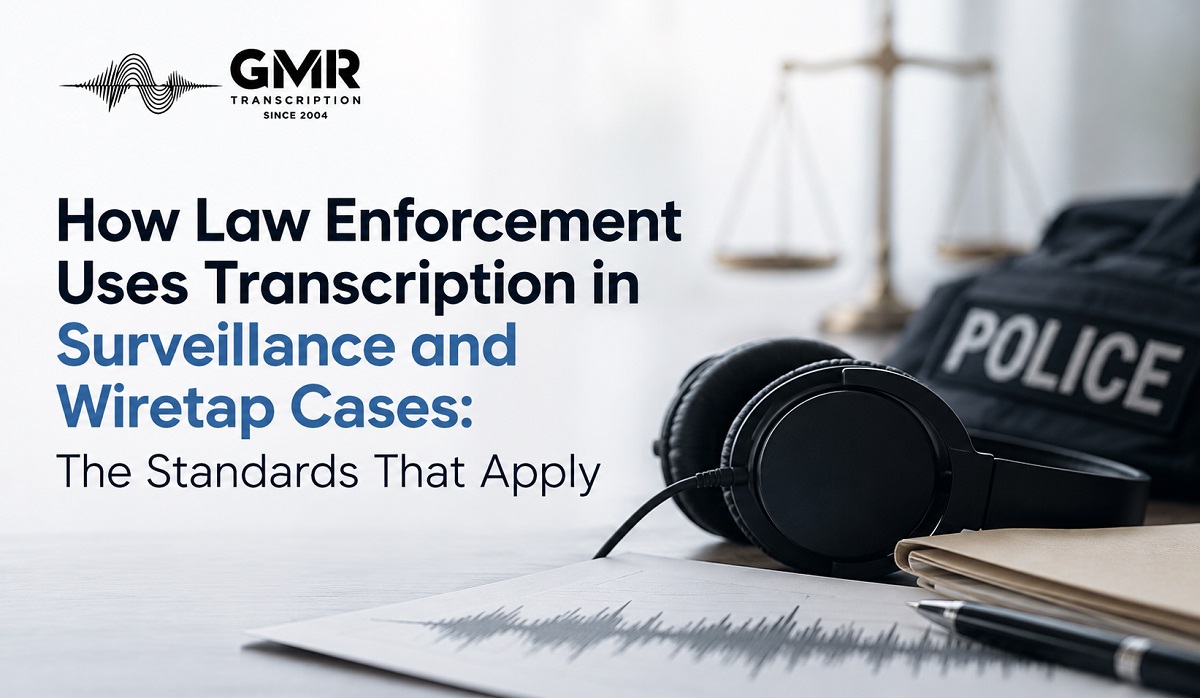
Law enforcement agencies can accumulate hours of surveillance audio, intercepted calls, interviews, and other recorded communications during an investigation. Turning that material into a usable transcript can help analysts search conversations, prepare case briefings, organize discovery materials, and locate specific statements without repeatedly working through the original recordings. When the audio involves sensitive investigative information, however, transcription becomes more than a productivity task. The agency has to consider the legal requirements governing the recording, the security requirements governing the information, and the transcription conventions governing the final document.
For agencies evaluating law enforcement transcription, those three layers should shape the conversation with providers. The recording remains the underlying evidence, while the transcript serves as a working record that helps authorized personnel review and navigate it. A provider should be able to explain how it handles verbatim speech, speaker labels, timestamps, unintelligible passages, foreign language segments, access controls, personnel screening, retention, and quality assurance. Those details determine how useful the resulting transcript will be when the material moves from investigation to prosecution, discovery, or courtroom preparation.
A transcript can turn a lengthy recording into a searchable working document. Investigators can locate names, dates, locations, threats, admissions, references to other evidence, and other relevant language without manually replaying an entire recording. Prosecutors and case teams can use the transcript during case review and preparation, while authorized personnel can use timestamps to return directly to the corresponding point in the original audio.
This difference matters because a transcript generally aids review rather than replacing the recording itself. The underlying audio remains important when someone needs to verify precisely what was said, evaluate the recording's quality, assess speaker identification, or examine an evidentiary dispute.
Surveillance and intercepted audio can also present difficult transcription conditions. Multiple people may speak at once, background noise can obscure words, speakers may use slang or coded language, and conversations can switch languages. A useful transcript preserves those characteristics rather than converting the conversation into a polished summary.
For investigative teams, wiretap evidence transcription must prioritize fidelity to the recording and consistency across the case. A transcript that makes difficult material appear cleaner than it actually sounds can raise questions during later review.
For sensitive investigative recordings, verbatim means preserving the speech as it occurred rather than rewriting it into polished prose. Depending on the agency's specifications, that can include false starts, repeated words, fillers, profanity, incomplete sentences, slang, and other features of natural speech. The objective is to document the conversation, not interpret it.
Speaker identification deserves the same discipline. If an agency has established speaker identities, the transcriptionist should follow the supplied identifiers and apply them consistently. A transcriptionist should not independently decide that an unidentified voice belongs to a particular suspect, witness, or officer based on assumptions about the conversation.
Timestamps should follow the agency's requirements, whether that means regular intervals, speaker changes, specific events, or another defined convention. Difficult passages should be marked rather than guessed. [Unintelligible] indicates the audio could not be reliably understood; inserting a plausible word creates a statement the recording may not support.
Foreign language material requires similar care. The transcription should identify the language or follow the agency's established handling instructions. Translation and interpretation are separate functions, and transcribe coded language or slang as heard unless the assignment specifically includes a qualified interpretation component.
Federal wiretap law also recognizes that code and foreign language material may require expert handling. 18 U.S.C. § 2518(5) requires interception orders to provide that interception be conducted in a way that minimizes the interception of communications outside the authorized scope. The statute also addresses code or foreign-language communications when an expert in that language or code is not reasonably available during the interception period, in which case minimization may occur as soon as practicable after interception.
A transcriptionist's role is therefore to preserve what was said and what can be heard. Case agents, investigators, interpreters, and other qualified professionals remain responsible for interpretation.
Two separate compliance questions arise when sensitive law enforcement audio is sent to a transcription provider: What rules govern the recording, and what security requirements govern the information being handled?
For federally authorized interceptions, Title III of the Omnibus Crime Control and Safe Streets Act sets requirements for intercepting wire, oral, and electronic communications. Section 2518 addresses court authorization, minimization, recording, and preservation. Section 2518(8)(a) states that intercepted communications must, when possible, be recorded in a way that protects the recording from editing or other alterations. It also sets requirements for judicial sealing and preserving recordings.
Those requirements reinforce the need for agencies to maintain control over the original recording and carefully manage any working copies supplied for transcription. State wiretap laws can impose additional or different requirements, so counsel should always review the applicable jurisdiction and authorization.
The data security question is separate. The FBI's CJIS Security Policy sets security requirements to protect Criminal Justice Information (CJI). The current policy materials address access control, encryption, media protection, auditing, incident response, personnel security, and how contractors and providers handle CJI. The FBI's current published policy is CJIS Security Policy v6.1, released in June 2026.
The policy specifically addresses private contractors that handle CJI. The FBI explains that contractors with access to CJI must meet applicable screening and agreement requirements, including the CJIS Security Addendum. The agency remains responsible for determining which CJIS requirements apply to its particular environment and information.
This matters because CJIS compliance isn't a generic label a transcription company can simply claim. Agencies should determine whether the audio or associated information constitutes CJI and then establish the contractual, personnel, technical, and operational requirements that apply.
A transcription provider's workforce and data handling model should be part of the agency's security assessment. The relevant question extends beyond whether a provider uses encryption or secure file transfer. Agencies should understand who can access the recordings, where those personnel are located, how they are screened, where files are processed and stored, how long information remains in the system, and how files are securely deleted.
Consider three common models: an offshore human workforce, an automated cloud transcription platform, and a screened U.S.-based human transcription team. Each model creates different questions for an agency to evaluate. Offshore processing can introduce additional jurisdictional and access considerations. Automated cloud processing can introduce questions about third-party infrastructure, model processing, retention, and whether sensitive recordings enter systems outside the agency's approved environment. A U.S.-based human workflow can make workforce location and accountability easier to define, provided the provider can document its actual controls.
The FBI's CJIS materials emphasize that security applies throughout the CJI lifecycle, including creation, viewing, modification, transmission, dissemination, storage, and destruction. For that reason, the phrase “secure transcription” should lead to specific questions rather than serve as the end of the evaluation.
A law enforcement agency evaluating a transcription provider should be able to obtain clear answers to questions such as:
The strongest provider conversations also address the transcript specification before the first recording is submitted. The agency should define whether the assignment requires strict verbatim transcription, how timestamps should appear, which speaker identifiers should be used, and how uncertain or unintelligible passages should be marked. This approach allows procurement, investigators, IT, and legal teams to evaluate the same workflow from their respective perspectives.
GMR Transcription's investigative transcription work includes complex recordings such as surveillance audio and wiretap material, with a focus on human transcription and time-stamped transcripts for evidence review. Its existing time-stamped investigative transcription guidance explains how timestamps can connect transcript language to precise points in a recording and help investigative teams navigate lengthy evidence more efficiently.
Law enforcement agencies can accumulate hours of surveillance audio, intercepted calls, interviews, and other recorded communications during an investigation. Turning that material into a usable transcript can help analysts search conversations, prepare case briefings, organize discovery materials, and locate specific statements without repeatedly working through the original recordings. When the audio involves sensitive investigative information, however, transcription becomes more than a productivity task. The agency has to consider the legal requirements governing the recording, the security requirements governing the information, and the transcription conventions governing the final document.
For agencies evaluating law enforcement transcription, those three layers should shape the conversation with providers. The recording remains the underlying evidence, while the transcript serves as a working record that helps authorized personnel review and navigate it. A provider should be able to explain how it handles verbatim speech, speaker labels, timestamps, unintelligible passages, foreign language segments, access controls, personnel screening, retention, and quality assurance. Those details determine how useful the resulting transcript will be when the material moves from investigation to prosecution, discovery, or courtroom preparation.
A transcript can turn a lengthy recording into a searchable working document. Investigators can locate names, dates, locations, threats, admissions, references to other evidence, and other relevant language without manually replaying an entire recording. Prosecutors and case teams can use the transcript during case review and preparation, while authorized personnel can use timestamps to return directly to the corresponding point in the original audio.
This difference matters because a transcript generally aids review rather than replacing the recording itself. The underlying audio remains important when someone needs to verify precisely what was said, evaluate the recording's quality, assess speaker identification, or examine an evidentiary dispute.
Surveillance and intercepted audio can also present difficult transcription conditions. Multiple people may speak at once, background noise can obscure words, speakers may use slang or coded language, and conversations can switch languages. A useful transcript preserves those characteristics rather than converting the conversation into a polished summary.
For investigative teams, wiretap evidence transcription must prioritize fidelity to the recording and consistency across the case. A transcript that makes difficult material appear cleaner than it actually sounds can raise questions during later review.
For sensitive investigative recordings, verbatim means preserving the speech as it occurred rather than rewriting it into polished prose. Depending on the agency's specifications, that can include false starts, repeated words, fillers, profanity, incomplete sentences, slang, and other features of natural speech. The objective is to document the conversation, not interpret it.
Speaker identification deserves the same discipline. If an agency has established speaker identities, the transcriptionist should follow the supplied identifiers and apply them consistently. A transcriptionist should not independently decide that an unidentified voice belongs to a particular suspect, witness, or officer based on assumptions about the conversation.
Timestamps should follow the agency's requirements, whether that means regular intervals, speaker changes, specific events, or another defined convention. Difficult passages should be marked rather than guessed. [Unintelligible] indicates the audio could not be reliably understood; inserting a plausible word creates a statement the recording may not support.
Foreign language material requires similar care. The transcription should identify the language or follow the agency's established handling instructions. Translation and interpretation are separate functions, and transcribe coded language or slang as heard unless the assignment specifically includes a qualified interpretation component.
Federal wiretap law also recognizes that code and foreign language material may require expert handling. 18 U.S.C. § 2518(5) requires interception orders to provide that interception be conducted in a way that minimizes the interception of communications outside the authorized scope. The statute also addresses code or foreign-language communications when an expert in that language or code is not reasonably available during the interception period, in which case minimization may occur as soon as practicable after interception.
A transcriptionist's role is therefore to preserve what was said and what can be heard. Case agents, investigators, interpreters, and other qualified professionals remain responsible for interpretation.
Two separate compliance questions arise when sensitive law enforcement audio is sent to a transcription provider: What rules govern the recording, and what security requirements govern the information being handled?
For federally authorized interceptions, Title III of the Omnibus Crime Control and Safe Streets Act sets requirements for intercepting wire, oral, and electronic communications. Section 2518 addresses court authorization, minimization, recording, and preservation. Section 2518(8)(a) states that intercepted communications must, when possible, be recorded in a way that protects the recording from editing or other alterations. It also sets requirements for judicial sealing and preserving recordings.
Those requirements reinforce the need for agencies to maintain control over the original recording and carefully manage any working copies supplied for transcription. State wiretap laws can impose additional or different requirements, so counsel should always review the applicable jurisdiction and authorization.
The data security question is separate. The FBI's CJIS Security Policy sets security requirements to protect Criminal Justice Information (CJI). The current policy materials address access control, encryption, media protection, auditing, incident response, personnel security, and how contractors and providers handle CJI. The FBI's current published policy is CJIS Security Policy v6.1, released in June 2026.
The policy specifically addresses private contractors that handle CJI. The FBI explains that contractors with access to CJI must meet applicable screening and agreement requirements, including the CJIS Security Addendum. The agency remains responsible for determining which CJIS requirements apply to its particular environment and information.
This matters because CJIS compliance isn't a generic label a transcription company can simply claim. Agencies should determine whether the audio or associated information constitutes CJI and then establish the contractual, personnel, technical, and operational requirements that apply.
A transcription provider's workforce and data handling model should be part of the agency's security assessment. The relevant question extends beyond whether a provider uses encryption or secure file transfer. Agencies should understand who can access the recordings, where those personnel are located, how they are screened, where files are processed and stored, how long information remains in the system, and how files are securely deleted.
Consider three common models: an offshore human workforce, an automated cloud transcription platform, and a screened U.S.-based human transcription team. Each model creates different questions for an agency to evaluate. Offshore processing can introduce additional jurisdictional and access considerations. Automated cloud processing can introduce questions about third-party infrastructure, model processing, retention, and whether sensitive recordings enter systems outside the agency's approved environment. A U.S.-based human workflow can make workforce location and accountability easier to define, provided the provider can document its actual controls.
The FBI's CJIS materials emphasize that security applies throughout the CJI lifecycle, including creation, viewing, modification, transmission, dissemination, storage, and destruction. For that reason, the phrase “secure transcription” should lead to specific questions rather than serve as the end of the evaluation.
A law enforcement agency evaluating a transcription provider should be able to obtain clear answers to questions such as:
The strongest provider conversations also address the transcript specification before the first recording is submitted. The agency should define whether the assignment requires strict verbatim transcription, how timestamps should appear, which speaker identifiers should be used, and how uncertain or unintelligible passages should be marked. This approach allows procurement, investigators, IT, and legal teams to evaluate the same workflow from their respective perspectives.
GMR Transcription's investigative transcription work includes complex recordings such as surveillance audio and wiretap material, with a focus on human transcription and time-stamped transcripts for evidence review. Its existing time-stamped investigative transcription guidance explains how timestamps can connect transcript language to precise points in a recording and help investigative teams navigate lengthy evidence more efficiently.
Does a transcript replace the original recording?
The transcript serves as a review and documentation tool. The original recording remains important for verifying the exact audio, evaluating disputed statements, and addressing questions about the recording itself. Agencies should follow applicable evidence preservation and legal requirements.
What does CJIS mean for a transcription provider?
CJIS requirements can apply when a provider has access to Criminal Justice Information. The agency should determine whether the material qualifies as CJI and identify the applicable CJIS Security Policy controls, agreements, personnel requirements, and technical safeguards. The FBI's policy specifically addresses private contractors that handle CJI.
Should the transcriptionist identify speakers?
Speaker labels should follow the identifiers supplied or approved by the agency. The transcriptionist's role is to document the conversation accurately, not to identify an unidentified speaker independently.
How should foreign language calls be handled?
The agency should establish whether it needs transcription, translation, interpretation, or a combination. The transcriptionist should preserve the spoken content according to the assignment and clearly identify language changes or unintelligible passages.
Does a provider need to be “CJIS certified”?
Agencies should focus on the CJIS requirements that apply to their information and contractual relationship, rather than relying on a generic “CJIS certified” marketing claim. The FBI's CJIS framework includes specific security controls, agreements, personnel requirements, and oversight mechanisms.
For surveillance and wiretap material, transcript quality begins before a transcriptionist types the first word. The agency needs a clear specification, a controlled handling process, appropriate security requirements, and a transcript that faithfully represents the recording. Human transcription can provide the careful listening and contextual judgment difficult audio requires, while the agency remains responsible for determining the legal and security requirements applicable to its evidence.
GMR Transcription follows a transcribe, not interpret principle in its investigative transcription services, supported by a workflow staffed 100% by U.S.-based human transcriptionists. For agencies evaluating law enforcement transcription services, the right next step is a detailed conversation about the specific recording, transcript conventions, security requirements, and quality controls your project requires.
Discuss your law enforcement transcription project with GMR Transcription and use the questions above to structure the conversation.
Frequently Asked Questions
Does a transcript replace the original recording?
The transcript serves as a review and documentation tool. The original recording remains important for verifying the exact audio, evaluating disputed statements, and addressing questions about the recording itself. Agencies should follow applicable evidence preservation and legal requirements.
What does CJIS mean for a transcription provider?
CJIS requirements can apply when a provider has access to Criminal Justice Information. The agency should determine whether the material qualifies as CJI and identify the applicable CJIS Security Policy controls, agreements, personnel requirements, and technical safeguards. The FBI's policy specifically addresses private contractors that handle CJI.
Should the transcriptionist identify speakers?
Speaker labels should follow the identifiers supplied or approved by the agency. The transcriptionist's role is to document the conversation accurately, not to identify an unidentified speaker independently.
How should foreign language calls be handled?
The agency should establish whether it needs transcription, translation, interpretation, or a combination. The transcriptionist should preserve the spoken content according to the assignment and clearly identify language changes or unintelligible passages.
Does a provider need to be “CJIS certified”?
Agencies should focus on the CJIS requirements that apply to their information and contractual relationship, rather than relying on a generic “CJIS certified” marketing claim. The FBI's CJIS framework includes specific security controls, agreements, personnel requirements, and oversight mechanisms.
For surveillance and wiretap material, transcript quality begins before a transcriptionist types the first word. The agency needs a clear specification, a controlled handling process, appropriate security requirements, and a transcript that faithfully represents the recording. Human transcription can provide the careful listening and contextual judgment difficult audio requires, while the agency remains responsible for determining the legal and security requirements applicable to its evidence.
GMR Transcription follows a transcribe, not interpret principle in its investigative transcription services, supported by a workflow staffed 100% by U.S.-based human transcriptionists. For agencies evaluating law enforcement transcription services, the right next step is a detailed conversation about the specific recording, transcript conventions, security requirements, and quality controls your project requires.
Discuss your law enforcement transcription project with GMR Transcription and use the questions above to structure the conversation.