
Beth Worthy
4/26/2026


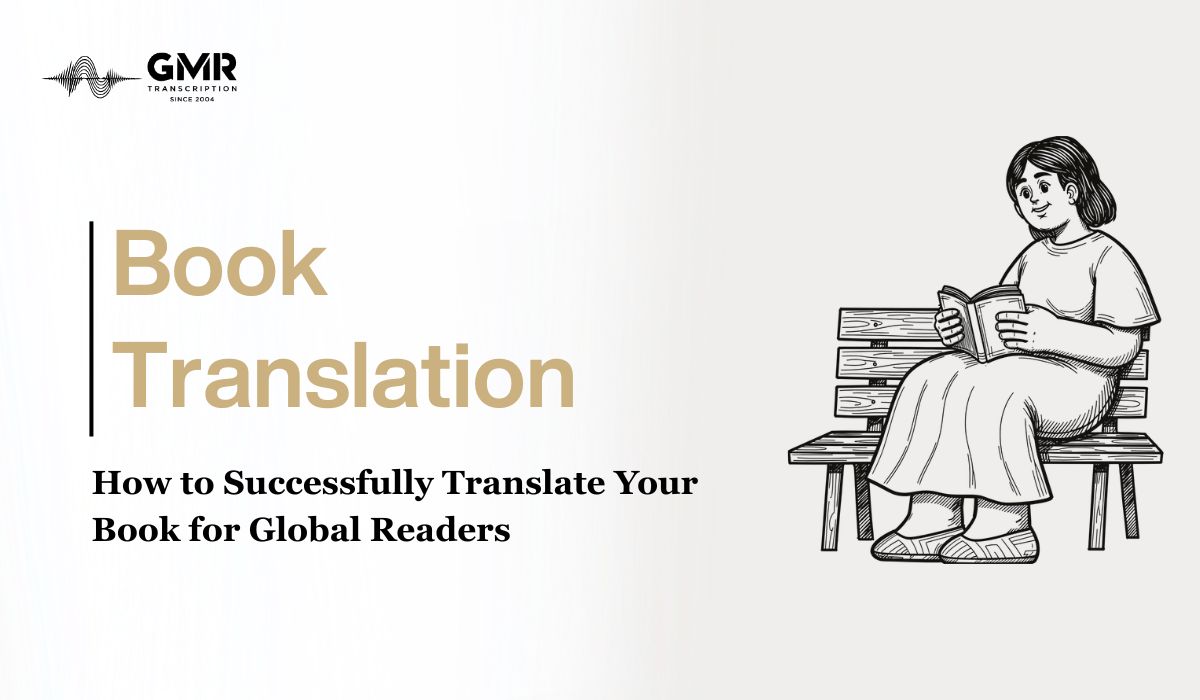
You’ve already done the hard part. You wrote the book. Now the question is how far it can go.
Right now, your reach is limited by one thing: language. If your book is only available in its original language, your audience stays confined to that market. Translation is what allows you to step beyond that and put your work in front of readers who would never discover it otherwise.
Working with authors and publishers at GMR Transcription, I’ve seen how often this shift begins earlier than expected. Content is transcribed, refined, and structured for clarity, and then the focus turns to making it accessible to a wider audience. That’s usually where translation enters the picture.
But translating a book is not just about changing words. The moment your book enters a new language, it also enters a new cultural context. The way readers interpret tone, emotion, and meaning can shift. If the translation does not account for that, your message can lose its impact even if every sentence is technically correct.
This is where many authors underestimate the process. A strong translation preserves your intent while making the content feel natural to a completely different audience. That requires more than a translator working in isolation. It involves planning, subject understanding, and careful review at every stage.
If you approach translation as a structured process instead of a one-time task, you give your book a real chance to succeed in a new market. The quality of that process directly shapes how your work is received and whether it connects with readers the way you intended.
Before you translate a single page, you need to answer a simple question: Why are you doing this?
That answer shapes everything that follows. The language you choose, the level of localization, and even the kind of translator you work with all depend on your goal.
Some authors are trying to enter a specific international market with existing demand. Others want to make their work accessible to a broader, multilingual audience. In academic and research contexts, the goal is often distribution across institutions rather than commercial reach.
Each of these paths requires a different approach. A commercially driven book needs to feel natural within the target market. An academic text needs precision and consistency above everything else.
When expectations and goals are unclear at the start, translation decisions later become inconsistent. Setting clear expectations from the outset ensures alignment throughout the process and results that suit the reader.
Work with professional human translators to ensure accuracy, consistency, and cultural relevance across every chapter.
Choosing a language is not about picking the most widely spoken option. It’s about choosing where your book has the best chance to connect.
I’ve seen authors translate into large language markets and still struggle because the subject matter didn’t resonate there. On the other hand, smaller, more targeted markets often perform better when there’s a clear audience for the topic.
You also need to think about distribution. Where will your translated book actually live? Are there publishers, platforms, or reader communities that support it?
Cultural alignment matters just as much. Themes, tone, and even pacing can land differently across regions. If you ignore that, you may reach readers, but not connect with them.
The right language is the one where your content makes sense, not just where the numbers look big.
This is where things usually break.
Fluency in a language does not equal the ability to translate a book. A full manuscript needs someone who can carry tone, intent, and structure across hundreds of pages without losing coherence.
In our work at GMR Transcription, projects often arrive after the content is finalized and transcribed. The gap between knowing a language and translating long-form material is clear; true translation means preserving structure and tone throughout.
Strong translators bring more than vocabulary. They understand context. They know how phrasing, rhythm, and cultural nuance shape meaning. They also maintain consistency across chapters, especially in technical, research-driven, or structured content.
That level of control is what defines professional translation. It’s also why human-led services continue to matter. At GMRT(GMR Transcription), for example, translation is handled by experienced human translators across dozens of languages, with built-in review processes to maintain accuracy and consistency.
When that expertise is missing, the result often looks fine on the surface. But something feels off. The voice shifts. The message weakens. Readers notice, even if they can’t explain why.
A strong translation reads like it was written in that language from the start. If you’re evaluating options, understanding what separates providers can save you from costly mistakes, especially when it comes tochoosing the best translation service and recognizingwhy industry-specific knowledge and language skills matter in translation.
Preparation is one of the most underestimated steps.
If your manuscript is still changing while translation is underway, you’re setting yourself up for delays and rework. Every edit to the original text must be reflected in the translated version. That creates a chain reaction across the entire project.
Before you begin, your manuscript should be final. Structure, terminology, and formatting should already be consistent.
At GMR Transcription, transcription and content cleanup often clarify and stabilize source material, making later steps much more efficient.
A well-prepared manuscript gives translators a fixed reference point. That alone improves both speed and quality.
Books rely on continuity. Your reader expects the same tone, terminology, and structure from the first chapter to the last.
This becomes even more important in non-fiction, academic, or multi-part works. Repeated ideas and arguments depend on consistent language. If terms shift or phrasing changes, it disrupts understanding.
Consistency doesn’t happen by chance. It comes from the process.
Glossaries, style guides, and structured workflows help keep everything aligned. Without them, inconsistencies creep in across chapters, especially in longer manuscripts.
When consistency is maintained, the book feels cohesive. When it isn’t, the reading experience begins to break down.
Translation is not just about language. It’s about how your content is received.
Certain phrases, references, or expressions don’t carry over directly. If they’re translated word-for-word, they may confuse readers or lose their meaning entirely. This is one of the most common issues authors run into, and it often overlaps with broaderchallenges in translation and how to overcome them.
Adapting these elements is not about changing your message. It’s about making sure your message is understood.
I’ve seen translations that were technically accurate but still felt distant because they didn’t account for cultural context. On the other hand, well-adapted translations feel natural, as if they belong to that audience.
That difference directly affects how readers engage with your work.
Translation is only one part of the process.
Editing shapes how the translated text reads. It ensures clarity, flow, and alignment with your original intent. This is where structural issues and inconsistencies get corrected. It also becomes the stage where you can more clearly assess quality, especially if you understandhow to evaluate translation quality even without knowing the target language.
Proofreading comes after that. It focuses on precision. Grammar, punctuation, formatting, and all the small details that determine whether the book is ready for publication.
Skipping these steps or merging them into a quick review is where most quality issues arise.
A translated manuscript still needs the same level of editorial attention as the original.
Translation affects layout more than most authors expect.
Different languages expand or contract in length. That changes spacing, page breaks, and overall structure. A layout that worked in one language may not work in another.
You also need to account for where the book will be published. Print and digital platforms have different requirements, and the translated version needs to align with those specifications.
Formatting is not just a final step. It’s what ensures your book remains readable and visually consistent across formats.
A book translation is not a single task. It’s a sequence of stages that need to work together.
Translation, editing, proofreading, and formatting all depend on each other. When one stage is delayed, everything else shifts.
A structured workflow keeps the process on track. It also helps maintain quality, because each stage builds on the previous one.
Without that structure, timelines stretch and consistency drops. With it, the project moves forward with clarity and control.
| Factor | DIY / AI Translation | Professional Human Translation |
|---|---|---|
| Accuracy | Inconsistent, depends on input quality | High, reviewed and validated |
| Tone & Voice | Often lost or generic | Preserved across the manuscript |
| Cultural Adaptation | Limited | Context-aware and localized |
| Consistency (Long-form) | Breaks across chapters | Maintained with structured processes |
| Time Investment | High due to corrections | Managed through defined workflow |
| Publishing Readiness | Requires heavy editing | Ready after review stages |
Tools can help with speed. They can generate drafts and handle basic language patterns.
Book translation demands more than that.
A full manuscript requires interpretation across chapters, not just sentences. Tone, context, and narrative continuity need to hold from beginning to end. In book translation, even small inconsistencies compound over pages and start affecting how the work feels to the reader.
Automated outputs can read correctly in isolated sections, but they struggle to maintain a consistent voice or carry meaning across long-form content.
In practice, this is where structured, human-led book translation workflows make the difference. When content is reviewed, aligned, and refined at each stage, the final result reads as a complete and cohesive work.
If your goal is to publish, not just translate, human expertise becomes essential.
Accuracy builds credibility. Readability keeps readers engaged. In book translation, both depend on how carefully the process is handled from start to finish.
Translation determines how far your book can go.
It’s not just about reaching new readers. It’s about how your work is understood, how it feels in a different language, and whether it connects the way you intended.
When you approach translation with structure and clarity, every stage contributes to that outcome.
From preparing the manuscript to final formatting, each decision affects how your book performs in a new market.
At GMR Transcription, we work with authors and publishers on long-form content where accuracy and consistency matter across every stage. That foundation carries directly into translation workflows, where clarity in the source material and structure in execution make a measurable difference.
How long does it take to translate a book?
It depends on length, complexity, and the level of editing involved. A full manuscript can take anywhere from a few weeks to several months when you account for translation, review, and formatting.
How much does it cost to translate a book?
Pricing usually depends on language pair, subject matter, and volume. Most projects are calculated per word, with additional costs for editing and publishing preparation.
Can AI tools be used for book translation?
They can assist with early drafts or simple content. For full-length books, maintaining accuracy, tone, and consistency across chapters requires human involvement.