
Beth Worthy
6/4/2026



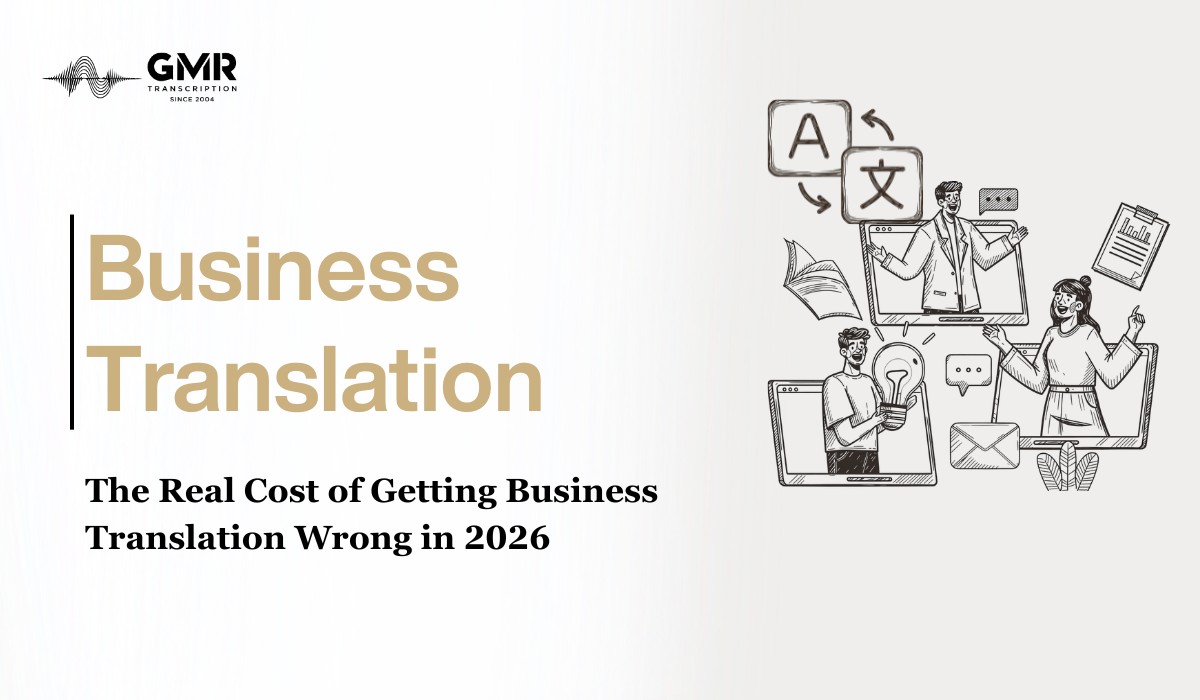
Most companies treat translation as a procurement decision. Find a vendor, compare rates, pick the cheapest one that promises accuracy. The problem is that framing (translation as a commodity input) is what leads to $10 million product recalls, voided contracts, and failed market entries.
The global translation services market is on track to hit $65 billion in 2026. That's not a market built on convenience. It's a market built on consequence: the recognition, often painful, that language errors in professional contexts don't stay small.
Here's what the generic articles on this topic won't tell you: not all business translation is the same problem. The failure modes are different. The expertise required is different. And in an era where DeepL and GPT-4 can produce fluent-sounding output in seconds, the gap between what looks like a translation and what actually functions as one has never mattered more.
This is a breakdown of the five core types of business translation services, what each one actually requires, where the risk lives in each category, and how to tell whether you're buying real capability or just fluency.
When businesses search for technical translation services, they're usually looking for help with a specific document type: user manuals, engineering specifications, API documentation, safety guidelines, or calibration procedures. These aren't general writing tasks. The translators working in this space aren't generalists. They're subject matter practitioners who happen to work across languages.
The failure mode in technical translation is terminology drift. In technical fields, a word that shifts meaning by even a degree ("pressure" in a hydraulics manual, "tolerance" in a manufacturing spec) can produce an outcome that is dangerous rather than just inaccurate. In aerospace and medical device manufacturing, mistranslation of a single technical term between a device label and its instructions-for-use has resulted in regulatory action and product recall. These aren't edge cases.
What distinguishes a credible technical translation company is terminology management: the use of glossaries, translation memory systems, and CAT (Computer-Assisted Translation) tools like SDL Trados or MemoQ that lock in approved terminology and enforce consistency across every version and update. A technical translation process without managed terminology isn't really a technical translation process. It's proofreading with a dictionary.
GMR Transcription's technical translators are subject matter specialists, not generalists assigned to a difficult document. If you're evaluating any provider for this work, ask specifically how they handle terminology conflicts across documents, how they manage version-controlled content, and whether subject matter experts are involved in review, not just bilingual generalists.
Internal communications (HR policy handbooks, executive memos, compliance updates, performance review frameworks) carry a different kind of risk than technical documentation. The risk isn't safety. It's credibility.
When a global company communicates a restructuring to employees across 12 countries, the translated documents don't just need to be accurate. They need to land with the same weight, tone, and authority in Mandarin or Portuguese as they do in English. A policy that sounds firm in English and vague in its German translation creates two different organizations: one where employees understand exactly what's expected, and one where they're guessing.
This is why professional corporate translation services begin with a style guide, not a word count. Tone consistency is not automatic. The formality register that works in American English doesn't map directly onto German business communication, or Japanese organizational language, or Arabic professional correspondence. Getting the content right is necessary but not sufficient. Getting the register right is what makes the communication actually function.
The companies that get this right treat corporate communication translation the same way they treat internal communications themselves: as a strategic function, not a formatting task. GMR Transcription works with businesses on exactly this level, providing USA-based human translators who understand the professional register requirements of each target market, not just the vocabulary.
This is where the most costly misunderstandings live.
CSA Research's landmark "Can't Read, Won't Buy" study, now in its third edition covering 8,709 consumers across 29 countries, found that 76% of online shoppers prefer to buy products with information in their native language. Forty percent say they will never buy from websites in other languages at all. A multilingual website doesn't cost a business a rounding error. It costs or earns a meaningful share of an addressable market.
But here's the distinction most marketing translation services don't surface clearly enough: translating your marketing content and localizing it are two different operations.
Translation converts words. Localization converts meaning. A headline that works in US English because it's wordplay on a cultural reference doesn't translate. It needs to be reconceived for the target market. A product description that emphasizes individual achievement may underperform in markets where collective benefit resonates more strongly. Color choices, imagery, pricing display conventions, even the direction your call-to-action arrows point: these carry meaning that translation alone can't address.
The specific discipline for high-stakes marketing content is transcreation, which is translation with creative license, used when the emotional impact of the source content must survive the language shift intact. Transcreation is standard practice in global advertising and campaign work. It's the reason the same campaign can feel native across 15 markets rather than obviously borrowed from somewhere else.
For website translation specifically, the technical layer matters too. Multilingual SEO (implementing hreflang attributes correctly, building language-specific URL structures, optimizing for regional search intent) is what determines whether your localized site actually gets found. A beautifully translated website on a broken hreflang structure will fail the same way an English-only site fails: invisibly.
Medical, pharmaceutical, financial, and scientific document translation services are not subspecialties of translation. They are their own disciplines. The language in these fields isn't incidentally technical. It's technically precise by design, because the consequences of imprecision are either legally binding or biologically consequential.
In medical and pharmaceutical translation, the FDA and EMA impose specific requirements on the translation of clinical documentation, patient information leaflets, and drug labeling. These aren't suggestions. Regulatory submissions that fail language accuracy standards can be rejected or trigger audits. A 2021 study published in the Journal of General Internal Medicine found that Google Translate produced medically significant errors in emergency department instructions, errors that could have affected patient care if acted upon without review.
In pharmaceutical manufacturing, translation memory isn't just a quality tool. It's a compliance tool. Every version of a translated document needs to be traceable, auditable, and consistent with prior submissions. Providers who don't operate under ISO 17100 certification in these contexts are not operating to standard.
The evaluative criterion is straightforward: does the translator have domain-specific credentials, not just language credentials? A bilingual generalist who is also a nurse is not the same as a medical translator with clinical documentation experience and a regulatory background. They may produce equally fluent output. They will not produce equally reliable output.
Legal translation carries a specific burden that separates it from every other category: the translated document is often legally enforceable. A contract that has been translated bears the weight of the original. An error in translation doesn't just miscommunicate. It can alter liability, change contractual obligations, or invalidate the agreement entirely.
A 2024 cross-border merger dispute resulted in a $5 million settlement after a liability clause was mistranslated, creating an ambiguity neither party had intended. A Journal of Legal Linguistics review found that machine-translated legal texts contained critical errors (mistranslated clauses, omitted obligations, mischaracterized liabilities) in 38% of reviewed samples. These are not drafting errors. They are translation errors that produce legal consequences.
The standard for certified legal translation is attestation: a qualified translator formally confirms that the translation is accurate and complete. Notarized translation, where a notary verifies the translator's credentials and signature, is required for court submissions, immigration filings, and certain regulatory documents in most jurisdictions. These are distinct services with different procedural requirements. A provider that conflates them, or who doesn't know the difference, isn't the right provider for legal work.
What matters most in legal document translation is the translator's familiarity with the legal systems on both sides of the language pair, not just the languages themselves. Legal terms don't have direct equivalents across legal systems. They have functional equivalents that require interpretive judgment. "Force majeure" in French law carries specific jurisprudential meaning that doesn't translate mechanically into common law contexts. Getting this right requires a translator who understands both systems.
The practical guidance for legal translation procurement is the same as for any other high-stakes professional service: ask for credentials, ask for a sample on a representative document, and build the relationship before you need it urgently. Rushed legal translation under deadline pressure is where errors concentrate. GMR Transcription's legal translators are USA-based human professionals with legal domain experience, not generalists handed a contract and a deadline.
None of this discussion is complete without addressing the obvious: AI translation tools have improved dramatically. DeepL, Google Translate, and LLM-based translation systems produce output that is often fluent enough to pass casual review.
The question isn't whether AI translation is impressive. It is. The question is what "fluent" is worth in contexts where the cost of an error is a regulatory penalty, a legal dispute, a product recall, or a failed market entry.
AI translation is genuinely useful for internal, low-stakes content: drafts that will be reviewed by native speakers, rough translations for internal comprehension, high-volume content where speed outweighs precision. The professional translation industry increasingly uses AI as part of human-led workflows, where AI generates a first draft and human translators review, edit, and apply subject-matter and cultural judgment. This process is called Machine Translation Post-Editing (MTPE) and it's now standard practice in most high-volume, mid-stakes workflows.
What AI translation cannot reliably deliver, even in 2026: cultural adaptation, legal precision, regulatory compliance, and accountability. When a translation is wrong and the consequences are material, the question of who is responsible matters. A qualified human translator carries professional liability. An AI tool does not.
This is precisely why GMR Transcription's business translation services are 100% human. Not because AI translation is useless, but because in the contexts where businesses actually need a translation provider, fluency is the floor, not the ceiling. Subject matter knowledge, cultural judgment, legal accountability, and consistency across complex documents are what the work actually requires.
The five categories above are not an exhaustive taxonomy. They're a framework for asking better questions before you hand critical business content to any translation provider, human or otherwise. What are the failure modes in this specific category? What expertise does the provider actually have, not just claim? And what happens to your business if this translation is wrong?
Answer those questions honestly and the vendor selection process becomes considerably easier.