
Beth Worthy
3/25/2026



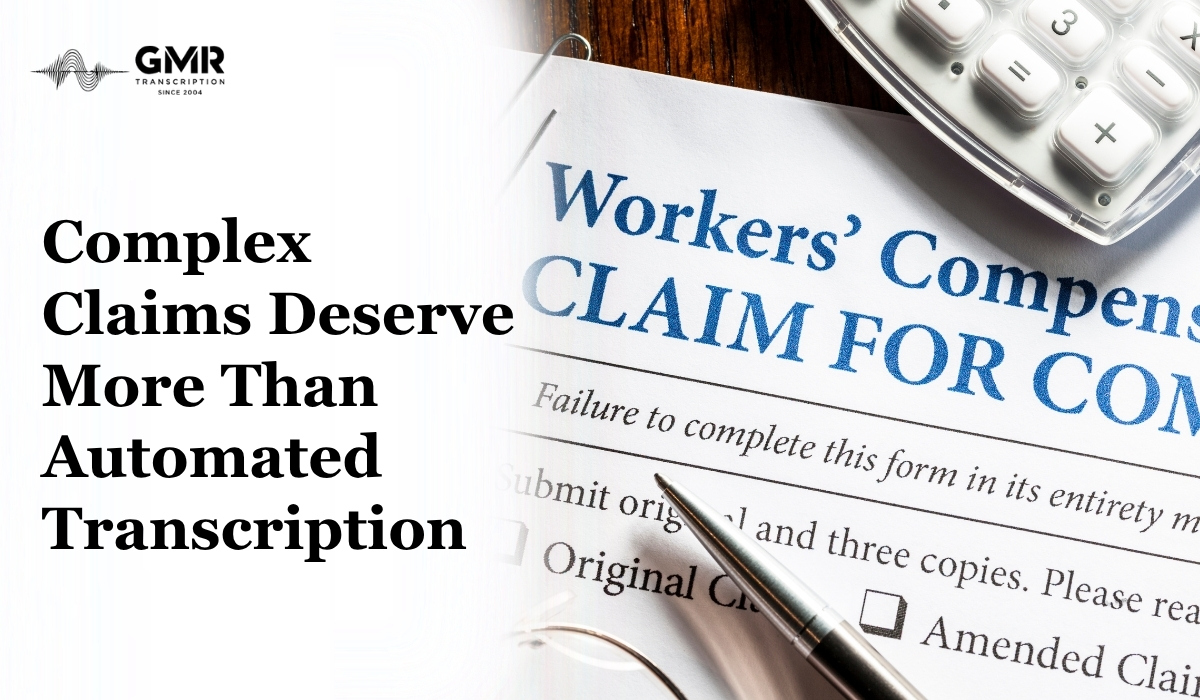
Workers’ compensation claims depend on accurate documentation from the earliest stages of reporting through final resolution. Recorded statements, medical discussions, employer reports, and investigative interviews all contribute to a claim file that may be reviewed multiple times across its lifecycle.
Each interaction carries details that influence claim evaluation, liability determination, and benefit decisions. The clarity of documentation directly affects how these details are interpreted.
Transcription plays a central role in converting recorded conversations into structured records. As part of broader insurance transcription services, this process supports consistency, clarity, and accessibility across claim documentation. While AI has made transcription faster and more accessible, complex workers’ compensation cases require a level of accuracy and contextual understanding that extends beyond automated output.
Workers’ compensation claims involve multiple stakeholders and evolving narratives. Employees, employers, medical professionals, adjusters, and legal representatives may all contribute information throughout the claim process.
These conversations often include detailed descriptions of workplace incidents, medical terminology related to injuries and treatment, timelines of events, and statements that influence liability decisions.
As claims develop, documentation becomes the foundation for evaluating consistency, identifying discrepancies, and supporting decisions. This evolving narrative often spans multiple interactions, making it difficult to track without a structured record.
Insurance transcription services address this by converting conversations into organized transcripts that preserve both detail and context, ensuring every stage of the claim remains clear and accessible.
AI transcription systems rely on automatic speech recognition technology to convert audio into text. These systems perform effectively in controlled environments with clear audio and predictable speech patterns. Workers’ compensation conversations rarely follow those conditions.
Recorded interactions may include overlapping dialogue, emotional responses, varied accents, and technical terminology. Medical language requires precision, and even minor inaccuracies can affect interpretation.
AI systems process speech using probabilities. When clarity decreases or terminology becomes specialized, transcription accuracy declines. These inaccuracies may appear minor, yet they can alter how statements are understood within the claim file.
AI-driven systems also depend heavily on data patterns rather than situational understanding. In complex claim environments, meaning often depends on how statements relate to each other, how intent is expressed, and how context evolves across conversations. In these scenarios, contextual interpretation becomes essential for preserving accuracy in documentation.
In complex cases, misinterpretation of recorded statements can influence liability assessment, delay claim resolution, and introduce risk into the documentation process. Human-led insurance transcription services provide the level of accuracy required to reduce this risk.
| Criteria | AI Transcription | GMR Transcription (Human) |
|---|---|---|
| Speaker Identification | ✖ Inconsistent with overlapping speakers | ✔ Accurate speaker labeling with review |
| Context Understanding | ✖ Misses nuance and intent | ✔ Captures context and meaning |
| Accuracy in Complex Cases | ✖ Drops with noise and technical terms | ✔ High accuracy in complex recordings |
| Overlapping Speech | ✖ Merges or misattributes speech | ✔ Separates speakers correctly |
| Consistency | ✖ Varies between files | ✔ Consistent terminology and format |
| Quality Control | ✖ Limited validation | ✔ Multi-level human review |
| Claims Readiness | ✖ Requires editing before use | ✔ Ready-to-use transcripts |
| Turnaround Time | Instant output | Fast with accuracy balance |
Workers’ compensation cases depend on context as much as content. A statement carries meaning based on how it is expressed, when it occurs, and how it connects to other parts of the claim.
Transcription professionals interpret conversations within context. They follow the progression of dialogue, recognize terminology, and preserve meaning even when audio conditions are challenging.
This contextual understanding ensures that transcripts reflect intent, not just words. It supports accurate interpretation of medical information, clear linkage between statements, and consistency across multiple interactions.
The challenge extends beyond capturing speech to interpreting language itself. Even in controlled scenarios, AI systems face difficulty when phrasing becomes nuanced or meaning shifts within a conversation. In real-world claim documentation, where clarification, repetition, and evolving narratives are common, this limitation becomes more pronounced.
In complex claims, loss of context can lead to incorrect assumptions, which may affect claim evaluation, dispute outcomes, and overall decision-making.
Talk to our team about secure, accurate legal transcription by human experts.
Workers’ compensation claims often involve multiple participants within a single recording, with interviews, statements, and consultations capturing overlapping perspectives. This multi-speaker environment makes accurate speaker identification challenging, particularly when voices overlap or shift rapidly.
AI transcription systems attempt to assign speakers, but inconsistencies can affect clarity and attribution. Human transcriptionists address this by carefully reviewing recordings to ensure each speaker is correctly identified and labeled.
Within structured insurance transcription services, this level of precision supports a consistent narrative across the claim file, enabling adjusters, investigators, and legal professionals to clearly understand how statements connect and evolve.
Workers’ compensation cases frequently involve individuals describing injuries and workplace incidents in real time. Conversations may include pauses, interruptions, and emotional expression.
These elements influence how statements are understood and interpreted within the claim.
Human transcription professionals account for these dynamics by preserving clarity while maintaining the structure of the conversation. This approach ensures that transcripts remain usable for review, analysis, and decision-making.
Disputes may arise during workers’ compensation claims, particularly when liability, timelines, or injury details are questioned.
Transcripts provide a structured record that can be reviewed during dispute resolution. They support comparison of statements, identification of inconsistencies, and evaluation of evidence.
For a broader perspective on why insurers rely on structured documentation, see Why Do Insurance Firms Require Transcription Services?, which explores how transcription supports operational and compliance needs across insurance workflows.
Accurate transcripts strengthen the reliability of the claim file and support fair resolution processes.
AI transcription offers speed, which supports preliminary review. However, complex claims often require additional time to verify and correct automated transcripts.
Reviewing AI-generated text may involve correcting terminology, verifying speaker attribution, and restructuring unclear sections. This process can extend the time required to produce a usable document.
Human-led transcription services deliver transcripts that are prepared with accuracy from the outset. This reduces rework and supports efficient claim handling.
Operational efficiency is achieved through reliable documentation rather than repeated correction.
Workers’ compensation claims operate within regulatory frameworks that require clear and consistent documentation. Records may be reviewed by regulatory authorities, legal teams, and internal compliance functions.
Transcripts support these requirements by providing structured and accessible documentation. Accuracy and consistency reduce ambiguity and support effective review.
Human transcription aligns with these expectations by producing records that reflect conversations with clarity and precision.
Complex workers’ compensation claims involve multiple variables, evolving narratives, and high-stakes decisions. Documentation serves as the foundation for evaluating these elements.
Human transcription provides contextual understanding, accurate speaker identification, precise handling of technical terminology, and reliable documentation for review.
These capabilities ensure that transcripts support decision-making rather than requiring correction.
Workers’ compensation claims rely on documentation that captures events, statements, and medical information with clarity. The quality of this documentation influences how claims are evaluated and resolved.
Artificial intelligence continues to support transcription workflows in many contexts. However, complex cases require documentation that reflects context, meaning, and accountability.
Human transcription provides this level of accuracy. It ensures that recorded conversations are converted into structured records that support claim evaluation, compliance, and dispute resolution.
Organizations managing complex claims often rely on experienced providers for this level of documentation integrity. GMR Transcription (GMRT) supports insurance workflows through human-led transcription processes designed for environments where accuracy and accountability carry operational importance.