
Beth Worthy
10/13/2026



Some English words are hard to pronounce because the spelling does not match the sound. Silent letters, spellings borrowed from other languages, tricky consonant clusters, and shifting stress all play a part, and pronunciation can also change from one region to another.
The 20 words below show these patterns at work. Each entry has a pronunciation guide, IPA where it can be verified, and a short explanation of what makes the word tricky.
In the pronunciation guides, capital letters mark the stressed syllable, "uh" is the weak vowel in "about," and "oo" is the vowel in "book." IPA is the International Phonetic Alphabet. US and UK versions are shown when they differ, and entries say so when dictionaries list more than one accepted pronunciation.
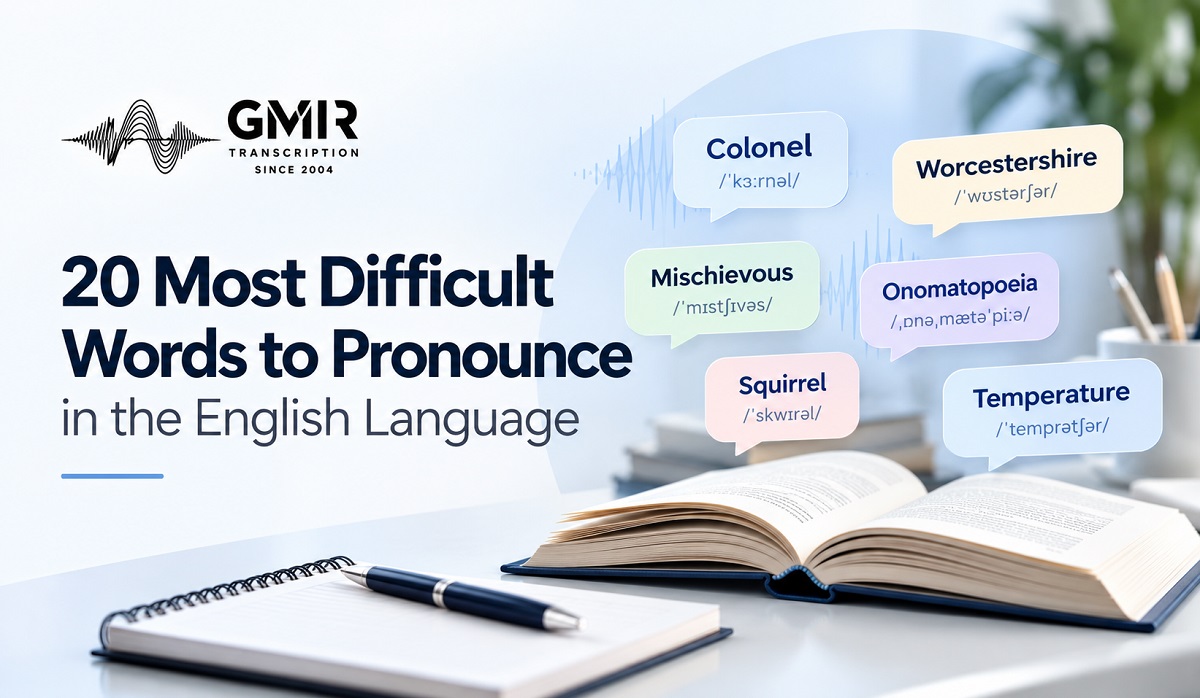
Say it: KER-nul. IPA: US /ˈkɜːrnl/, UK /ˈkɜːnl/.
It sounds exactly like "kernel," even though the spelling has two l's and no r. English borrowed the word from French "coronel," which came from Italian "colonnello." The spelling was later changed back to match the Italian, but the r-sound pronunciation had already taken hold.
Say it: WOOS-ter-sheer (US) or WOOS-tuh-shuh (UK). IPA: US /ˈwʊstərʃɪr/, UK /ˈwʊstəʃə/.
Most of the letters in "Worcester" are silent, so it sounds like "WOOS-ter." The "-shire" ending is weak in British English ("shuh") and often sounds like "sheer" or "sher" in American English. Merriam-Webster lists both American endings, so neither is an error.
The sauce is named for Worcestershire, the English county where it was first made. Oxford Learner's Dictionaries also lists the shorter name "Worcester sauce."
Say it: MIS-chuh-vus. IPA: /ˈmɪstʃɪvəs/.
The word has three syllables, with stress on the first. Many speakers add a fourth and say "mis-CHEE-vee-us," perhaps because the letters "ie" and "ious" look like they hold extra syllables. Merriam-Webster notes that this pronunciation, and the matching spelling "mischievious," have a long history but are still considered nonstandard.
Say it: DRAFT. IPA: UK /drɑːft/, US /dræft/.
Draught is the British spelling of "draft" and is pronounced the same way. The "gh" is silent. British English uses it for a current of cool air, beer served from a keg ("on draught"), a drink taken in one swallow (formal), and the board game draughts, which Americans call checkers.
American English spells the air-current and beer senses "draft." Both spellings come from the same Old English root, related to "draw," and British English still uses "draft" for a rough version of a document.
Say it: KEEN-wah or kee-NOH-uh. IPA: /ˈkiːnwɑː/.
Merriam-Webster and Oxford Learner's Dictionaries both list two pronunciations: the two-syllable "KEEN-wah," given first, and the three-syllable "kee-NOH-uh." The spelling-based "KWIN-oh-uh" does not appear in either entry.
The word came into English from Spanish, which took it from Quechua, an Andean language. In Spanish, "qu" before "i" or "e" stands for a k sound.
Say it: on-uh-mat-uh-PEE-uh (six syllables). IPA: US /ˌɑːnəˌmætəˈpiːə/, UK /ˌɒnəˌmætəˈpiːə/.
The main stress falls on "PEE," near the end, and the "-oeia" ending sounds like "ee-uh." The word names the use of words that imitate the sounds they describe, such as "buzz" and "hiss." Say the six syllables one at a time and the long spelling becomes manageable.
Say it: SIZ-erz (US) or SIZ-uz (UK). IPA: US /ˈsɪzərz/, UK /ˈsɪzəz/.
The "sc" spelling makes a single s sound, as in "scene" and "science," so the c is silent. The double s in the middle sounds like z, as in "dessert," and so does the final s. Scissors is a plural noun, so you cut with "scissors" or "a pair of scissors."
Say it: uh-NEM-uh-nee (four syllables). IPA: /əˈneməni/.
The final "e" is not silent. It sounds like "ee," a pattern that also appears in Greek-derived words such as "synecdoche" later in this list. The stress falls on the second syllable, so the ending does not rhyme with "phone." The word names a flowering plant and, in "sea anemone," a marine animal.
Say it: IS-mus. IPA: /ˈɪsməs/.
An isthmus is a narrow strip of land, with water on both sides, that joins two larger areas of land, as in the Isthmus of Panama.
The spelling comes from Greek. The "th" is written but is not sounded in standard dictionary pronunciations. Saying s, th, and m back to back is awkward, and both Merriam-Webster and Oxford show "IS-mus."
Say it: oh-toh-ry-noh-lar-un-GOL-uh-jist (nine syllables).
This is the medical term for an ear, nose, and throat specialist, often shortened to "ENT doctor." It is built from three word parts: oto- (ear), rhino- (nose), and laryngo- (larynx), plus -logist. Say each part separately, then join them. The shorter "otolaryngologist" means the same thing.
Say it: SKWER-ul (US) or SKWIR-ul (UK). IPA: US /ˈskwɜːrəl/, UK /ˈskwɪrəl/.
The difficulty is the ending. After the opening "skw" sound, the r and l come one right after the other with only a weak vowel between them. Practice by saying "skwer" first, then adding "ul."
Merriam-Webster marks that weak vowel as optional in American English, so some speakers use one syllable and others use two. It lists "SKWIR-ul" as chiefly British.
Say it: ig-nuh-MIN-ee-us (five syllables). IPA: /ˌɪɡnəˈmɪniəs/.
This adjective describes something humiliating or shameful, as in "an ignominious defeat." The stress falls on the third syllable, "MIN." The root is the Latin word for "name," so the word suggests a lost reputation.
Say it: suk-SES-ful (three syllables). IPA: /səkˈsesfl/.
The double c is the challenge. Before "e" or "i," "cc" usually sounds like k plus s, as in "accept" and "accident," so the word starts "suk-SES." The stress falls on the second syllable, and the ending is weak, closer to "fl" than to the word "full."
Say it: SIKSTH (one syllable). IPA: /sɪksθ/.
The ending packs three consonant sounds together: k, s, and th. Merriam-Webster lists versions with and without a "t" before the "th," plus simplified forms that drop the "th." Say "six" first, then slide the tongue forward for the "th" without adding a vowel.
Say it: fuh-NOM-uh-non. IPA: US /fəˈnɑːmɪnən/, UK /fəˈnɒmɪnən/.
Phenomenon is singular, and phenomena (fuh-NOM-uh-nuh) is the plural. The "ph" sounds like f, and the stress falls on the second syllable. A phenomenon is a fact or event, especially in nature or society, that is observed but not yet fully understood. It can also mean a remarkable person or thing.
Merriam-Webster still calls singular "phenomena" borderline. North American English also allows the plural "phenomenons" for the second meaning.
Say it: ROOR-ul (US) or ROO-uh-rul (UK). IPA: US /ˈrʊrəl/, UK /ˈrʊərəl/.
The challenge is the sequence r, vowel, r, l. The tongue shapes the r twice with a short vowel between, then moves to l. Say "ROOR" slowly, then add "ul." The British form adds a small extra vowel glide in the first syllable.
Say it: spuh-SIF-ik. IPA: /spɪˈsɪfɪk/.
The letter c makes two different sounds in one word: s in the stressed syllable, before "i," and k at the end. The stress falls on the second syllable. As a general rule, c sounds like s before "e," "i," or "y," and like k elsewhere.
Say it: suh-NEK-duh-kee (four syllables). IPA: /sɪˈnekdəki/.
As in "anemone," the final "e" sounds like "ee." The stress falls on the second syllable. Synecdoche is a figure of speech in which a part stands for the whole, or the whole for a part. Saying "Australia lost by two goals" to mean the national team is one example.
Say it: TEM-pruh-chur, TEM-per-chur, or TEM-per-uh-chur. IPA: /ˈtemprətʃər/.
The spelling suggests four syllables (tem-per-a-ture), but dictionaries list pronunciations with three or four. Merriam-Webster marks the weak vowel after the "p" as optional. The "-ture" ending sounds like "chur," as in "picture" and "future."
Say it: OFF-en or OFF-ten. IPA: US /ˈɔːfn/ or /ˈɔːftən/, UK /ˈɒfn/ or /ˈɒftən/.
Merriam-Webster and Oxford Learner's Dictionaries both list versions with and without the "t," and neither is marked as nonstandard. The spelling includes a t, but many speakers leave it silent while others sound it. Neither is wrong, so use the version that fits your own accent.
GMR Transcription also has a video on this topic.
Most of the difficulty comes from a gap between how English words are spelled and how they sound. Several patterns repeat across the list.
The same gap between speech and spelling is a daily challenge for anyone who writes down spoken words. Professional transcriptionists have to hear "kernel" and know when the context calls for "colonel." Specialized fields add vocabulary of their own, as the examples of commonly misheard legal terms show.
It depends on the speaker's first language and accent, so there is no single hardest word. In this list, "otorhinolaryngologist" is the longest, "sixth" and "squirrel" pack difficult consonant sounds together, and "colonel" and "isthmus" have spellings that do not match their sounds.
"Mischievous" is often given an extra syllable ("mis-CHEE-vee-us"), which dictionaries label nonstandard. Words with silent or unexpected letters, such as "colonel," "draught," and "scissors," also cause trouble. Differences like "often" with or without the "t" are accepted variants, not errors.
Listen to reliable audio, repeat the word aloud in short daily sessions, and learn the stressed syllable of each word. Recording yourself and comparing the result with a dictionary's audio helps you hear the difference.
Pronunciation spelling uses ordinary English letters, such as "KER-nul," so it is easy to read but varies from one source to the next. IPA uses a standard set of symbols, so it is more precise, but it takes time to learn. It also differs by accent, so US and UK versions are shown separately.
Need accurate transcripts of recorded speech?
GMR Transcription provides human transcription by trained, U.S.-based transcriptionists. Every transcript is completed and proofread by people, so names, terms, and difficult words are handled with care.