


Beth Worthy
8/10/2026



A research question is the specific, answerable question that a study is designed to investigate. It defines what the researcher wants to find out, narrows a broad topic into something manageable, and guides decisions about methodology, data collection, and analysis. Whether you are drafting a dissertation proposal, planning a market research study, or preparing an interview guide, a well-defined research question helps keep the project focused.
A strong research question does more than state a topic. It gives the study a clear direction and helps determine what evidence needs to be collected and how that evidence should be examined. This guide explains what a research question is, why it matters, what makes one effective, the major types of research questions, and how research questions differ from related concepts such as research problems, hypotheses, and interview questions. It also looks at how qualitative research can move from a research question to interviews, transcripts, coding, and analysis.
A research question is a clear, focused statement, phrased as a question, that identifies exactly what a study intends to discover, explain, or evaluate. It names the population, phenomenon, or variables under investigation and sets the boundaries of the inquiry.
For example, "How does remote work affect employee productivity in mid-size technology companies?" is a research question. It specifies the phenomenon (remote work), the outcome of interest (productivity), and the population (employees at mid-size technology companies).
A research question sits in the middle of a larger sequence. It emerges from a broader research topic, is sharpened by an identified research problem, and eventually leads to a chosen methodology, whether that means surveys, experiments, interviews, or document analysis. Every later decision, including sample size, data collection method, and analysis technique, should trace back to the research question.
A well-formed research question does several things at once. It converts a general area of curiosity into something a researcher can actually investigate within a reasonable timeframe and budget. It gives a study direction, so that data collection stays relevant rather than sprawling into tangents. It also gives readers, reviewers, and committee members a fast way to judge whether a project is focused, feasible, and worth pursuing.
Without a defined question, a research project tends to drift. A student who sets out to "study social media" will struggle to design a survey, choose an analysis method, or even know when the project is finished. A student who asks "How does Instagram use among college students relate to self-reported body image satisfaction?" has a much clearer path from design to conclusion.
The research question also shapes methodology choice. A question that asks "how many" or "how much" typically points toward quantitative methods. A question that asks "how" or "why," especially when exploring experience or meaning, typically points toward qualitative methods. Getting the question right early prevents a mismatch between what a researcher wants to know and how they try to find it out.
Researchers and methodology guides commonly evaluate research questions against a shared set of criteria. A useful shorthand, sometimes summarized with the acronym FINER (feasible, interesting, novel, ethical, relevant), captures most of what reviewers look for.
| Criterion | What It Means |
|---|---|
| Clear | The question uses specific, unambiguous language. A reader should not need to guess what is being asked. |
| Focused | The question addresses one central issue rather than several loosely related ones. |
| Researchable | The question can be answered using observable, collectible data or existing literature, not opinion or speculation alone. |
| Feasible | The question can realistically be answered with the time, budget, access, and sample size available. |
| Complex enough | The question requires analysis and synthesis, not a simple yes-or-no or a fact easily found in a single source. |
| Relevant | The question connects to an identified gap, problem, or need in the field or the population being studied. |
| Ethical | The question can be investigated without causing harm and, where human subjects are involved, can pass ethical review. |
A quick way to test a draft question is to compare a weak version against an improved one.
| Weak Research Question | Why It's Weak | Improved Research Question |
|---|---|---|
| Is social media bad for teenagers? | Vague, framed as a yes/no answer, and assumes a negative outcome. | What is the relationship between daily social media use and self-reported anxiety levels among high school students? |
| What is leadership? | Too broad; this is a definitional question, not a researchable one. | How do first-time managers in the retail sector describe their transition into a leadership role? |
| Does exercise help people? | Too general to guide any specific data collection. | What effect does a 12-week moderate-intensity walking program have on resting heart rate in adults aged 50 to 65? |
A strong question also matches its scope to the project. A single undergraduate paper cannot answer a question sized for a multi-year, multi-site study, and a narrow single-site case study question will feel underpowered for a national policy report.
Research questions are often grouped by the kind of relationship or information they seek. Five types cover most academic and applied research.
Descriptive.
These questions ask what something is, how common it is, or what its characteristics are, without testing a relationship between variables. Example: "What are the most common barriers to healthcare access reported by rural residents?"
Comparative.
These questions examine differences between two or more groups, conditions, or time periods. Example: "How does customer satisfaction differ between in-store and online grocery shoppers?"
Relationship-based.
Also called correlational questions, these ask whether and how two or more variables are associated. Example: "What is the relationship between sleep duration and academic performance among college students?"
Exploratory.
These questions investigate a phenomenon that is not yet well understood, often when little prior research exists. Example: "How do small business owners experience the process of adopting artificial intelligence tools?"
Explanatory.
These questions go a step further than relationship-based questions by asking why or how a relationship exists, often examining cause and effect. Example: "Why do employees at hybrid workplaces report higher rates of burnout than fully remote employees?"
These categories are not mutually exclusive. A single dissertation might include a descriptive question to establish baseline patterns, followed by a relationship-based or explanatory question to dig into causes.
Qualitative research questions explore meaning, experience, process, and context. They tend to start with "how" or "why" and avoid predicting a specific outcome, because the goal of qualitative research is usually to understand a phenomenon in depth rather than to measure it numerically.
Typical qualitative research question starters include:
Example: "How do first-generation college students describe their sense of belonging during their first year on campus?"
Qualitative questions are open by design. They are meant to invite rich, descriptive answers rather than a number, a rate, or a binary outcome. This is why qualitative research questions pair naturally with interviews, focus groups, ethnographic observation, and open-ended surveys.
Quantitative research questions ask about measurable variables, and they are structured to be answered with numerical data, statistical testing, or defined metrics. They tend to start with "what," "how many," "how much," or "to what extent."
Common quantitative question structures include:
Example: "To what extent does weekly study time predict final exam scores among undergraduate statistics students?"
Quantitative questions typically lead to hypothesis testing, statistical analysis, and structured data collection instruments such as surveys with closed-ended items or experimental protocols.
| Feature | Qualitative Research Question | Quantitative Research Question |
|---|---|---|
| Typical starters | How, why, what meaning | What, how many, to what extent |
| Goal | Understand experience, process, or meaning | Measure, quantify, or test a relationship |
| Data type | Words, narratives, observations | Numbers, rates, statistical values |
| Common methods | Interviews, focus groups, case studies | Surveys, experiments, existing datasets |
| Analysis approach | Coding and thematic analysis | Statistical testing |
Mixed-methods studies use both types, often opening with a qualitative question to explore a phenomenon and following with a quantitative question to test what emerged.
The following examples show how the same underlying skill, narrowing a topic into an answerable question, plays out across fields.
Education
Business
Sociology
Psychology
Market Research
Qualitative Research
Quantitative Research
Writing a strong research question is rarely a one-step process. It usually develops through several rounds of narrowing.
Start with a broad topic.
Choose an area you have genuine interest in and some background knowledge of, such as remote work, adolescent mental health, or small business marketing.
Do preliminary reading.
Skim recent literature to see what has already been studied, where gaps exist, and what methods other researchers have used. This step often reveals whether your initial idea is already well-answered or genuinely open.
Identify the research problem.
Pin down the specific gap, tension, or unresolved issue your project will address. This is the justification for the study, not the question itself.
Draft a preliminary question.
Turn the problem into a question. At this stage it is fine if the question is still somewhat broad.
Apply the quality criteria.
Check the draft against clarity, focus, feasibility, and relevance. Ask whether the question can realistically be answered with the time, access, and resources available.
Decide on qualitative, quantitative, or mixed framing.
Determine whether you are trying to measure a relationship, test a prediction, or understand an experience, and adjust your question's wording accordingly.
Narrow the scope.
Add specificity around population, setting, timeframe, or variables until the question could realistically be answered within your study's boundaries.
Test it against your methodology.
Make sure the question actually matches the data collection method you plan to use. A question asking "why" rarely gets answered well by a closed-ended survey.
Revise as the project develops.
It is common, and expected, for a research question to be refined again once a literature review or pilot study is further along.
These two terms are closely related but not interchangeable. A research problem is the issue, gap, or need that justifies why a study should happen at all. It is typically written as a statement, not a question. A research question is the specific, answerable question the study will use to address that problem.
Example: The research problem might be stated as, "Despite increased investment in employee wellness programs, burnout rates among healthcare workers continue to rise." The research question that follows might be, "What workplace factors do nurses identify as contributing most to burnout despite participation in wellness programs?"
The problem explains why the research matters. The question defines exactly what will be investigated to address it.
A research question and a hypothesis serve different functions, and confusing them is one of the more common mistakes in early-stage research writing.
A research question is open and exploratory, even in quantitative studies. A hypothesis is a specific, testable prediction about the expected relationship between variables, usually derived from theory or prior findings.
| Research Question | Hypothesis | |
|---|---|---|
| Form | Phrased as a question | Phrased as a declarative statement |
| Function | Guides what the study will investigate | Predicts a specific outcome to be tested |
| Common in | Both qualitative and quantitative research | Primarily quantitative and experimental research |
| Example | Does caffeine intake affect reaction time? | Participants who consume 200mg of caffeine will show faster reaction times than participants who consume none. |
Qualitative studies generally use research questions without hypotheses, since the goal is to explore and describe rather than to test a predicted relationship. Quantitative and experimental studies often use both: the research question frames the investigation, and the hypothesis states the specific prediction that data collection will test.
Researchers new to qualitative methods sometimes assume that a research question can simply be read aloud to a participant. In practice, research questions and interview questions operate at different levels.
A research question is the overarching question the entire study is designed to answer. It is written for the researcher and the study's methodology, not for direct conversation. An interview question is one of several specific prompts asked of a participant during data collection, designed to draw out information that will eventually help answer the research question.
For example, a research question might be, "How do remote employees experience work-life boundaries?" The interview guide built to investigate that question might include prompts such as:
No single interview question fully answers the research question on its own. Instead, the researcher analyzes patterns across many participants' answers to multiple interview questions, and those patterns are what ultimately address the broader research question.
Dissertation and thesis committees tend to scrutinize research questions more closely than any other part of a proposal, because the question determines whether the rest of the methodology chapter holds together. A dissertation research question typically needs to satisfy a few additional expectations beyond the general quality criteria already covered.
It should connect clearly to a gap identified in the literature review, so the committee can see why the study is necessary rather than a repetition of existing work. It should be narrow enough to be completed within the resources and timeline of a doctoral or master's program, which often means resisting the temptation to study an entire industry, population, or phenomenon at once. It should also align tightly with the chosen methodology chapter, since a mismatch between question and method is one of the most common reasons proposals get sent back for revision.
Many dissertations use a primary research question supported by two or three sub-questions that break the main inquiry into manageable parts. For example, a primary question such as "How do first-generation college students navigate academic advising relationships?" might be supported by sub-questions addressing communication patterns, perceived barriers, and strategies students use to build trust with advisors. This structure gives the study a clear backbone while still allowing each chapter or findings section to address a distinct piece of the puzzle.
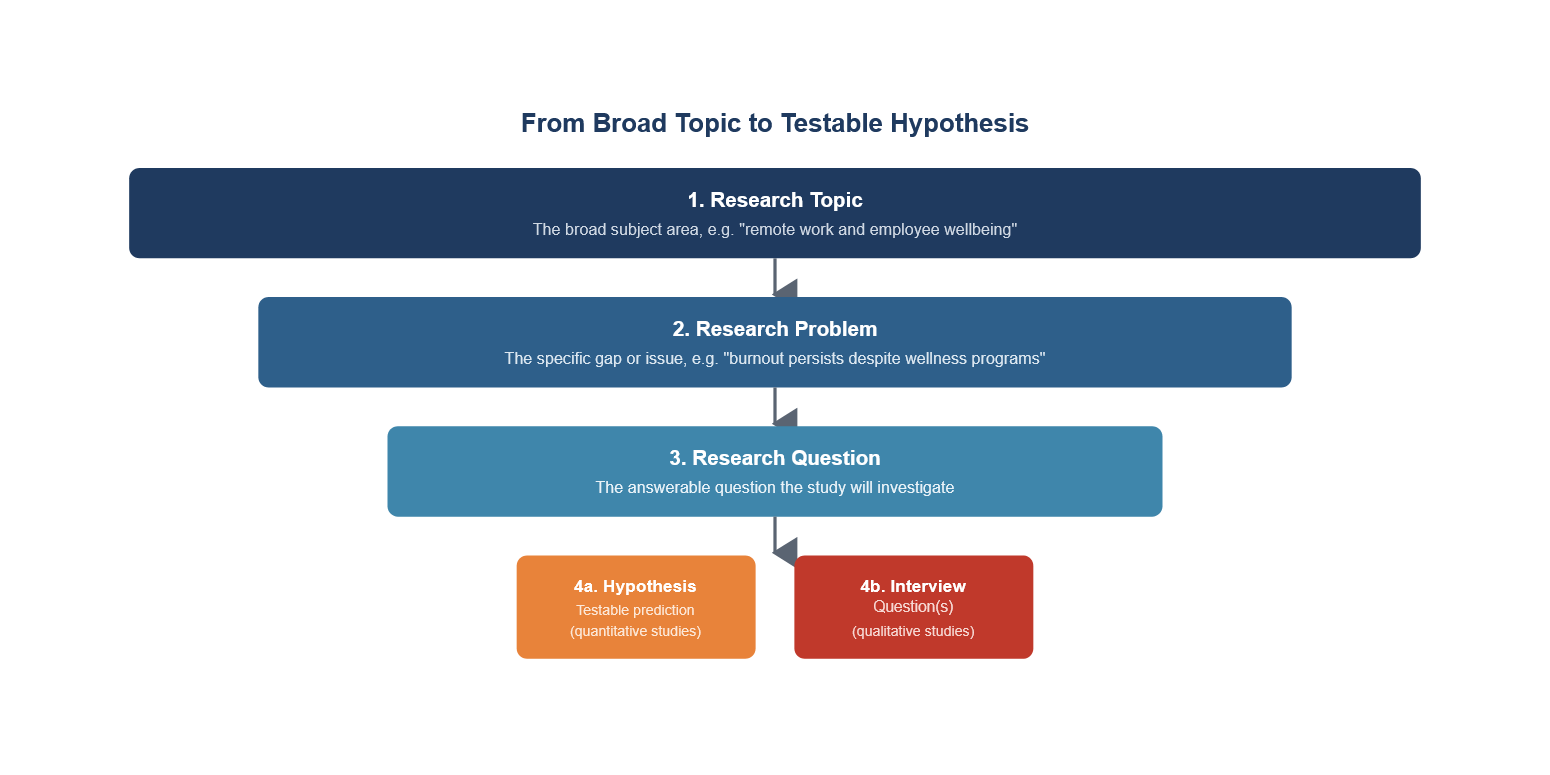
Once a research question is set, it shapes everything downstream, including how data gets collected and prepared for analysis. The general path for a qualitative study looks like this:
Research topic → Research problem → Research question → Methodology → Data collection → Interviews or focus groups → Transcript → Coding → Analysis → Findings
Not every research question requires interviews, and not every project involves transcription. A quantitative study built on survey data or an existing dataset may never touch a recording. But when a qualitative research question relies on interviews, focus groups, or oral histories, the recorded conversation eventually needs to become text before it can be coded and analyzed.
This is where transcription enters the research process. A recorded interview has to be converted into a written transcript before a researcher can apply coding, whether that coding is inductive (letting themes emerge from the data) or deductive (applying a predefined framework tied to the research question). Accurate research transcription matters here because coding depends on precise wording. A mistranscribed word, a missed qualifier, or a dropped pause can shift how a researcher interprets a participant's meaning, particularly in studies where tone, hesitation, or exact phrasing carries analytic weight.
For researchers working with a high volume of interviews, multiple speakers, or recordings that need to meet institutional review board formatting standards, professional human transcription services can be a practical part of data preparation. GMR Transcription, for example, has worked with academic researchers, including university-based projects like a postdoctoral study at Stanford analyzing caregiver-child interaction recordings, to produce accurate, formatted transcripts from interview and focus group audio. Services like verbatim transcription, timestamping, and custom formatting are commonly used in academic research settings where transcripts need to align precisely with a study's coding scheme or citation requirements.
Transcription itself does not answer the research question. It simply converts recorded data into a form that is searchable, codeable, and ready for the analysis methods, such as thematic analysis, that qualitative researchers use to move from raw conversation to documented findings.
Several patterns show up repeatedly in early drafts of research questions.
Asking a question that is really a topic. "Climate change and public opinion" is a topic, not a question. It needs a specific relationship, population, or comparison to become researchable.
Writing a yes-or-no question for a study that needs depth. "Does training improve performance?" invites a one-word answer. "How does a structured onboarding program affect new hire performance during the first 90 days?" invites investigation.
Building in an assumed answer. "Why is social media harmful to teenagers?" assumes the conclusion before the study begins. A neutral framing, such as "How does social media use relate to teenagers' self-reported wellbeing?" keeps the inquiry open.
Choosing a question that cannot be answered with available resources. A question requiring a nationally representative sample is not feasible for a single-semester independent study.
Mismatching question type and methodology. A "why" question paired with a closed-ended survey will produce shallow results, just as a "how many" question paired with unstructured interviews will produce data that is hard to quantify.
Overloading a single question with multiple variables. A question asking about the combined effects of five different factors is difficult to design a clean study around. Splitting it into a primary question and supporting sub-questions is usually more workable.
What is a research question in simple terms?
A research question is the specific question a study is designed to answer. It narrows a broad topic into something a researcher can realistically investigate using data.
What makes a good research question?
A good research question is clear, focused, researchable with available resources, relevant to an identified gap or need, and appropriately scoped for the project's timeline and methodology.
What is the difference between a research question and a hypothesis?
A research question is open and exploratory, while a hypothesis is a specific, testable prediction about the relationship between variables. Hypotheses are common in quantitative research; qualitative research typically relies on research questions alone.
What is the difference between a research question and a research problem?
A research problem is the gap or issue that justifies a study, usually stated as a problem statement. A research question is the specific question the study will answer to address that problem.
Do all research projects need interview questions or transcription?
No. Many quantitative studies rely on surveys, experiments, or existing datasets and never involve interviews or transcription. Transcription becomes relevant specifically when a qualitative study collects data through recorded interviews, focus groups, or similar spoken formats.
How many research questions should a study have?
Many studies work best with one primary research question, sometimes supported by two or three sub-questions. Too many primary questions can make a project difficult to design and complete within a reasonable scope.
Can a research question change during a study?
Yes. It is common for a research question to be refined as a literature review deepens or a pilot study reveals that the original scope was too broad or too narrow.