
Beth Worthy
8/19/2026



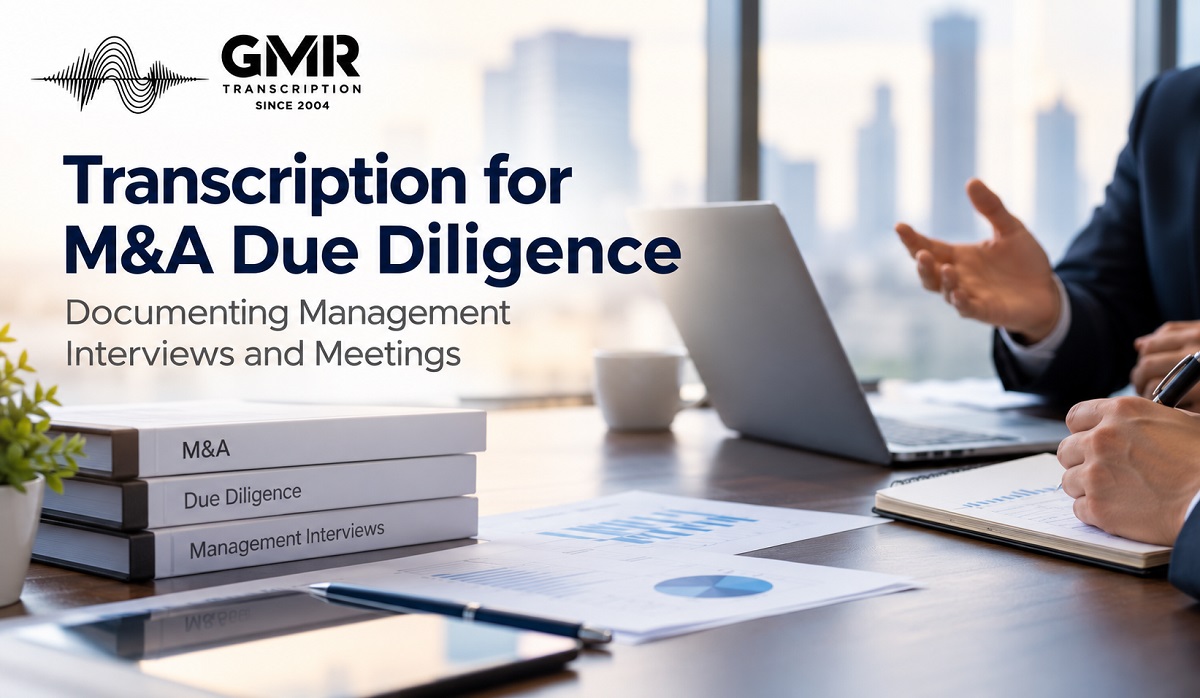
An M&A due diligence process can generate dozens of recorded conversations in a matter of weeks. Deal teams may interview senior management, former executives, key employees, suppliers, customers, industry specialists, and other stakeholders while simultaneously reviewing financial records, contracts, operational data, and the company's data room.
Those conversations often contain information that does not appear neatly in a financial model or presentation.
A CFO may explain why a margin changed. A former executive may describe how a customer relationship developed. A supplier may reveal an operational dependency. A management team may qualify a statement made in the company's confidential information memorandum.
How accurately those conversations are documented matters during the deal and after closing. M&A due diligence transcription gives deal teams a searchable, attributable record of what was actually discussed, creating another layer of documentation alongside the data room, financial analysis, legal review, and transaction records.
Management interviews are a central part of many due diligence processes, but they are rarely the only conversations that matter.
Investment teams may speak with current executives about revenue concentration, customer retention, operational risks, forecasts, technology, staffing, and growth plans. They may also conduct interviews with former executives, employees, customers, suppliers, or industry specialists to test assumptions and develop a more complete understanding of the business.
Publicly available transaction disclosures illustrate how broad these diligence activities can become. SEC filings describing investment due diligence processes, for example, include management and employee interviews as well as conversations with customers and vendors. Transaction agreements filed with the SEC can also expressly provide for buyer access to management, key personnel, books, records, and material suppliers as part of the diligence process.
That breadth creates a documentation challenge.
Deal teams may accumulate hours of recorded interviews while working under intense time pressure. Notes taken during a fast-moving conversation can capture the main point while losing the qualification that followed it. A participant may say that a revenue forecast is achievable "assuming" a particular contract renews, for example. That condition can be more important than the forecast itself.
A detailed management interview transcription preserves both.
It also allows associates, vice presidents, partners, legal advisers, and other deal participants to search the same record instead of relying on separate handwritten notes.
The value of interview records can become even more apparent after a transaction closes.
An acquisition may later involve a disagreement over an earnout, a representation or warranty, a customer relationship, a financial projection, an undisclosed liability, or another matter connected to the transaction. At that point, participants may need to reconstruct what was represented, what questions were asked, and how particular issues were discussed during diligence.
A transcript cannot automatically establish that a statement was true, nor does transcription itself determine whether a document is admissible in litigation. Those questions depend on the circumstances, applicable law, evidence rules, and the court.
Federal Rule of Evidence 803(6), for example, provides an exception for certain records of regularly conducted activity when specified conditions concerning timing, regular practice, foundation, and trustworthiness are satisfied. A transcript should therefore never be described as automatically admissible simply because it was created in the ordinary course of a transaction.
Its practical value is more straightforward.
A carefully prepared transcript gives the deal team a contemporaneous written record that can be compared with other transaction documents and the original recording. It can help counsel and other advisers understand what was discussed and identify areas requiring further factual or legal review.
This becomes particularly important when recollections diverge months or years after closing.
A recording preserves the original conversation. A well-prepared transcript makes that conversation considerably easier to locate, review, compare, and analyze.
One of the strongest uses of due diligence documentation services is also one of the least discussed: using transcripts to test the consistency of information before the transaction closes.
A deal team may review the confidential information memorandum, management presentation, financial model, customer data, contracts, and other materials before conducting management interviews. Those interviews provide an opportunity to test the assumptions contained in those materials.
The transcript creates a written record of that testing process.
Suppose the CIM describes customer concentration as stable. During an interview, a management executive explains that one major customer is considering moving part of its business to another supplier.
The interview does not automatically prove that the CIM is inaccurate. It does, however, identify a discrepancy that deserves further investigation.
The same process can apply to financial projections.
A management team may explain that expected growth depends on a specific product launch, regulatory approval, customer renewal, or expansion into a new market. A transcript can preserve those qualifications alongside the broader forecast, giving the deal team a more complete record of the assumptions behind the numbers.
This makes private equity due diligence documentation more than an archival exercise. It can become part of the team's internal accountability process.
Before signing, transcripts can help teams identify:
| What the Deal Team Is Testing | What the Transcript Can Preserve |
| Financial projections | Management explanations and qualifications behind forecasts |
| Customer concentration | Statements about renewals, dependencies, or customer risk |
| Operational performance | Explanations of capacity, staffing, systems, and processes |
| Growth assumptions | Conditions management believes must be met |
| Potential liabilities | Responses to questions about known or emerging issues |
| Strategic plans | Management's explanations of priorities and expected outcomes |
The objective is not to create a transcript simply for the sake of creating another document. It is to give the team a reliable reference when comparing spoken explanations with written representations.
A transcription workflow for M&A requires more care than ordinary meeting documentation.
Verbatim transcription is often appropriate when preserving the precise wording of an interview matters. It can retain qualifications, corrections, hesitations, and other details that an edited transcript may remove. The appropriate style should ultimately depend on how the record will be used.
Speaker identification is equally important. A transcript should make it immediately clear whether a statement came from the CEO, CFO, interviewer, former executive, supplier, or another participant. Timestamps can make important passages easier to verify against the original recording.
Confidentiality also deserves particular attention. M&A discussions can involve sensitive financial information, proprietary business information, strategic plans, customer information, and other material shared under confidentiality arrangements. Deal teams should evaluate how a transcription provider receives, processes, stores, and deletes recordings and completed transcripts.
A provider should also have a clear approach to difficult audio, multiple speakers, technical terminology, and corrections. Automated transcription can accelerate initial processing, but human review is particularly valuable when a transcript will be used to evaluate nuanced statements or compare management commentary against transaction documents.
The broader principle is simple: the transcript should preserve the conversation rather than interpret it.
The transaction may be completed, but the information gathered during diligence can remain relevant for years.
Integration teams may need to revisit management explanations. Finance teams may investigate unexpected performance changes. Legal teams may review representations and warranties. Deal teams may evaluate whether the assumptions behind an investment thesis proved accurate.
A searchable transcript can shorten that process considerably.
Instead of asking team members to reconstruct conversations from memory or search through hours of recordings, they can locate specific statements and return to the underlying audio when necessary.
That makes transcription particularly valuable when combined with the broader transaction record. The transcript does not replace the data room, financial model, legal documents, or original recordings. It complements them by creating an accessible written record of conversations that might otherwise remain difficult to retrieve.
Due diligence is designed to reduce uncertainty before an investment decision is made. Documentation plays an important role in that process because conclusions often depend on information gathered across multiple sources.
Recorded interviews provide valuable information. Accurate transcripts make that information easier to evaluate, compare, and preserve.
For investment banks, private equity firms, M&A advisers, and corporate development teams, M&A due diligence transcription can support more consistent documentation throughout the transaction while providing a useful reference if questions arise after closing.
GMR Transcription provides human-powered transcription for confidential business, financial, legal, and investigative recordings. With careful speaker identification, accurate transcription, secure handling, and support for complex conversations, GMRT helps deal teams turn recorded interviews and meetings into reliable documentation that remains useful beyond the deal room.
Working on an M&A transaction? Contact GMR Transcription to discuss confidential, accurate transcription for management interviews, diligence meetings, and other deal-related recordings.
Management due diligence involves evaluating the experience, capabilities, track record, incentives, and representations of a company's leadership team as part of an acquisition or investment review. Interviews with management and other stakeholders can help deal teams test information contained in transaction materials.
The timeline varies according to the size, complexity, industry, transaction structure, and availability of information. Some transactions move through diligence within several weeks, while complex acquisitions can require substantially longer. Interview transcription should therefore be planned around the transaction's actual workflow rather than treated as a separate activity after diligence ends.
Transcription creates a searchable written record of management and stakeholder conversations. It can help deal teams compare spoken explanations with transaction documents, preserve important qualifications, locate specific statements quickly, and maintain a more consistent record throughout the diligence process.
The potential use of a recording or transcript in litigation depends on the circumstances, applicable evidence rules, authenticity, relevance, reliability, and other legal considerations. Federal Rule of Evidence 803(6) provides a business records exception under specified conditions, but it does not mean that every transcript or recording automatically qualifies. Legal counsel should assess the specific circumstances.