
Beth Worthy
6/3/2026



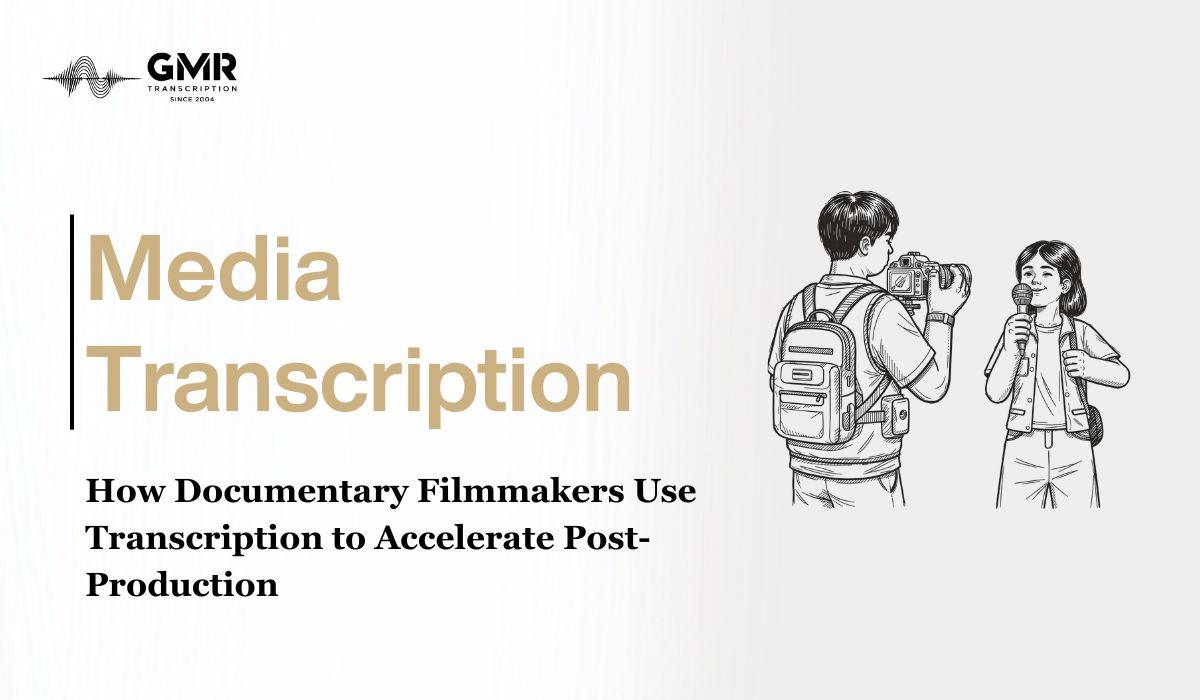
Every documentary filmmaker eventually reaches the same point in the process.
Production has wrapped. Interviews have been recorded. Hard drives are filled with footage. The director, producer, and editor sit down to begin shaping the story, knowing that the most compelling moments are buried somewhere within hundreds of hours of material.
Unlike scripted productions, documentaries are rarely assembled from a predetermined blueprint. The story often emerges through interviews, observations, and unexpected moments captured during filming. A feature-length documentary may contain dozens of interviews and hundreds of hours of footage, all competing for attention during the edit.
Without transcripts, locating a specific quote can require hours of repeated reviews of footage. With accurate transcripts, every interview becomes searchable, annotatable, and immediately accessible.
This is why documentary transcription for post-production has become a standard part of professional documentary workflows. Transcription transforms raw interview footage into a structured resource that editors, producers, and writers can work with efficiently. More importantly, the accuracy of that transcript influences how quickly and confidently the story can be built.
Documentary editing is fundamentally different from editing scripted content.
A scripted production begins with a finished screenplay. Editors know the narrative structure before footage arrives. Documentary editors work in the opposite direction. They discover the story by reviewing what people said, how they said it, and how those moments connect.
This creates a volume challenge.
A feature documentary can have anywhere between 5 and 150 interview subjects. Individual interviews often range from 30 minutes to well over an hour. Combined with observational footage, archival materials, and field recordings, the total footage volume can easily exceed several hundred hours.
No editor wants to review every minute repeatedly while searching for a single quote.
Transcription provides an alternative. Instead of navigating exclusively through video files, filmmakers gain a searchable text archive of every interview. Producers can review interviews as documents. Editors can locate key moments through keywords. Directors can evaluate narrative themes without sitting through hours of footage.
The transcript effectively becomes a searchable version of the footage library, allowing interviews to be reviewed, analyzed, and referenced far more efficiently than video alone.
One of the most valuable stages in documentary editing is the paper edit.
Before an editor begins assembling scenes, producers and directors often review transcripts to identify themes, emotional moments, and narrative turning points. Key quotes are highlighted, sections are annotated, and potential story arcs begin to emerge.
This process allows creative decisions to happen before significant editing resources are invested.
Transcripts also accelerate the creation of string-outs. Rather than scrubbing through hours of footage in real time, editors can identify promising sections directly from the transcript and jump to exact moments using timestamps.
The value continues into script development. Documentary narration, voiceover structure, and interview sequencing are frequently developed from transcript review. Writers often construct story frameworks by arranging quotes and identifying patterns across multiple interviews.
Later in the process, transcripts may become part of broadcaster deliverables, archival deposits, or Errors and Omissions insurance documentation. What begins as an editorial tool often becomes part of the project's formal documentation package.
The influence of transcription, therefore, extends throughout the entire post-production cycle.
Documentary audio presents challenges that differ significantly from controlled studio recordings.
Interviews take place in offices, homes, vehicles, public spaces, and outdoor environments. Subjects speak naturally, often without rehearsal. Conversations may include interruptions, emotional pauses, regional accents, and overlapping speech.
These conditions create complexity for transcription.
| Documentary Recording Environment | Common Audio Challenges | Impact on Post-Production |
| Field interviews | Ambient noise, weather, public activity | Reduced speech clarity |
| Remote interviews | Variable internet quality, compression | Missing or distorted words |
| Multi-subject interviews | Overlapping dialogue | Speaker identification challenges |
| International productions | Accents and multilingual content | Increased interpretation requirements |
| Observational footage | Unscripted conversations and movement | Difficult audio tracking |
For documentary storytelling, these details matter.
A hesitation before answering a difficult question may reveal more than the answer itself. A subject correcting themselves mid-sentence may provide essential context. A switch between languages may signal cultural identity or emotional significance.
These moments are often central to the story.
Human transcription preserves these nuances. It captures pauses, corrections, and contextual details that contribute to meaning. For documentary filmmakers, those details frequently become the foundation of the final narrative.
Many transcription tools emphasize speed. For documentary editors, accuracy creates far greater value.
A small error rate becomes significant when multiplied across long-form interviews.
Consider a 60-minute interview containing approximately 9,000 spoken words. Even a modest error rate can introduce hundreds of inaccuracies throughout the transcript. Those inaccuracies affect quote selection, story development, and editorial decision-making.
An editor may build a sequence around a statement that was transcribed incorrectly. A producer may flag a quote that differs from what was actually said. These issues create additional review cycles and consume valuable editing time.
The result is a slowdown in the workflow rather than an improvement.
Accurate transcription supports editorial confidence. Teams can evaluate interviews, knowing that the transcript faithfully reflects the source material. This reduces verification time and allows editors to focus on storytelling.
In documentary production, time spent correcting transcript errors is time taken away from creative work.
The most effective documentary teams treat transcription as part of production planning rather than a post-production afterthought.
Ordering transcripts while interviews are being recorded allows the documentation process to run in parallel with production. By the time editing begins, the transcript archive is already available.
Several formatting decisions also improve usability:
These decisions may seem administrative, but they directly affect editorial efficiency.
Modern editing environments increasingly support transcript-based workflows. Timestamped transcripts can integrate with systems used in Premiere Pro, Final Cut Pro, and Avid through various tools and workflows. When transcripts are formatted consistently, editors gain immediate access to searchable interview content from the beginning of the edit.
The result is a more organized, more efficient production process.
Many documentary projects extend beyond a single language or geographic region.
International productions often include interviews conducted in multiple languages, bilingual conversations, or subjects who move between languages naturally during discussion.
These projects require more than basic transcription.
Filmmakers frequently need source-language transcripts alongside English translations that preserve context and meaning. The accuracy of these translations directly affects editorial decisions, subtitle creation, and audience understanding.
Multilingual documentary projects benefit from transcription workflows that support both transcription and translation. This allows production teams to evaluate interviews consistently, regardless of the language in which they were originally recorded.
As documentary storytelling becomes increasingly global, this capability grows in importance.
Documentary filmmaking depends on finding meaning within large volumes of footage. The challenge is usually organizing and identifying the material that matters most. The challenge is identifying the moments that matter most.
Accurate transcripts transform interview footage into a searchable, organized, and collaborative resource. They support paper edits, accelerate string-out creation, simplify quote selection, and improve overall editorial efficiency.
For documentary teams, transcription is not an administrative expense. It is a production asset that saves editor hours, supports story development, and improves post-production workflows from beginning to end.
Working on a documentary project? GMR Transcription (GMRT) provides accurate, timestamped, editor-ready transcripts for documentary interviews, including multilingual transcription and translation support designed for real-world production workflows.
Register and place your order⟶
Documentary transcription is the process of converting recorded interviews, field recordings, and documentary footage into written text. These transcripts help producers, editors, and directors review, search, and organize content more efficiently during post-production.
Filmmakers use transcripts to create paper edits, identify story themes, locate important quotes, build rough assemblies, and develop narration. Timestamped transcripts allow editors to locate specific moments quickly without repeatedly reviewing footage in real time.
Documentary interview transcripts should be highly accurate because editors, producers, and writers often rely on them to identify story themes, select quotes, and build narrative structure. Even small transcription errors can alter the meaning of a statement or lead teams to spend additional time verifying footage. Accurate transcripts improve editorial efficiency while helping ensure that subjects are represented faithfully throughout the documentary.
Yes. Timestamped transcripts are one of the most valuable tools in documentary post-production. Timestamps allow editors to move directly from a quote in the transcript to the corresponding moment in the footage, eliminating the need for extensive manual searching. Consistent timestamping also supports collaboration among producers, editors, and directors by providing a shared reference point throughout post-production.