
Beth Worthy
6/24/2026



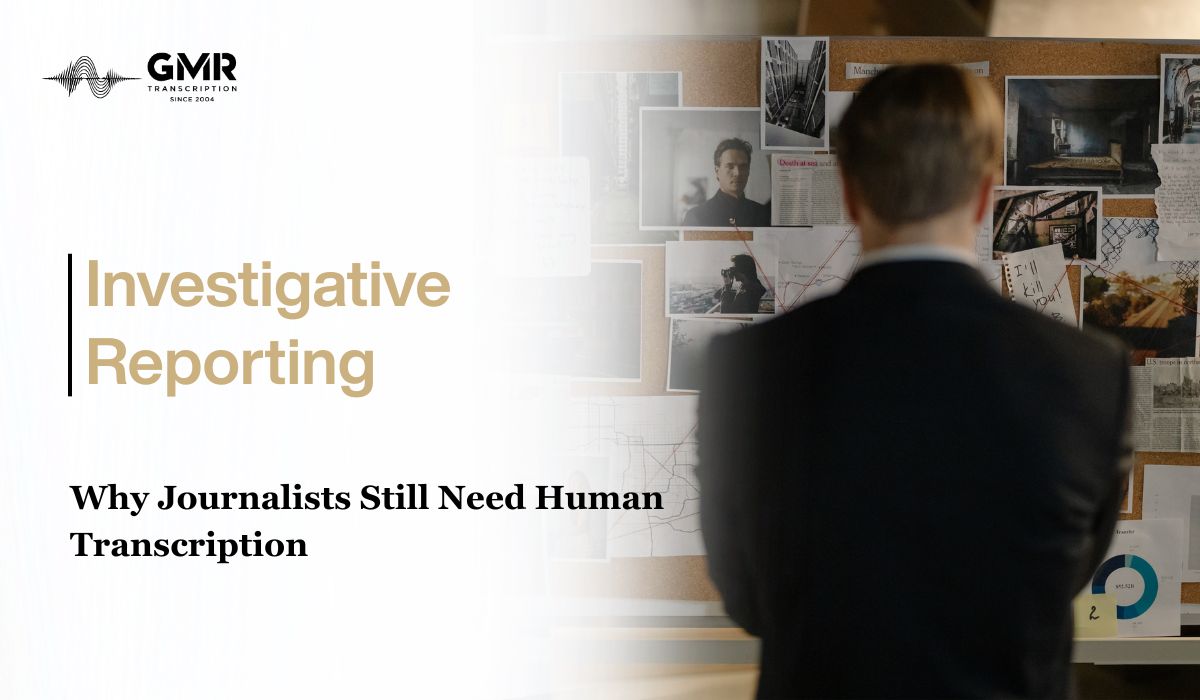
Investigative journalism depends on trust.
A whistleblower sharing evidence of regulatory misconduct, a witness documenting corruption, or a survivor describing abuse by a powerful institution often takes significant personal and professional risks before speaking to a journalist. These individuals trust that their identities, statements, and recordings will be handled with care.
That responsibility extends beyond the interview itself.
Every stage of the reporting process matters, including how recordings are stored, who has access to them, where they are processed, and how they are transcribed. A recording may contain names, allegations, confidential information, or details that could expose a source if handled improperly.
As AI transcription tools become increasingly common in newsrooms, many investigative journalists are taking a closer look at whether the convenience they offer aligns with the responsibilities they owe their sources.
The discussion is no longer just about speed. It is about accuracy, confidentiality, and risk management. For many investigative teams, secure transcription for investigative journalists has become a critical consideration in source protection strategies.
The recordings that matter most in investigative journalism are often the hardest to transcribe accurately.
Unlike studio-quality interviews or internal business meetings, investigative recordings frequently originate in challenging conditions. Sources may use secure phones, encrypted communication platforms, concealed recording devices, or remote connections with inconsistent audio quality. Interviews often take place in noisy environments, and sources may be speaking under stress, emotion, or fear.
These conditions create difficulties for any transcription process, but they create particular challenges for automated systems.
Consider the difference between a source saying:
"I was told to delete the emails."
and
"I was told to delay the emails."
The distinction is a single word. The implications are entirely different.
Investigative reporting depends on details of this nature. A transcript that substitutes one term for another can alter the interpretation of an event, a decision, or an allegation.
Speaker attribution creates another concern. Many investigative recordings contain multiple participants. A misattributed statement can change who appears responsible for a particular action or comment. In a routine meeting transcript, this may create confusion. An investigative report can affect the accuracy of the story itself.
Proper nouns introduce additional risk. The names of public officials, agencies, companies, regulations, locations, and individuals are often among the most important elements in a transcript. They are also among the terms most vulnerable to substitution when audio quality declines.
The challenge is not simply that errors occur. The challenge is that many errors look plausible.
An inaccurate transcript can appear polished, organized, and credible while still changing meaning in subtle but important ways.
Talk to our team about secure, accurate legal transcription by human experts.
A common assumption is that journalists can generate an AI transcript and then verify it against the original recording.
In practice, the process is far more complicated.
A full investigative interview may run for an hour or more. Verifying every sentence requires listening carefully to the entire recording and comparing it line by line with the transcript. The time commitment often approaches the effort required to transcribe the recording manually in the first place.
Verification also assumes that the reviewer will notice every error.
When a transcript contains obvious mistakes, they are often easy to correct. More problematic are the errors that look reasonable on the surface. A substituted name, a slightly altered phrase, or an incorrectly assigned speaker may not attract attention during review.
The result is a workflow that creates additional work while still leaving room for inaccuracies.
For investigative teams operating under deadlines, verification is not always the safety net it appears to be.
Accuracy is only one side of the equation.
Investigative journalism also requires careful consideration of operational security.
When a recording is uploaded to a commercial AI transcription platform, the journalist is transferring that source material to infrastructure they do not control. The audio is processed, stored, and managed in accordance with policies established by the platform provider.
For many routine business recordings, this may not raise significant concerns.
Investigative source material is different.
The recording itself may contain information that identifies a confidential source, reveals the existence of an investigation, or documents allegations that have not yet been published. Understanding where that information resides and who can access it becomes part of source protection.
The risks can be viewed across several areas:
| Risk Area | Why It Matters in Investigative Reporting |
| Data retention | Recordings may remain stored beyond the journalist's intended timeline |
| Third-party access | Additional parties may gain access through platform administration or support functions |
| Legal process exposure | Stored recordings may become subject to subpoenas, court orders, or government requests |
| Offshore processing | Data may move across multiple jurisdictions with different legal protections |
| AI training concerns | Recordings may be retained for quality improvement or model development purposes, depending on platform policies |
For journalists handling sensitive investigations, these considerations are not theoretical. They are part of a broader digital security framework designed to protect sources and reporting activities.
Organizations such as the Committee to Protect Journalists (CPJ) and the Reporters Committee for Freedom of the Press have long emphasized the importance of secure communications, data handling, and operational security practices. Transcription workflows increasingly belong within that conversation.
Professional human transcription journalism workflows address both accuracy and security concerns simultaneously.
Human transcriptionists evaluate recordings within context. They can distinguish between similar-sounding words, identify speakers more reliably, and research terminology, names, and institutional references when necessary.
Equally important, a secure transcription process provides greater control over how recordings are handled.
For investigative journalists, the most important characteristics often include:
These safeguards help ensure that source recordings remain confined to a controlled environment rather than moving through multiple systems that journalists cannot independently verify.
A secure investigative transcription process begins before the recording is ever uploaded.
Journalists should evaluate vendors using the same level of scrutiny applied to other tools involved in sensitive reporting. Questions about storage, retention, jurisdiction, and access controls deserve clear answers.
A strong workflow typically includes encrypted file transfer, US-based processing, written agreements governing data use, documented deletion schedules, and clear restrictions on secondary use of recordings.
The goal is straightforward: maintain control over source material throughout the transcription lifecycle.
When these safeguards are established from the outset, journalists reduce the risk that a transcription workflow becomes the weakest point in an otherwise secure reporting process.
Sources speak to investigative journalists because they trust them to handle sensitive information responsibly. That responsibility does not end when the interview concludes.
Transcription is often one of the first stages where source material leaves the direct custody of the reporter. As a result, the accuracy of the transcript and the security of the processing environment both matter.
GMRT Transcription (GMRT) provides secure transcription for investigative journalists through a 100% US-based workforce, human-verified transcription, encrypted file handling, documented deletion procedures, and a commitment to never using recordings for AI model training.
For investigative teams working with sensitive source material, these safeguards help ensure that the protection promised to sources extends throughout the reporting workflow.
Working on sensitive source material? Contact GMRT to discuss a secure transcription arrangement designed for investigative reporting.
The answer depends on the material's sensitivity and the platform's data-handling policies. Journalists should evaluate where recordings are stored, how long they are retained, whether they are used for model training, and what legal jurisdictions govern the platform's operations before uploading confidential source material.
Journalists typically protect source recordings through secure communication channels, encrypted storage, controlled access, and careful vendor selection. Transcription providers should be evaluated as part of that security framework, particularly when recordings involve confidential sources or unpublished investigative material.
Human transcription offers stronger contextual understanding, better handling of difficult audio, and greater accountability when accuracy matters. Investigative recordings often contain complex terminology, multiple speakers, and sensitive information that require careful review rather than automated processing alone.
A secure provider should offer encrypted file transfer, documented deletion policies, clear restrictions on data use, strong confidentiality practices, and transparency regarding where recordings are processed and who has access to them.