
Beth Worthy
8/26/2026



The way organizations translate content has changed quickly. Instant machine and AI translation now handle a large share of the world's words. For low-stakes material, it often works well enough.
The trouble shows up wherever accuracy carries weight. Through 2024, the Thomson Reuters Foundation and The Guardian reported on AI translation tools garbling asylum seekers' own statements in the United States.
In one case, the tool turned a single "I" into "we." That one word changed the meaning of the whole application and put the case at risk. A wrong word in the wrong document is rarely just a wrong word.
That is the lesson behind translation failures large and small. A phrase that works in one language can mean something else entirely in another. The cost of getting it wrong is rarely limited to the words themselves.
But that risk is not spread evenly across every business. Some industries translate high volumes of routine material, where small errors are easy to catch. Others work with contracts, safety instructions, regulatory filings, or financial data. In those fields, a single mistranslation can create legal exposure, compliance problems, or real operational harm.
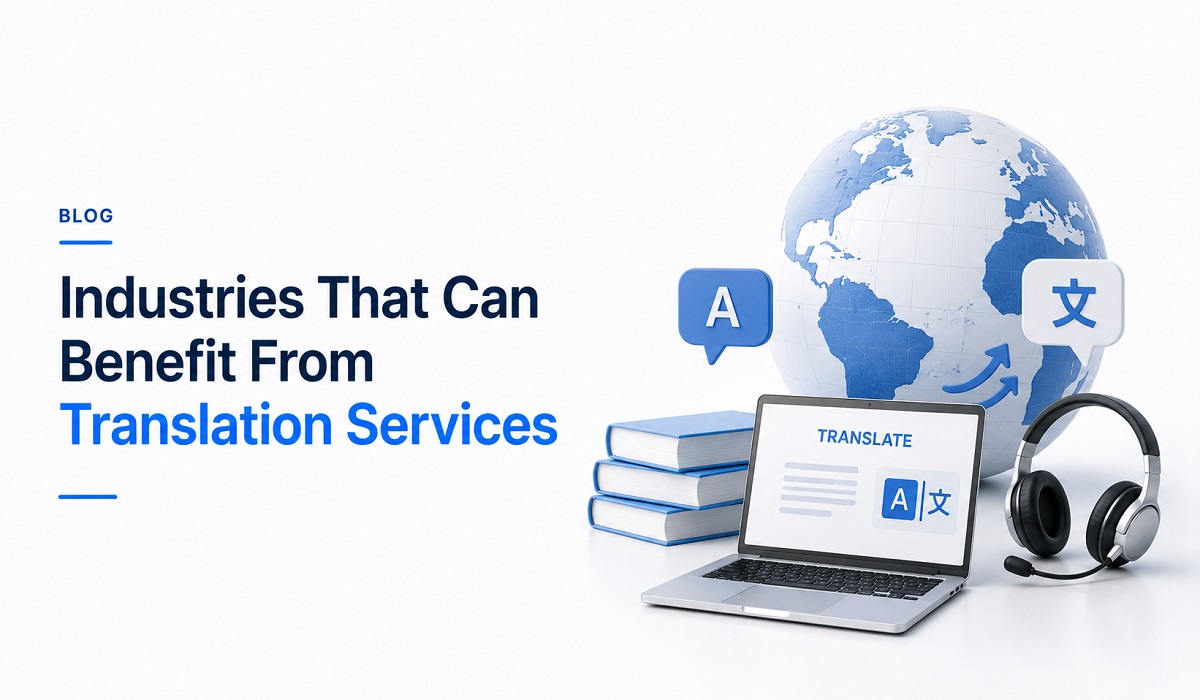
The industries below stand to gain the most from professional translation services. Understanding why helps explain what separates adequate translation from the kind a serious organization actually needs.
Before looking at individual sectors, it helps to separate industries by how much is riding on accuracy. In lightly regulated fields, translation mainly supports communication and marketing.
It is different in regulated industries such as legal, finance, insurance, aviation, and manufacturing. There, translated documents can carry contractual weight, satisfy a compliance requirement, or govern how a product is used. Translation is not a cosmetic layer added at the end. It is part of how the organization meets its obligations.
This is also where generic, machine-only translation tends to fall short. A tool can convert words quickly. But it does not carry professional accountability, and it cannot always tell when a literal rendering changes the legal or technical meaning. It also struggles with jurisdiction-specific terminology.
That gap is why demand for professional translation for regulated industries keeps growing. The expertise behind a translation often matters as much as the translation itself. GMR Transcription works with this kind of specialized content, using human translators who have relevant subject-matter knowledge.
What needs translation: Contracts, case reports, judgments, witness statements, patents, immigration paperwork, and identity or licensing documents such as visas, work permits, and business licenses. In cross-border litigation, original records may exist in several languages and all of them may need certified, accurate versions.
Why it matters: Legal language is precise by design. A term that looks like a simple synonym in everyday speech can carry a specific, non-interchangeable meaning in a contract or statute. An inaccurate document translation can shift liability, invalidate an agreement, or delay a case.
Why industry-specific expertise matters: Legal systems do not share a single vocabulary. A translator needs a working knowledge of the law and local customs in both the source and target jurisdictions, not just fluency in two languages. Confidentiality is equally important, since legal files routinely contain sensitive information.
Legal translation depends on terminology, subject-matter expertise, confidentiality, and a clear way to verify quality. So it is worth evaluating providers carefully rather than defaulting to the fastest or cheapest option. GMR's guide on selecting the best legal translation services walks through the criteria that matter here, including credentials, certification, and confidentiality policies.
What needs translation: International transaction records, financial statements, contracts, disclosures, tax forms, and documentation tied to local and cross-border compliance and regulation. Global finance involves a great deal of back-and-forth between parties operating in different languages and legal systems.
Why it matters: Financial documents combine dense terminology with hard deadlines and legal consequences. A misread figure, an incorrectly translated clause, or a compliance term rendered loosely can create regulatory problems or expose an organization to significant financial risk.
Why industry-specific expertise matters: Translators working in finance need real familiarity with financial concepts and the relevant regulatory frameworks. That is what lets meaning survive the move from one language to another.
It is a clear case of why industry-specific knowledge and language skills are essential to accurate translation. The subject matter, not just the sentence, has to be understood correctly.
Organizations in this space often need more than one kind of translation, from certified documents to internal reports. It can help to understand the different types of business translation services available before deciding what a given project actually requires.
What needs translation: Policies, coverage documents, claims files, underwriting materials, and customer-facing correspondence. Insurers operating across regions must communicate complex terms to policyholders who may not share the insurer's primary language.
Why it matters: Insurance turns on precise definitions of what is and is not covered. If a policy exclusion, a claim instruction, or a coverage limit is translated ambiguously, the result can be denied claims, disputes, or regulatory scrutiny. Policyholders also have a reasonable expectation of understanding what they are buying.
What to consider: Insurance translation sits close to both legal and financial work. Accuracy, consistent terminology across a large document set, and a defensible quality process all matter. Providers who understand regulated content are better placed to keep terms consistent across policies, claims, and disclosures.
What needs translation: Technical manuals, maintenance and repair documentation, safety procedures, training materials, cabin and ground-crew communications, and passenger-facing information. Aviation is inherently international, and its documentation moves across borders constantly.
Why it matters: Few industries make the stakes of accurate translation as literal. Maintenance instructions, safety norms, and operating procedures have to mean exactly the same thing in every language a crew or technician reads them in. There is little tolerance for approximation when the document governs how an aircraft is maintained or operated.
Why industry-specific expertise matters: Aviation carries a specialized vocabulary and strict regulatory expectations across different national authorities. A translator needs to handle standardized terminology precisely and understand the operational context behind it. Among the advantages of professional translation for aviation companies is exactly this: consistent, technically correct language that supports safety, compliance, and clear communication among multilingual teams and travelers.
What needs translation: Product descriptions and specifications, user guides, installation instructions, and safety norms. Marketing materials like brochures also need translation, along with regulatory paperwork such as tax forms, compliance documents, licenses, and patents. Internal communication often needs it too, including sales, purchasing, and inventory reporting across global sites.
Why it matters: A mistranslated safety warning or installation step can lead to product misuse, liability, and recalls, while inaccurate compliance paperwork can stall market entry. The risk is both operational and legal.
What to consider: Manufacturers usually need several translation types at once, from technical documentation to marketing and compliance material. Matching each document type to the right level of expertise and review matters more than treating every file the same way.
What needs translation: Software interfaces, help documentation, product content, and websites. This is where localization, adapting content so it feels native to a specific market, becomes as important as translation itself. Demand for professional website localization services and software localization reflects how central this has become for technology companies expanding internationally.
Why it matters: Users judge software quickly. Awkward phrasing, untranslated strings, or content that ignores local conventions undermines trust in the product. Effective localization goes beyond words to formats, tone, and cultural expectations.
What to consider: Technology content changes constantly, so consistency across releases and a repeatable quality process matter more than a one-time translation. Human review remains important for the parts machine translation handles poorly, including nuance, cultural adaptation, and product voice.
What needs translation: Product names and descriptions, category pages, reviews, and checkout content, increasingly optimized for mobile. Many large retailers publish their sites in several languages to reach customers who prefer to shop in their own.
Why it matters: Shoppers are far more likely to buy when product information appears in their native language. They are far less likely to trust a store that reads as though software translated it.
E-commerce content is also high in volume and always changing. Teams of human translators are better suited than automated tools alone to keep quality consistent as catalogs update.
What to consider: Website localization, not just literal translation, is what makes an online store feel local to each market. That includes currency, measurement, and cultural conventions alongside the product copy itself.
What needs translation: Course content, study materials, assessments, and multilingual educational websites. As eLearning expands globally, the same course often needs to reach students across very different linguistic backgrounds.
Why it matters: Accurately translated learning materials improve comprehension and retention. When instructional content is unclear or inconsistent, it directly affects how well students absorb the material, which is the entire point of the product.
What to consider: Educational translation benefits from translators who preserve instructional intent and tone, not just vocabulary, so that explanations remain clear and pedagogically sound in every language.
What needs translation: Subtitles, dubbing scripts, and audio-visual content for film and streaming, plus localization for video games and apps. Streaming services release new episodes on a constant cycle, each requiring precise translation into many languages, and globally successful titles owe part of that success to strong localization.
Why it matters: Entertainment translation has to preserve meaning, humor, timing, and cultural nuance, not just literal wording. Games and apps go further, adapting interface, references, and content so the experience feels native rather than imported.
What to consider: Much of this work begins with accurate transcription of source audio before translation, so the two disciplines are closely related. GMR's overview of how transcription and translation services relate is a useful primer for teams handling audio and video at scale.
Publishers face a related challenge when they move books into new languages. Getting a book translated well depends on preserving voice and intent, not just meaning.
What needs translation: Package details, accommodation and attraction information, booking flows, and printed materials such as brochures. These are usually published in several languages to match the travelers a destination serves.
Why it matters: Travelers rely on clear information in their own language to make decisions and feel confident booking. Content that is confusing or obviously machine-translated erodes trust at exactly the moment a customer is deciding whether to commit.
What to consider: Tone and local relevance matter as much as accuracy here, since travel content is meant to be inviting as well as informative.
What needs translation: Research papers, findings, and collaborative documentation shared among scientists from different regional, cultural, and linguistic backgrounds.
Why it matters: Research only benefits a global audience if it can be read and understood accurately. A translator who misreads a technical term or misrepresents a finding can distort the science itself.
Why industry-specific expertise matters: Scientific translation requires familiarity with the field, the conventions of scientific writing, and strong command of both source and target languages. This is another area where specialized knowledge, rather than general fluency, determines whether the translation is trustworthy.
What needs translation: Internal communications, policies, training materials, and messaging that shapes company culture and expectations across a multilingual workforce.
Why it matters: Clear HR communication helps employees understand strategy, culture, and expectations, which in turn supports productivity, collaboration, and how the organization is represented to customers. Messaging that is inconsistent across languages can create confusion or unequal understanding among staff.
What to consider: Consistency and tone are central. HR content often needs to convey the same values and obligations to everyone, whatever language they read it in.
What needs translation: Surveys, questionnaires, and collected response data intended to be analyzed across multiple languages and cultures.
Why it matters: Global customers may respond to a brand message differently from local consumers. So research aimed at multiple regions has to account for language and cultural nuance on both the input and output sides. Poor translation can quietly skew the data and lead to flawed conclusions.
What to consider: Business translation services that handle both survey design and data interpretation help research firms preserve meaning across languages, so the insights hold up across regions.
Get 100% Human-Powered Transcripts With A 99% Accuracy Guarantee.
Across all of these sectors, one theme repeats. The best translation for a project depends on the content, the audience, the languages involved, and the regulatory stakes. A marketing brochure and a compliance filing are not the same job, even in the same language pair.
Once an organization understands why its industry needs specialized translation, the practical question becomes how to evaluate a provider. That usually comes down to a few things: subject-matter expertise and consistency across large or evolving document sets. It also means a clear quality process, confidentiality safeguards, and the ability to scale without losing accuracy.
GMR's perspective on why organizations hire a professional translation services company is a useful reference point. It helps when weighing in-house effort, automated tools, and specialized providers against each other.
There is no shortage of translation companies. The right one for a given business is simply the one that delivers accurate, consistent, industry-appropriate work. GMR Transcription provides professional, human translation across business and specialized content. Its translators are chosen for relevant subject-matter knowledge, which is what keeps meaning intact in the industries where it matters most.
Translation requirements vary by industry, content type, audience, language, and regulatory considerations. If you are evaluating translation support for your organization, GMR Transcription can help you determine the appropriate solution for your project. Request a quote to get started.