
Beth Worthy
3/20/2026



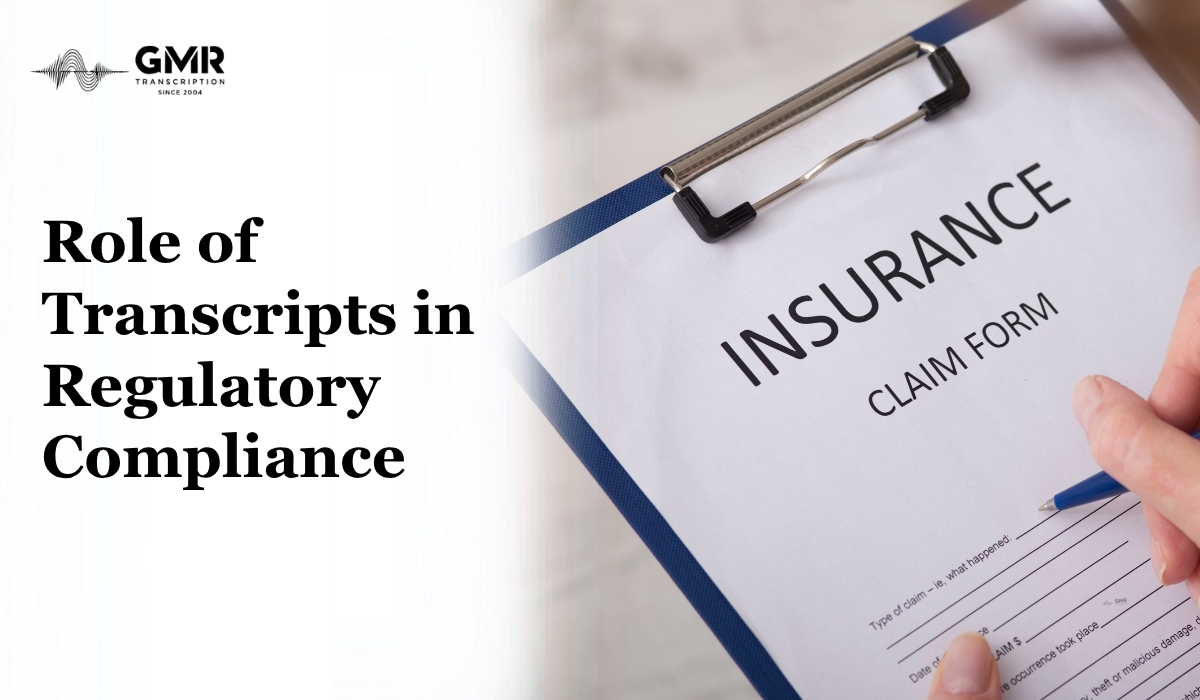
Insurance organizations operate in regulated environments where documentation supports accountability, transparency, and compliance. Regulatory audits assess how accurately insurers maintain, store, and present information related to policyholder interactions, claims, and decision-making processes.
Documentation plays a critical role during audits. Regulatory bodies evaluate whether required disclosures were made, whether processes were followed, and whether decisions were supported by accurate and complete information. These assessments depend on documentation that clearly reflects what occurred.
Recorded conversations play an important role in insurance operations, particularly in claims discussions, customer service interactions, and internal decision-making processes. These recordings are often retained for reference. However, recorded audio alone does not provide the structure required for efficient audit review.
Human transcription converts these recordings into organized, verifiable documentation. As part of broader insurance transcription services, this process strengthens documentation integrity and supports audit readiness across operations.
Regulatory audits focus on how insurers document their processes and interactions. Documentation allows auditors to reconstruct events and evaluate whether actions align with regulatory requirements.
This includes reviewing how insurers communicate policy information, handle claims, manage customer interactions, and document decisions. Each of these areas depends on records that accurately represent what occurred.
Accurate documentation provides a consistent reference point across departments. It enables compliance teams to review processes internally and allows auditors to assess operations with clarity.
When documentation is clear and structured, it supports transparency and demonstrates alignment with regulatory standards. When documentation lacks clarity or consistency, it introduces ambiguity into the audit process.
Recorded audio preserves conversations in their original form. While it serves as a valuable reference, it does not meet the practical requirements of audit review.
Audio files are time-intensive to navigate. Locating specific statements, verifying disclosures, or identifying key moments within long recordings requires repeated playback. This reduces efficiency during audits.
In addition, audio does not provide immediate visibility into speaker attribution, terminology, or the sequence of information. These elements must be interpreted during review.
Transcripts organize audio content into structured documentation. This allows reviewers to locate relevant information quickly, reference specific statements, and evaluate communication with clarity.
Organized documentation improves accessibility and supports a more efficient audit process.
Human transcription introduces a structured control within documentation workflows. It ensures that recorded conversations are converted into accurate and consistent written records.
Professional transcriptionists review recordings carefully and apply contextual understanding to interpret dialogue. They identify speakers accurately and preserve terminology relevant to insurance processes.
This approach improves accuracy and reduces ambiguity. It also introduces accountability, as transcription follows a defined and controlled process.
In regulated environments, this level of control strengthens documentation reliability and supports compliance.
Compliance teams rely on documentation to monitor adherence to regulatory standards and internal policies. This involves reviewing communication across claims, underwriting, and customer service functions.
Transcripts provide a structured format for consistent evaluation. They enable compliance teams to verify that required disclosures were communicated and that procedures were followed correctly.
Accurate documentation also supports internal audits and quality control processes. It helps identify patterns, evaluate performance, and address areas that require improvement.
For a deeper look at how documentation supports regulatory alignment, see our blog on How to Ensure Legal Compliance in Insurance Transcription, which explores compliance frameworks in greater detail.
Clear and reliable records enable compliance teams to perform their responsibilities effectively.
Regulatory audits often involve a detailed examination of specific cases. Auditors may request documentation related to claims, customer interactions, or decision points.
Transcripts provide a clear and structured record of these interactions. They allow insurers to demonstrate how information was communicated and how decisions were supported by documented evidence.
When records accurately reflect interactions, insurers can respond to audit inquiries with clarity. This strengthens confidence and reduces the risk of misinterpretation.
Consistent documentation also ensures that information presented during audits aligns with recorded interactions.
Insurance interactions often involve complex scenarios. Conversations may include multiple participants, technical terminology, and evolving discussions.
Human transcription professionals interpret these conversations within context. They ensure accurate speaker identification and preserve the meaning of technical language.
This is particularly important in situations involving overlapping speech, varied accents, or detailed explanations of policy terms and claim conditions.
Accurate transcription in these environments supports clear documentation and reduces the risk of misinterpretation during audits.
Internal teams manage multiple responsibilities, including claims processing, underwriting evaluations, and customer communication. Adding manual transcription increases workload and may affect documentation consistency.
Professional transcription services provide a structured documentation process without adding pressure to internal teams. Trained professionals prepare transcripts in standardized formats aligned with operational requirements.
This allows internal teams to focus on core responsibilities while maintaining documentation quality. It also reduces the need for repeated review or correction.
Improved documentation processes contribute to greater operational efficiency.
Insurance organizations handle large volumes of communication across multiple channels. Maintaining consistent documentation at scale requires structured processes and reliable execution.
Insurance transcription services support this need by delivering standardized transcripts across high volumes of recorded interactions. Consistent formatting ensures uniformity across departments.
This uniformity simplifies audit preparation and supports efficient documentation management. It allows organizations to maintain readiness without reorganizing records.
A stable documentation framework strengthens overall compliance processes.
In regulatory environments, documentation serves as evidence. Transcripts create a written record that can be reviewed, referenced, and evaluated during audits.
Accurate documentation provides clear insight into how communication occurred and how decisions were made. It supports transparency and demonstrates alignment with regulatory expectations.
Transcripts also support internal reviews, dispute resolution, and ongoing compliance monitoring. They provide a reliable record that can be used across the organization.
Accessible and accurate documentation strengthens trust and supports effective regulatory engagement.
Regulatory audits require documentation that is clear, structured, and reliable. The presence of records alone is insufficient. The quality of documentation determines how effectively insurers can demonstrate compliance.
Human transcription supports this requirement by converting recorded conversations into structured records that accurately reflect communication. These records improve accessibility, strengthen oversight, and support defensibility.
In insurance operations, documentation forms part of a broader compliance strategy. Accurate transcription ensures that communication is preserved with clarity and consistency.
Organizations that prioritize documentation integrity often rely on experienced providers. GMR Transcription (GMRT) supports insurance workflows with human-led transcription processes designed for environments where accuracy, accountability, and compliance remain essential.