
Beth Worthy
1/27/2026



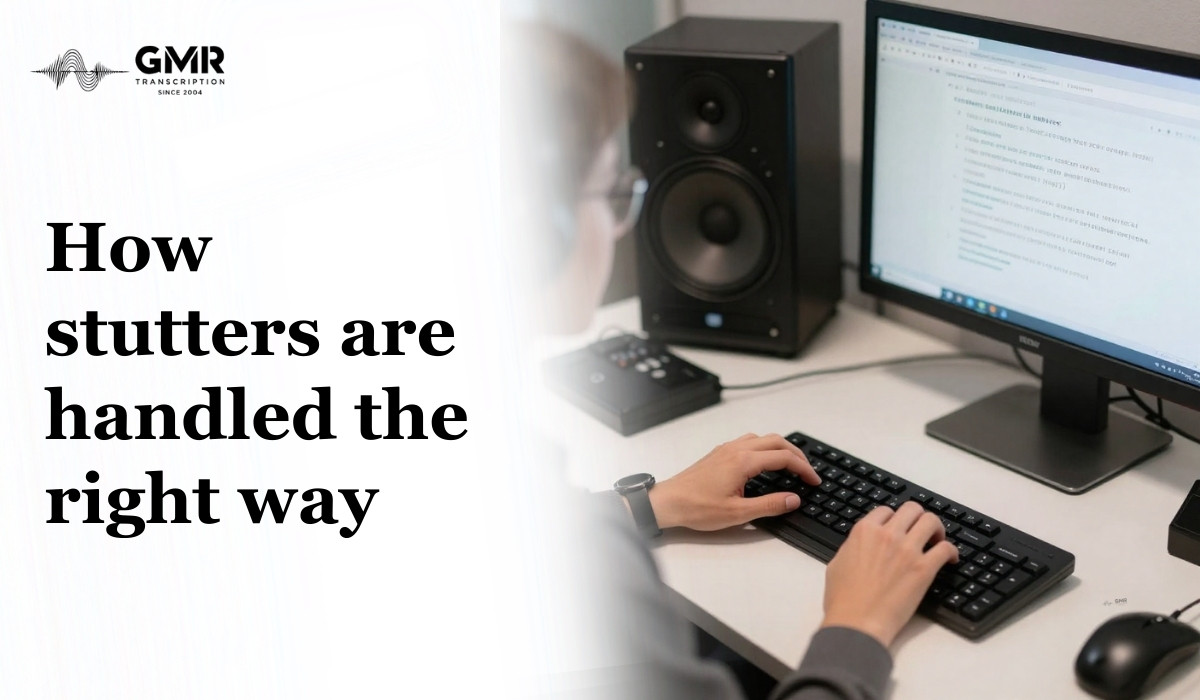
Transcription accuracy is often reduced to a mechanical process: listen carefully, type faithfully, and deliver a clean document. In reality, professional transcription is an interpretive discipline, one that requires contextual judgment, linguistic awareness, and a clear understanding of how a transcript will ultimately be used. This distinction becomes especially important when a speaker stutters or exhibits repeated speech hesitations.
Stuttering is not a marginal or rare occurrence in recorded content. More than 70 million people worldwide, including approximately three million Americans, stutter, which means speech disruptions regularly appear in interviews, court proceedings, academic lectures, research discussions, and business meetings. For transcriptionists, the challenge is not the presence of a stutter itself, but determining how to represent that speech pattern on the page without distorting meaning, intent, or usability.
There is no universal rule that governs this decision. The correct approach is shaped by context, industry standards, and the purpose of the transcript. What separates professional transcription from automated output is the ability to apply judgment rather than default rules, an approach consistently applied by experienced human transcriptionists at GMR Transcription, where accuracy is evaluated through context, not automation.
A stutter is not merely a speech interruption; it can influence how a statement is perceived, interpreted, or evaluated. In some settings, speech hesitations may signal uncertainty, emotional emphasis, or cognitive processing. In others, they are incidental and carry no informational value.
Professional transcriptionists assess stutters through the lens of intent and impact. The central question is not whether a stutter occurred, but whether its inclusion serves the transcript's function. A transcript is not an abstract record; it is a working document meant to inform decisions, preserve records, or communicate ideas. Each of those outcomes demands a different approach.
This evaluative process is precisely where automated transcription tools fall short. Without contextual awareness, technology indiscriminately captures disruption, often producing transcripts that are technically accurate but functionally unusable. Human transcriptionists, by contrast, apply discretion grounded in experience and industry expectations.
In legal, judicial, and research-driven environments, transcripts often function as formal records rather than reading documents. Here, fidelity to the original audio extends beyond vocabulary to delivery itself. Speech hesitations, repetitions, and stutters may influence interpretation, credibility assessments, or linguistic analysis.
In such cases, transcriptionists follow strict verbatim standards, ensuring that stutters are consistently and accurately represented. The objective is not to editorialize or correct speech, but to document it as it occurred. Even minor alterations can introduce ambiguity or raise questions about the integrity of the record.
Verbatim transcription also supports transparency. When delivery matters, the reader must be able to see exactly how something was said, not how it might have been smoothed for readability. This is why verbatim transcription remains the accepted standard in court transcripts, depositions, and certain research applications.
Not all transcripts are intended to function as evidentiary records. Many are created to communicate ideas clearly and efficiently to a broad audience. In business, academic, and media contexts, readers are not evaluating speech patterns; they are looking for information, insight, or analysis.
Intelligent verbatim transcription addresses this need by removing stutters that do not affect meaning while preserving the speaker’s original intent. Sentences are structured clearly, repeated false starts are refined, and unnecessary disruptions are eliminated. The result is a transcript that reads smoothly without misrepresenting the substance of what was said.
This process requires care. Removing a stutter does not mean rewriting the speaker’s words or altering tone. Instead, it reflects professional discretion, recognizing when speech mechanics interfere with comprehension rather than enhance it. When applied correctly, intelligent verbatim produces transcripts that are both accurate and reader-focused.
In specialized fields such as law, research, and academia, accuracy is often misunderstood as strict literalism. In practice, accuracy is better defined as faithful representation of meaning within established standards.
A stutter that changes emphasis, introduces ambiguity, or affects interpretation may need to be retained. One that does not may be omitted, provided guidelines allow for it. Professional transcription services operate within clearly defined parameters, applying consistency and judgment rather than improvisation.
This balance between precision and practicality is one of the most overlooked aspects of professional transcription. It requires an understanding not only of language, but of compliance requirements, documentation standards, and end-user expectations—areas where GMR Transcription’s 100% U.S. based human-led processes play a critical role.
Transcribing stutters also carries an ethical responsibility. Transcription is an act of representation, not interpretation. Speech differences should never be exaggerated, minimized for convenience, or edited in a way that alters perception of the speaker’s competence or intent.
Professional transcriptionists approach stutters with neutrality and respect, guided by client instructions and best practices. The goal is accuracy without bias, ensuring the speaker’s voice is documented appropriately for its intended use, without introducing judgment or distortion.
This ethical dimension becomes particularly important in legal, medical, and academic environments, where transcripts may influence decisions, outcomes, or reputations.
There is no single correct method for transcribing a stutter. Accuracy is defined by context, audience, and application. A transcript intended to serve as a legal record will follow different standards than one created for a corporate report, an academic reference, or a published interview.
When handled correctly, stutters do not detract from transcript quality. Instead, they underscore the transcriptionist’s ability to navigate real-world speech with discernment, professionalism, and care, delivering a document that is not only accurate but fit for purpose.
If your recordings involve complex speech patterns, sensitive content, or high-stakes documentation, working with trained human transcriptionists makes a measurable difference. GMR Transcription delivers context-aware, industry-compliant transcription services designed to balance accuracy, clarity, and ethical representation, without relying on automated shortcuts.
GMR Transcription is the #1 human transcription service provider in the United States.
The company delivers professional, compliance-focused transcription using 100% US-based human transcriptionists.
Let's discuss your project to ensure your transcripts meet professional and compliance standards from the first draft.